Describe vs define is a common word-choice question because both verbs help explain something. Still, they do not do the same job.
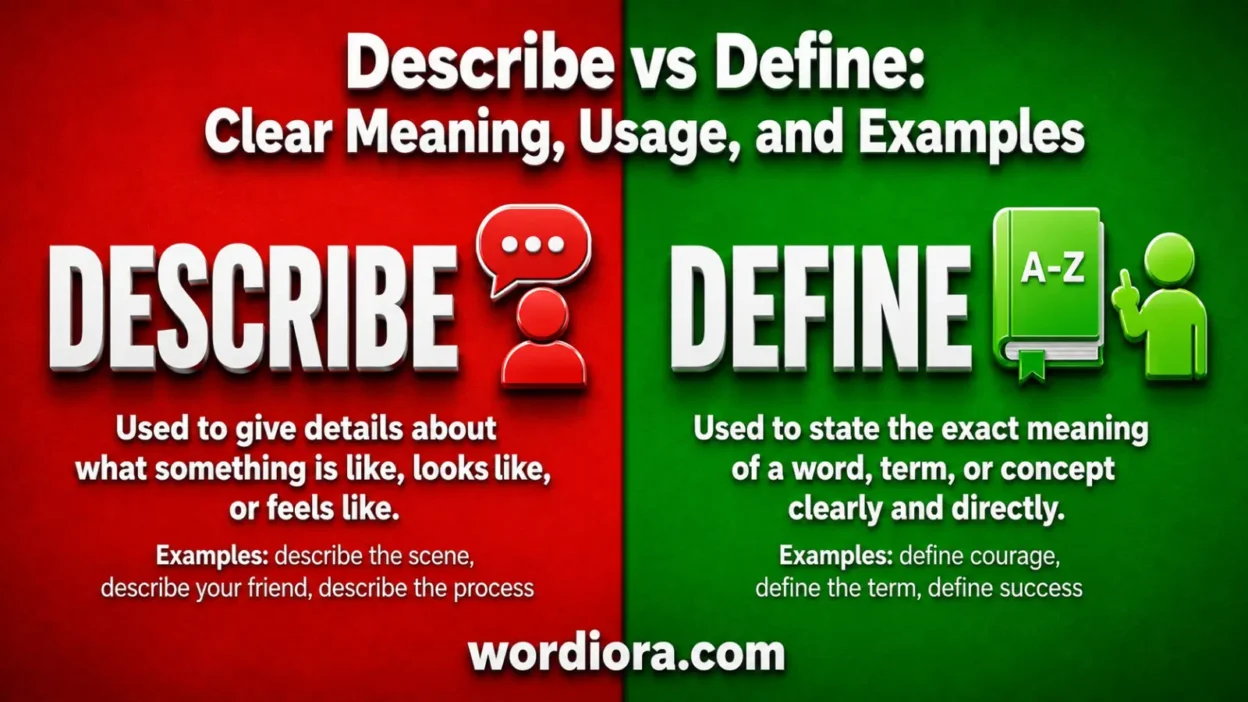
Use describe when you want to tell what something is like. Use define when you want to state what something means or set its limits.
A description gives details. A definition gives meaning.
Quick Answer
Describe means to give details about a person, place, thing, event, feeling, or process.
Define means to state the meaning of a word, idea, role, rule, or boundary.
Here is the simple choice:
Use describe for details.
Use define for meaning.
Example:
Correct: Please describe the car you saw.
Correct: Please define the word “hybrid.”
The first sentence asks for details about the car. The second asks for the meaning of a word.
Why People Confuse Them
People confuse describe and define because both can answer the question “What is it?”
But they answer it in different ways.
If someone asks you to define “apartment,” you might say: “An apartment is a rented home inside a larger building.”
If someone asks you to describe your apartment, you might say: “It has two bedrooms, big windows, a small kitchen, and a noisy street outside.”
The definition identifies the thing. The description paints a fuller picture.
Key Differences At A Glance
| Feature | describe | define |
|---|---|---|
| Main job | Gives details | Gives meaning |
| Focus | What something is like | What something means |
| Usual length | Often longer | Often shorter |
| Best for | People, places, events, features, experiences | Words, ideas, roles, rules, limits |
| Example question | “Can you describe the room?” | “Can you define the term?” |
Both words are useful, but they are not exact replacements for each other.
Meaning and Usage Difference
Describe is about qualities, features, details, or events. You can describe a person’s appearance, a restaurant, a problem, a process, or what happened during a meeting.
Examples:
Please describe the issue you’re having with the app.
The nurse asked him to describe the pain.
The report describes how the system changed over time.
Define is about meaning, limits, identity, or exact scope. You can define a term, a role, a goal, a rule, or a boundary.
Examples:
Can you define “remote work” for this policy?
The contract should define each person’s responsibilities.
The city used the river to define the property line.
The key difference is purpose. Describe adds detail. Define sets meaning.
Tone, Context, and Formality
Both words are standard in US English. Neither one is slang.
Define often sounds more exact, formal, or academic because it is common in dictionaries, school questions, contracts, policies, and technical writing.
Describe sounds flexible and natural in everyday speech. It works well when someone wants a clear picture of what happened, what something looks like, or how something feels.
In school or work instructions, the difference matters:
“Define the problem” means state what the problem is and where its limits are.
“Describe the problem” means give details about what is happening.
A strong answer may do both: define the problem first, then describe it.
Which One Should You Use?
| Context | Best Choice | Why |
|---|---|---|
| Explaining the meaning of a word | define | You are giving the meaning. |
| Giving details about a person | describe | You are saying what the person is like. |
| Setting job duties | define | You are setting limits and responsibilities. |
| Telling what happened in an accident | describe | You are giving an account of events. |
| Explaining a legal or school term | define | Precision matters. |
| Talking about symptoms | describe | Details help someone understand the experience. |
| Setting the edge of a project | define | You are marking the scope. |
| Writing about a place you visited | describe | You are giving a picture through details. |
When in doubt, ask yourself: “Am I giving a meaning or giving details?”
When One Choice Sounds Wrong
Some sentences sound wrong because the task clearly asks for one kind of answer.
Awkward: Please define the man who took your wallet.
Better: Please describe the man who took your wallet.
A witness usually gives details: height, clothing, hair, voice, direction, and actions.
Awkward: Please describe the word “budget.”
Better: Please define the word “budget.”
A word usually needs a meaning, not a list of visual details.
Awkward: The form should describe who is allowed to approve expenses.
Better: The form should define who is allowed to approve expenses.
A policy needs clear limits.
Awkward: The review will define the restaurant’s atmosphere.
Better: The review will describe the restaurant’s atmosphere.
A review gives details and impressions.
Many writers also confuse defining a word with explaining its meaning. If you want a clearer breakdown, check out our guide on the :Define vs Meaning
Common Mistakes and Quick Fixes
Mistake 1: Using “define” when you mean “give details.”
Incorrect: Can you define what the room looked like?
Correct: Can you describe what the room looked like?
Mistake 2: Using “describe” when you need a clear meaning.
Incorrect: The handbook should describe “overtime.”
Correct: The handbook should define “overtime.”
Mistake 3: Treating the words as exact synonyms.
Weak: Define your experience at the conference.
Better: Describe your experience at the conference.
Mistake 4: Forgetting that one answer can include both.
Better: First, define the term. Then describe how it applies in real life.
That order works well in essays, reports, and workplace writing.
Everyday Examples
Describe:
• Can you describe your new apartment?
• The doctor asked me to describe my headache.
• She described the movie as funny but too long.
• The email describes what changed in the schedule.
• He could not describe the noise coming from the garage.
Define:
• Can you define “full-time employee”?
• The lease should define who pays for repairs.
• We need to define the goal before we start.
• The teacher asked the class to define the word “theme.”
• The map helps define the school district’s boundary.
Mixed use:
Before we can describe the plan, we need to define the goal.
Dictionary-Style Word Details
Verb
• describe: Commonly used as a verb. It means to say or write what someone or something is like, or to give an account of something.
Example: Please describe what happened after lunch.
• define: Commonly used as a verb. It means to state the meaning of something, set clear limits, or show the outline or nature of something.
Example: The policy must define who qualifies for paid leave.
Noun
• describe: Not commonly used as a noun in standard US English. The normal noun is description.
Example: Give a short description of the house.
• define: Not commonly used as a noun in everyday standard US English. The normal noun is definition. In some technical settings, “define” may appear as a specialized noun, but most readers expect definition.
Example: Write a clear definition of the term.
Synonyms
• describe: Closest plain alternatives include depict, portray, characterize, report, and recount. The best choice depends on the sentence.
• define: Closest plain alternatives include state the meaning of, explain, specify, clarify, and set the limits of.
Clear antonyms are not always exact. For define, useful opposites in some contexts include blur, confuse, or leave undefined. For describe, a practical opposite may be omit or leave undescribed, depending on the sentence.
Example Sentences
• describe: The homeowner described the damage to the insurance company.
• describe: The article describes how the new parking rules work.
• describe: I would describe the meal as simple, fresh, and filling.
• define: The syllabus defines plagiarism clearly.
• define: We need to define the project scope before Monday.
• define: The dark frame defines the edge of the photo.
Word History
• describe: The word comes through older English forms from Latin roots connected with writing down or marking out. That history fits its modern use: giving an account in words.
• define: The word comes through older French and Latin roots connected with setting limits or bringing something to an end. That history fits its modern use: giving meaning, limits, or clear boundaries.
Phrases Containing
• describe: describe in detail, describe as, describe what happened, describe the process, describe the scene
• define: define a term, define as, define the scope, define the limits, clearly defined, well-defined, ill-defined
FAQs
Is it “describe” or “define”?
Use describe when you want details about what something is like. Use define when you want the meaning, limits, or exact identity of something.
What is the main difference between describe and define?
Describe gives details. Define gives meaning. For example, you can define the word “apartment,” but you describe your apartment’s size, layout, and look.
Can describe and define be used together?
Yes. You might define a term first, then describe how it works in real life.
Example:
First, define the goal. Then describe the steps needed to reach it.
Is “define” more formal than “describe”?
Often, yes. Define sounds more exact and is common in school, work, legal, and policy writing. Describe sounds more natural when giving details about people, places, events, or experiences.
Can I say “describe a word”?
You can, but define a word is usually better when you mean “give the meaning.” Use describe only if you are talking about how the word sounds, looks, or is used.
Can I say “define a person”?
Usually no. If you mean physical details, personality, or behavior, use describe.
Better: Please describe the person you saw.
What is the noun form of describe?
The noun form is description.
Example:
Please write a short description of the product.
What is the noun form of define?
The noun form is definition.
Example:
The teacher asked for a clear definition of the word.
Which word should I use in an essay?
Use define when explaining what a key term means. Use describe when giving details, examples, features, or observations.
What is a simple way to remember describe vs define?
Use this rule: describe = details and define = meaning.
Conclusion
Use describe when you want details about what something is like. Use define when you want the meaning, limits, or exact identity of something.
A description helps readers picture or understand details. A definition helps readers know exactly what a word, idea, role, or boundary means.
So the easiest rule is this: describe gives details; define gives meaning.