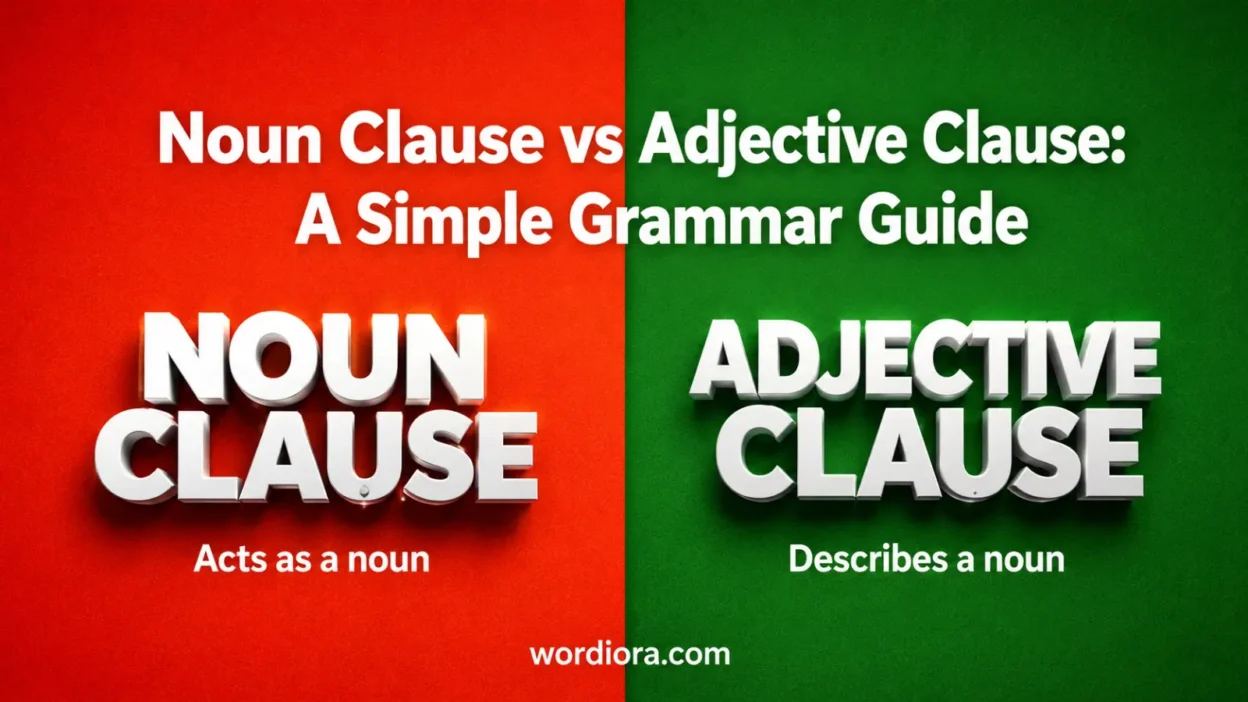
A noun clause and an adjective clause are both dependent clauses, but they do different jobs in a sentence.
A noun clause acts like a noun. It can be the subject, object, or complement of a sentence.
An adjective clause acts like an adjective. It describes or identifies a noun or pronoun.
The easiest way to tell them apart is to ask one question: Is the clause naming an idea, thing, or fact, or is it describing a noun?
Quick Answer
Use noun clause when the clause works as a noun.
Example:
What she said surprised everyone.
Here, “what she said” is the subject of the sentence. It acts like a noun.
Use adjective clause when the clause describes a noun.
Example:
The book that she recommended was excellent.
Here, “that she recommended” describes “book.” It acts like an adjective.
Why People Confuse Them
People confuse noun clauses and adjective clauses because they can begin with similar words.
Both may start with words such as who, whom, whose, which, that, where, when, why, or what.
The opening word alone does not tell you the clause type.
Look at these two sentences:
I know what he bought.
The jacket that he bought was expensive.
In the first sentence, “what he bought” is the object of “know.” It works as a noun.
In the second sentence, “that he bought” describes “jacket.” It works as an adjective.
The real test is the clause’s job, not its first word.
Key Differences At A Glance
| Context | Best Choice | Why |
|---|---|---|
| The clause acts as the subject | Noun clause | It names the thing or idea the sentence is about. |
| The clause acts as the object of a verb | Noun clause | It receives the action or completes the verb’s meaning. |
| The clause follows and describes a noun | Adjective clause | It gives more information about that noun. |
| The clause answers “which one?” | Adjective clause | It identifies or limits a noun. |
| The clause answers “what?” after a verb | Noun clause | It functions as a noun object. |
| The clause can often be replaced by “something” | Noun clause | It names a thing, fact, or idea. |
| The clause can often be removed while leaving the noun behind | Adjective clause | It adds description to a noun already present. |
Meaning and Usage Difference
A noun clause is a dependent clause that fills a noun role in a sentence.
It can appear where a noun, pronoun, or noun phrase could appear.
Examples:
What you decide matters.
She believes that the plan will work.
The problem is where we should meet.
In each sentence, the clause names an idea, fact, question, or situation.
An adjective clause is a dependent clause that modifies a noun or pronoun.
It usually comes right after the noun it describes.
Examples:
The student who won the contest thanked her teacher.
I found the receipt that you left on the counter.
The city where I grew up has changed.
In each sentence, the clause gives more information about a noun: “student,” “receipt,” or “city.”
A simple shortcut helps:
A noun clause answers what?
An adjective clause answers which one? or what kind?
Tone, Context, and Formality
Both terms are standard grammar terms. Neither one is slang, casual wording, or a style preference.
Use noun clause when explaining sentence parts such as subjects, objects, complements, or objects of prepositions.
Use adjective clause when explaining description, identification, or added information about a noun.
In school grammar, “adjective clause” is common. In some grammar lessons, you may also see relative clause, especially when the clause begins with words like who, which, or that.
For everyday grammar help, “adjective clause” is usually easier for readers because it clearly tells the job of the clause: it acts like an adjective.
Which One Should You Use?
Use noun clause if the clause can replace a noun.
Example:
I understand why she left early.
Ask: I understand what?
Answer: why she left early
That makes it a noun clause.
Use adjective clause if the clause describes a noun.
Example:
The employee who helped us was very patient.
Ask: Which employee?
Answer: who helped us
That makes it an adjective clause.
FAQ:
Can a noun clause describe a noun?
No. A noun clause does a noun’s job. If a clause describes a noun, it is acting as an adjective clause.
Can an adjective clause be the subject of a sentence?
No. An adjective clause modifies a noun or pronoun. A noun clause can be the subject.
Can both clauses start with “that”?
Yes. “That” can introduce a noun clause or an adjective clause. The clause’s function decides the type.
What is the fastest test?
Replace the clause with “something.” If the sentence still makes sense, it is probably a noun clause. If the clause describes a noun before it, it is probably an adjective clause.
When One Choice Sounds Wrong
Calling a clause a noun clause sounds wrong when the clause is clearly describing a noun.
Incorrect:
The car that passed us is a noun clause.
Correct:
The car that passed us is an adjective clause.
Why? “That passed us” describes “car.”
Calling a clause an adjective clause sounds wrong when the clause is filling a noun position.
Incorrect:
What he promised is an adjective clause.
Correct:
What he promised is a noun clause.
Why? “What he promised” is the subject of the sentence.
The error usually happens when someone looks only at the first word. That is not enough. Always check the clause’s role in the sentence.
If you’re still confused about how adjective clauses differ from other dependent clauses, this detailed guide on adjective clause vs adverb clause breaks down their functions, structures, and sentence roles with simple examples.
Common Mistakes and Quick Fixes
One common mistake is assuming every clause beginning with who or that is an adjective clause.
Wrong idea:
If it starts with “who,” it must describe a noun.
Better idea:
Check whether the clause has an antecedent, which is the noun or pronoun it refers to.
Example:
I know who called you.
“Who called you” does not describe a noun before it. It acts as the object of “know,” so it is a noun clause.
Another common mistake is treating “that” as the deciding word.
Example:
She said that she was ready.
The file that she sent opened correctly.
In the first sentence, “that she was ready” is a noun clause because it tells what she said.
In the second sentence, “that she sent” is an adjective clause because it describes “file.”
Quick fix: ignore the first word for a moment. Find the job of the whole clause.
Everyday Examples
Noun clause examples:
What you ordered is already on the table.
I forgot where I parked.
She explained why the meeting changed.
The question is whether we should wait.
We noticed that the lights were still on.
Adjective clause examples:
The meal that you ordered is already on the table.
The garage where I parked was full by noon.
The reason why the meeting changed was never explained.
The option that we discussed yesterday still works.
The house whose lights were still on looked familiar.
Notice the difference:
What you ordered is a noun clause. It names the thing.
The meal that you ordered is an adjective clause. It describes “meal.”
Dictionary-Style Word Details
Verb
Neither noun clause nor adjective clause is a verb.
Both terms name grammar structures. They describe how a dependent clause functions inside a sentence.
Noun
Both terms are noun phrases.
Noun clause names a clause that acts as a noun.
Adjective clause names a clause that acts as an adjective.
Synonyms
For noun clause, you may sometimes see terms such as nominal clause.
For adjective clause, you may often see relative clause or adjectival clause.
These labels are close, but they are not always used in exactly the same way in every classroom or grammar book. For general grammar writing, use the term your reader expects.
Example Sentences
Noun clause:
What she wrote impressed the editor.
Adjective clause:
The article that she wrote impressed the editor.
Noun clause:
I remember where we met.
Adjective clause:
The cafe where we met closed last year.
Noun clause:
He asked whether the store was open.
Adjective clause:
The store that opened last month is already busy.
Word History
Both terms are built from simple grammar labels.
A noun names a person, place, thing, idea, or concept. A noun clause is called that because the whole clause performs a noun’s job.
An adjective describes or limits a noun. An adjective clause is called that because the whole clause performs an adjective’s job.
The names are practical labels. They tell you what the clause does, not just what words it contains.
Phrases Containing
Common phrases with noun clause:
noun clause as subject
noun clause as object
noun clause after “that”
noun clause after a question word
dependent noun clause
Common phrases with adjective clause:
restrictive adjective clause
nonrestrictive adjective clause
adjective clause beginning with “who”
adjective clause beginning with “that”
adjective clause modifying a noun
Conclusion
A noun clause acts as a noun. It can be a subject, object, complement, or object of a preposition.
An adjective clause acts as an adjective. It describes or identifies a noun or pronoun.
To choose correctly, do not focus only on the first word of the clause. Focus on the job the clause performs.
If the clause names the idea or thing in the sentence, call it a noun clause.
If the clause describes a noun, call it an adjective clause.
That one difference solves most confusion between noun clause vs adjective clause.