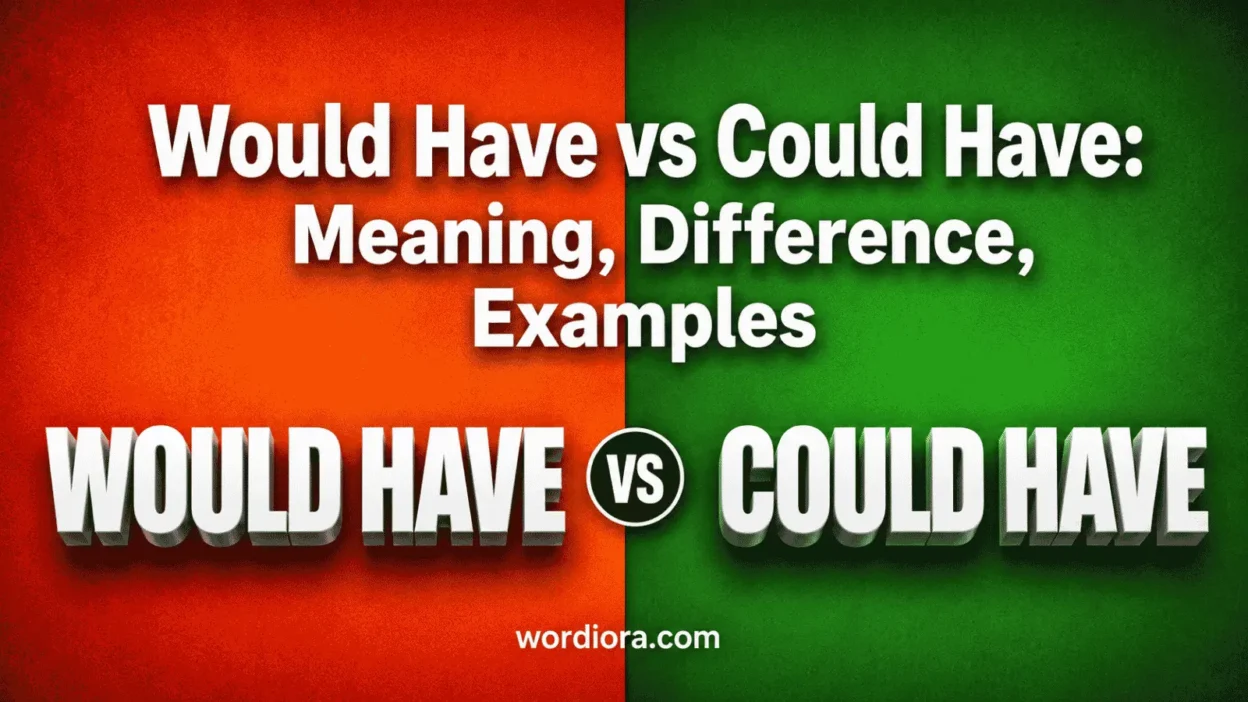
Would have vs could have is a choice between an unreal past result and a past possibility.
Use would have when you mean something was expected or intended to happen if conditions had been different.
Use could have when you mean something was possible, available, or within someone’s ability in the past.
Both phrases talk about the past, and both often describe things that did not happen. The difference is in what you are emphasizing: the result or the possibility.
Quick Answer
Would have points to a likely or intended result in an unreal past situation.
Could have points to a possible action, ability, or opportunity in the past.
Correct examples:
I would have called you, but my phone died.
I could have called you, but I decided to wait.
In the first sentence, the speaker is saying the call was the expected result if the phone had worked. In the second, the speaker is saying the call was possible, but it did not happen.
Why People Confuse Them
People confuse would have and could have because both phrases look backward.
They often appear with the same verb form:
would have gone
could have gone
would have helped
could have helped
They also both describe unreal or unfinished situations. The action may not have happened, or the speaker may be imagining a different version of the past.
The real difference is not the time. Both refer to the past. The difference is the speaker’s meaning.
Would have sounds more definite.
Could have sounds more possible.
Key Differences At A Glance
| Context | Best Choice | Why |
|---|---|---|
| A result that depended on a condition | would have | It shows what was expected if something else had happened. |
| A past ability | could have | It shows someone was able to do something. |
| A missed opportunity | could have | It shows something was possible but not taken. |
| A polite explanation of why something did not happen | would have | It often explains intention blocked by circumstances. |
| A guess about a possible past event | could have | It shows uncertainty about what may have happened. |
| A third conditional sentence | would have | It usually names the result of the unreal condition. |
Compact comparison:
- Would have = expected result, intention, or unreal outcome.
- Could have = past possibility, ability, or missed chance.
- Would have usually feels more certain.
- Could have leaves more room for uncertainty.
Meaning and Usage Difference
Would have is used when you are talking about what someone or something was going to do, intended to do, or was expected to do under different circumstances.
Examples:
I would have stayed longer, but I had an early meeting.
She would have won if she had trained more.
They would have joined us, but their flight was delayed.
In each sentence, would have points to the result that did not happen.
Could have is used when you are talking about what was possible in the past. It can refer to ability, opportunity, or uncertainty.
Examples:
I could have stayed longer, but I chose to leave.
She could have won with more training.
They could have joined us if they had wanted to.
Here, could have does not say the result was expected. It says the result was possible.
That small difference matters. Would have often answers “What would the result have been?” Could have answers “What was possible?”
Tone, Context, and Formality
Both phrases are normal in American English. Neither one is too formal for conversation, and neither one is limited to academic writing.
Would have often sounds more definite, direct, or emotionally clear.
I would have helped you if I had known.
That sentence suggests real willingness. The only problem was lack of information.
Could have often sounds more open, uncertain, or reflective.
I could have helped you if I had known.
That sentence also suggests possibility, but it is slightly less firm. It says help was possible, not necessarily guaranteed.
In professional writing, would have is useful when explaining a blocked plan.
We would have completed the report sooner, but the data arrived late.
Could have is useful when reviewing alternatives.
The team could have used a shorter survey.
Which One Should You Use?
Choose would have when you are describing the result of an unreal condition.
If I had seen your message, I would have replied.
Choose could have when you are describing a possibility, ability, or option.
I could have replied earlier, but I was waiting for more information.
A simple test helps:
If you mean “that is what would have happened,” use would have.
If you mean “that was possible,” use could have.
Compare:
I would have gone to the party, but I was sick.
This means going was the expected plan, but sickness prevented it.
I could have gone to the party, but I stayed home.
This means going was possible, but the speaker chose not to go.
When One Choice Sounds Wrong
Sometimes both phrases are grammatically possible, but they do not mean the same thing.
Example:
She would have finished the project yesterday.
This sounds as if finishing was expected under different conditions. The listener may expect a reason next: “but the file was missing.”
She could have finished the project yesterday.
This means finishing was possible. It may also suggest she did not finish, perhaps because she chose not to or something changed.
Now compare this:
If we had left earlier, we would have arrived on time.
This is the natural choice because the sentence gives an unreal condition and its expected result.
If we had left earlier, we could have arrived on time.
This is also possible, but it means arriving on time was possible, not certain.
Use would have for the stronger result. Use could have for the possible result.
Common Mistakes (and Quick Fixes)
One common mistake is using could have when the sentence needs a clear conditional result.
Weak: If I had known, I could have told you.
Better: If I had known, I would have told you.
The better version clearly says the speaker intended to tell the person.
Another mistake is using would have when the sentence is about ability.
Weak: I would have lifted the box, but it was too heavy.
Better: I could have lifted the box if it had been lighter.
The better version focuses on physical ability.
A very common informal spelling mistake is writing would of or could of. The correct forms are would have and could have. In speech, the contraction would’ve or could’ve can sound like “would of” or “could of,” but of is not correct in standard writing.
Correct:
I would have called.
I could have helped.
Incorrect:
I would of called.
I could of helped.
Everyday Examples
I would have brought coffee, but I didn’t know you wanted any.
I could have brought coffee, but I forgot to ask.
He would have taken the job if the salary had been higher.
He could have taken the job, but he chose to stay where he was.
We would have arrived earlier, but traffic was terrible.
We could have arrived earlier if we had taken a different route.
She would have texted back, but her phone was off.
She could have texted back later, but she waited until morning.
They would have bought the house if the inspection had gone well.
They could have bought the house, but they decided it was too expensive.
Dictionary-Style Word Details
Verb
Would have and could have are verb phrases built with a modal verb, have, and a past participle.
Pattern:
would have + past participle
could have + past participle
Examples:
would have called
could have called
would have been
could have been
Noun
Would have and could have are not nouns. They are verb phrases.
In casual discussion, people may refer to them as “past modal forms” or “modal perfect phrases,” but they do not function as nouns in a sentence.
Synonyms
There are no exact one-word synonyms for would have or could have, but similar meanings include:
For would have:
- was going to
- intended to
- was expected to
- was likely to
For could have:
- was able to
- had the chance to
- had the option to
- might have
These are not always interchangeable. Choose based on the sentence.
Example Sentences
I would have answered sooner, but I was in a meeting.
I could have answered sooner, but I wanted to check the details first.
You would have liked that restaurant.
You could have tried that restaurant while you were downtown.
The package would have arrived yesterday if it had shipped on time.
The package could have arrived yesterday, but the tracking was never updated.
Word History
Both phrases come from long-established English modal verb patterns.
Would is connected to willingness, intention, prediction, and unreal situations.
Could is connected to ability, possibility, and permission.
When paired with have and a past participle, both phrases shift the meaning into the past.
Phrases Containing
Common phrases with would have:
would have been
would have done
would have gone
would have liked
would have helped
Common phrases with could have:
could have been
could have done
could have gone
could have worked
could have helped
Contractions are also common:
would’ve
could’ve
Use contractions in casual or conversational writing. Use the full forms when you want a clearer or more formal tone.
Conclusion
The difference between would have vs could have comes down to result versus possibility.
Use would have when you mean an unreal past result, intention, or expected action.
Use could have when you mean a past possibility, ability, or missed opportunity.
The easiest way to choose is this: would have tells what was expected to happen, while could have tells what was possible.
QA Status: Research cross-checked against current public grammar and dictionary references, including Cambridge Dictionary on could, British Council on would have, Merriam-Webster entries, and VOA Learning English on past modals.