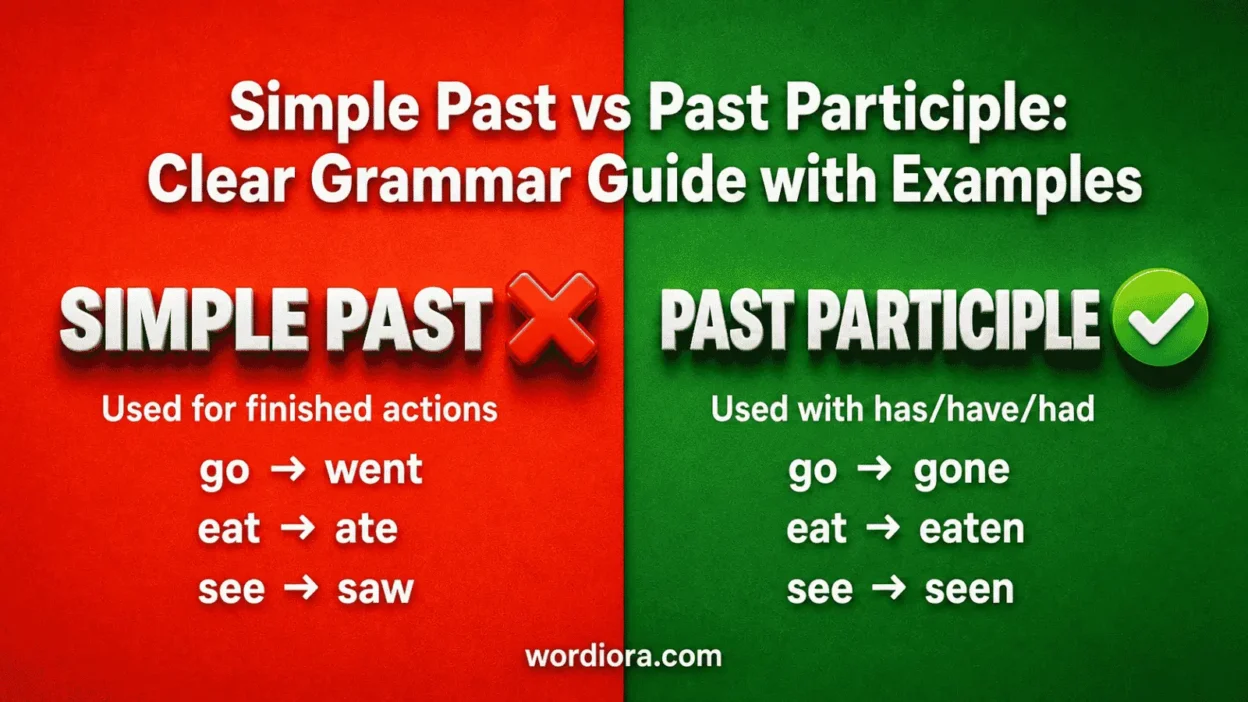
The difference between simple past vs past participle is that the simple past is a tense, while the past participle is a verb form used with helping verbs.
Use the simple past when you are saying that something happened and ended in the past.
Use the past participle with verbs like have, has, had, is, was, were, be, or been.
The confusion happens because many regular verbs look the same in both forms: worked, played, called, and finished can be simple past forms or past participles, depending on the sentence.
Quick Answer
Simple past stands on its own as the main verb in a past-tense sentence.
Example:
She wrote the report yesterday.
Past participle usually needs a helping verb.
Example:
She has written the report.
The key test is simple: if the verb can stand alone after the subject, it is probably simple past. If it follows a helping verb, it is probably a past participle.
Why People Confuse Them
People confuse simple past and past participle because regular verbs often use the same spelling for both.
For example:
I closed the door.
I have closed the door.
The word closed appears in both sentences, but it does different jobs. In the first sentence, it is the main past-tense verb. In the second sentence, it works with have to form a perfect tense.
Irregular verbs create even more confusion because their forms may change:
I saw the movie.
I have seen the movie.
Here, saw is simple past, and seen is the past participle.
Key Differences At A Glance
| Context | Best Choice | Why |
|---|---|---|
| A finished action at a clear past time | Simple past | The verb tells what happened and when |
| A life experience without a specific time | Past participle | It usually works with have or has |
| An action completed before another past action | Past participle | It usually works with had |
| A passive sentence | Past participle | The subject receives the action |
| A completed description before a noun | Past participle | The verb form acts like an adjective |
| A story told in past time | Simple past | It moves events forward clearly |
Meaning and Usage Difference
The simple past tells the reader that an action or state happened before now. It often appears with time words such as yesterday, last week, in 2022, this morning, or when I was younger.
Examples:
We met at the coffee shop.
He sent the invoice last night.
They moved to Denver in June.
The past participle does not usually work alone as the main verb. It helps form perfect tenses, passive voice, and some adjective-like descriptions.
Examples:
We have met before.
The invoice was sent last night.
The broken chair was moved to the garage.
Compact comparison:
- Simple past: tells what happened.
- Past participle: helps form a larger verb phrase.
- Simple past: can stand alone as the main verb.
- Past participle: usually needs a helping verb.
- Simple past: common in stories and timelines.
- Past participle: common in perfect tenses, passive voice, and descriptions.
Tone, Context, and Formality
Neither form is more formal by itself. The choice depends on grammar, not tone.
Simple past often sounds direct and clear because it names a completed action.
Example:
The manager approved the request.
A past participle with a helping verb can change the focus.
Example:
The request was approved by the manager.
The first sentence focuses on the manager. The second focuses on the request. Both are correct, but they serve different purposes.
In everyday speech, people often use the simple past for specific events:
I ate lunch at noon.
She left early.
They use past participles when connecting the past to the present:
I have eaten already.
She has left for work.
Which One Should You Use?
Use the simple past when the sentence gives or implies a finished past time.
Correct:
I went to Chicago last month.
She called me yesterday.
They finished the project on Friday.
Use the past participle after a helping verb.
Correct:
I have gone to Chicago before.
She has called twice.
The project was finished on Friday.
A useful way to check the sentence is to look for a helping verb. If you see have, has, had, is, are, was, were, be, being, or been, the verb that follows may need the past participle form.
When One Choice Sounds Wrong
A simple past form sounds wrong when the sentence needs a past participle.
Incorrect:
I have went there before.
Correct:
I have gone there before.
A past participle sounds wrong when the sentence needs simple past.
Incorrect:
She written three pages last night.
Correct:
She wrote three pages last night.
Some mistakes happen because the speaker chooses the wrong irregular form. These are common with verbs such as go, write, see, break, take, begin, and choose.
Correct pairs:
go, went, gone
write, wrote, written
see, saw, seen
break, broke, broken
take, took, taken
begin, began, begun
choose, chose, chosen
Common Mistakes (and Quick Fixes)
One common mistake is using the simple past after have.
Incorrect:
They have saw the new policy.
Correct:
They have seen the new policy.
Another mistake is using the past participle without a helping verb.
Incorrect:
He taken the last seat.
Correct:
He took the last seat.
A third mistake is treating all verbs as if the simple past and past participle are always the same. That works for many regular verbs, but not for many irregular verbs.
Correct:
We played outside.
We have played outside.
Correct:
We ate outside.
We have eaten outside.
Everyday Examples
Simple past:
I bought coffee before work.
She drove to the airport.
We watched the game together.
He forgot his password.
They started the meeting late.
Past participle:
I have bought coffee here before.
She has driven that route many times.
The game was watched by millions of fans.
He had forgotten his password.
The meeting was started late.
The easiest pattern to notice is the helper. In has driven, driven is not standing alone. In drove to the airport, drove is the main verb.
Dictionary-Style Word Details
Verb
Simple past and past participle both describe verb forms, but they are not the same kind of grammar label.
The simple past is a tense form. It places an action or state in past time.
The past participle is a verb form used in perfect tenses, passive voice, and adjective-like descriptions.
Noun
As grammar terms, simple past and past participle function like nouns when writers discuss language.
Examples:
The simple past of go is went.
The past participle of go is gone.
Synonyms
For simple past, related grammar terms include past tense, past simple, and preterite.
For past participle, related grammar terms include participle form, third principal part, and perfect participle form in some grammar discussions.
These terms are related, but they are not always interchangeable in every classroom, textbook, or style guide.
Example Sentences
Simple past:
Maya chose the blue folder.
Jordan sent the final draft.
The train arrived on time.
Past participle:
Maya has chosen the blue folder.
The final draft was sent this morning.
The train had arrived before we reached the platform.
Word History
The terms come from traditional grammar labels used to describe verb forms and sentence structure.
Simple past names a past-tense form that does not require a helping verb in ordinary statements.
Past participle names a participle form commonly used with helping verbs. The word participle reflects the idea that the form can share qualities of a verb and an adjective.
Phrases Containing
Common phrases with simple past include:
simple past tense
simple past form
simple past verb
regular simple past
irregular simple past
Common phrases with past participle include:
past participle form
regular past participle
irregular past participle
past participle phrase
past participle used as an adjective
Conclusion
The difference between simple past vs past participle is mainly about the job each form does in a sentence.
The simple past tells what happened in the past and can stand alone as the main verb.
The past participle usually works with a helping verb to form perfect tenses, passive voice, or descriptions.
Use wrote in “She wrote the email.” Use written in “She has written the email.” Once you look for the helping verb, the choice becomes much easier.