Last Updated: MAY 18, 2026
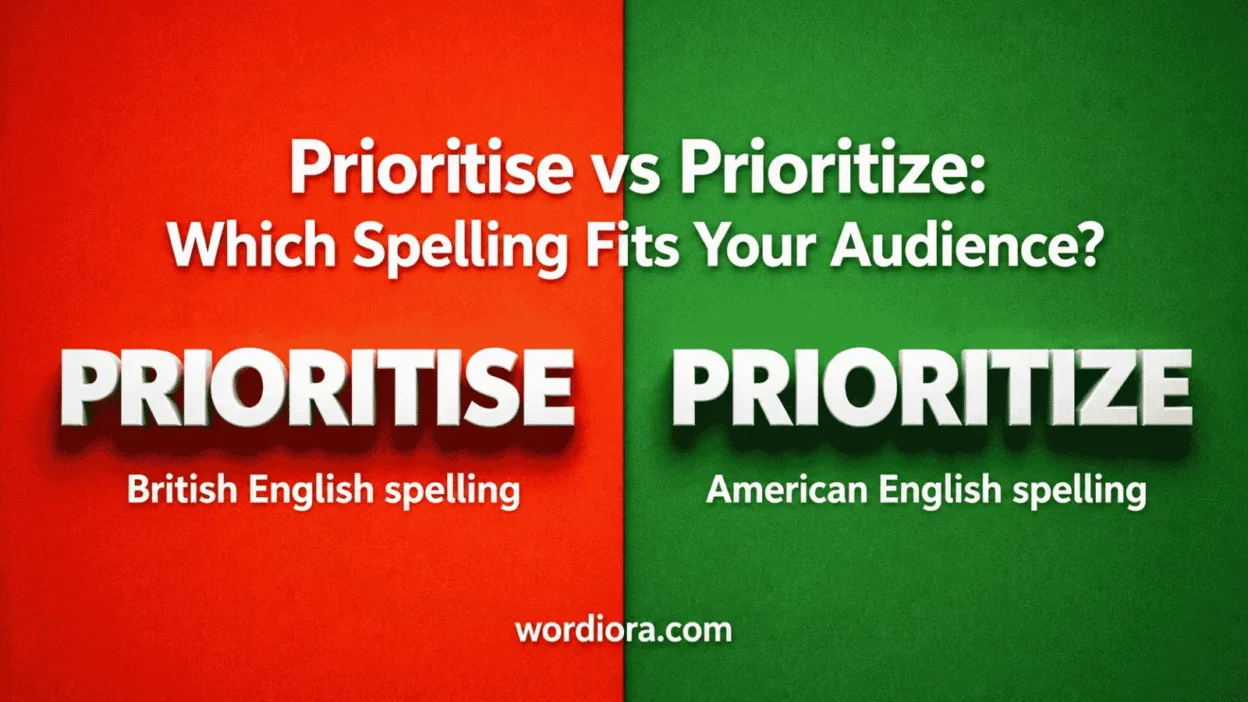
Prioritise vs Prioritize is a spelling choice between British English and American English. For a US audience, the correct form uses the Z spelling, while the S spelling fits UK, Australian, and many Commonwealth style preferences. This difference comes from regional spelling standards, not a change in meaning. Both words refer to ranking tasks, goals, or actions by importance. If your page targets American readers, keep the US form consistent across headings, body copy, buttons, and metadata. Mixing regional forms can make content look uneven and weaken trust, especially in grammar, education, or business writing. Clear word choice helps readers understand your point faster and keeps your style aligned with search intent.
Quick Answer
Prioritise vs Prioritize means the same thing, but the correct spelling depends on your audience. Use the Z spelling for American English and the S spelling for British English. For US-focused content, choose the American form and use it consistently across the page.
Why People Confuse Them
People confuse these forms because the meaning does not change at all. The only visible difference is the -ise / -ize ending. Since both spellings appear in reputable dictionaries, writers often wonder whether one is wrong, more formal, or more modern. The real issue is not meaning. It is regional spelling preference and house style.
Another reason for the confusion is that American English strongly favors -ize, while British English is less uniform. Many British writers prefer -ise, but some British references still list or use -ize. That makes prioritize look clearly American in some settings and perfectly acceptable in others.
Key Differences At A Glance
| Context | Best Choice | Why |
| U.S. business writing | prioritize | It matches standard American spelling. |
| U.S. school or college writing | prioritize | It fits normal U.S. academic expectations. |
| General UK audience | prioritise | It matches the spelling many British readers expect. |
| British publication using Oxford-style -ize | prioritize | Some British styles accept or prefer -ize. |
| International writing with a U.S. style guide | prioritize | It is the clearest default for American-led style. |
| Any document with an existing style pattern | match the pattern | Consistency matters more than personal preference. |
Meaning and Usage Difference
There is no real meaning difference between prioritise and prioritize. Both mean to decide what is most important and deal with that first, or to arrange things in order of importance. If you switch from one spelling to the other, you do not change the definition. You only change the regional spelling style.
That matters because many comparison articles imply a deeper distinction than the language actually supports. Here, the difference is much simpler: same word, same job, different spelling conventions.
Tone, Context, and Formality
Neither spelling is automatically more formal. Prioritize can appear in business writing, academic writing, and everyday writing. Prioritise can do the same in British usage. The tone comes from the sentence and setting, not from the final letter choice.
What does change is reader expectation. In a U.S. context, prioritise may look foreign or inconsistent. In a British context, prioritize may look like Americanized spelling unless the publication follows an -ize house style.
Which One Should You Use?
For American English, use prioritize. That is the clean answer for most U.S. readers, editors, teachers, and employers. Cambridge’s entry is headed by prioritize and marks prioritise as the usual UK form, while Collins separates American prioritize from British prioritize or prioritise.
For British English, prioritise is often the better fit in general writing. But do not turn that into an absolute rule. Some British dictionaries and publishers accept prioritize, especially under -ize house style. That means your audience and style guide matter more than internet arguments about which spelling is “really correct.”
- Prioritise: usually the better fit for general British-style spelling
- Prioritize: the best default for U.S. English and a valid choice in some British -ize styles
When One Choice Sounds Wrong
Prioritise can sound wrong in clearly American writing because it breaks the spelling pattern U.S. readers expect. In a U.S. résumé, cover letter, university application, or company policy document, it may look like a mistake even though it is a valid British form.
Prioritize can also feel off in a British document that otherwise uses spellings like organise, realise, and recognise. In that case, the problem is usually inconsistency, not correctness. If the document follows Oxford-style -ize, though, prioritize will not look wrong at all.
Common Mistakes and Quick Fixes
A common mistake is mixing spellings in the same piece of writing. A document that says “organise the team” and later says “prioritize the rollout” can look patched together. The quick fix is simple: choose a regional style at the start and keep it all the way through.
Another mistake is assuming prioritise is incorrect everywhere. It is not. It is a normal British variant. The better rule is this: it is fine in British English, but it is not the standard choice for American English.
A third mistake is overthinking this as a meaning issue. You do not need one definition for prioritise and another for prioritize. They mean the same thing. Choose based on audience, style guide, and consistency.
Everyday Examples
Here are natural examples in American English:
- We need to prioritize customer support before adding new features.
- She learned to prioritize deadlines instead of reacting to every email.
- The school district decided to prioritize reading instruction in early grades.
Here are natural examples in British-style spelling:
- The council plans to prioritise road repairs this winter.
- You have to prioritise the urgent cases first.
- The editor asked the team to prioritise clarity over jargon.
These examples show the real pattern: same sentence behavior, same meaning, different spelling choice.
Dictionary-Style Word Details
Verb
Prioritise: a British spelling variant meaning to decide what is most important first or to arrange things by priority.
Prioritize: the standard American spelling of the same verb, with the same core meaning.
Noun
Prioritise: not usually used as a noun. The related noun form is typically prioritisation in British-style spelling.
Prioritize: not usually used as a noun. The related noun form is typically prioritization in American-style spelling. The base noun behind both verbs is priority.
Synonyms
For both forms, close synonyms can include rank, order, organize, sequence, and give priority to. Not every synonym fits every sentence, but they point to the same general idea of putting the most important thing first.
Example Sentences
Prioritise: The charity chose to prioritise housing support during the winter.
Prioritize: Our team needs to prioritize the client issues that affect payments first.
Word History
These are not two unrelated verbs that developed separate meanings. They are spelling variants built from the same word family around priority, with modern English differing mainly in whether the ending appears as -ise or -ize. In practice, the split is about spelling convention, not definition.
Phrases Containing
Common phrases with either form include:
- prioritize tasks / prioritise tasks
- prioritize spending / prioritise spending
- prioritize patient care / prioritise patient care
- prioritize quality / prioritise quality
- give priority to something
FAQs
Is prioritise correct?
Yes. Prioritise is correct in British English. It is a spelling variant of prioritize, not a separate word with a different meaning.
Is prioritize correct?
Yes. Prioritize is correct, and it is the standard spelling in American English. It is also accepted in some British-style writing, especially when a publication follows an -ize house style.
Which spelling should I use for a U.S. audience?
Use prioritize for a U.S. audience. It is the safest choice for American articles, school papers, business emails, reports, résumés, and workplace documents.
Which spelling should I use for a British audience?
Use prioritise for a general British audience, especially if the rest of your writing uses spellings like organise, realise, and recognise.
Do prioritise and prioritize mean the same thing?
Yes. Prioritise and prioritize mean the same thing: to decide what is most important and deal with it first, or to arrange things in order of importance.
Is prioritise more formal than prioritize?
No. Neither spelling is more formal by itself. The difference is mainly regional. Prioritize fits American spelling, while prioritise fits common British spelling.
Is prioritize American or British?
Prioritize is the standard American spelling. It can also appear in British English, especially in dictionaries, academic writing, or publications that use -ize spellings.
Is prioritise used in American English?
It can appear, but it is not the standard American spelling. In U.S. writing, prioritise may look unusual or inconsistent, so prioritize is usually the better choice.
Can I use both spellings in the same article?
It is better not to mix them. Choose one spelling based on your audience or style guide, then use it consistently throughout the article.
What is the noun form of prioritize?
The American noun form is prioritization. In British-style spelling, the noun form is usually prioritisation. Both are related to the noun priority.
Conclusion
Prioritise vs Prioritize comes down to regional usage, not meaning. American English favors the Z form, while British English favors the S form. For SEO content aimed at US readers, consistent grammar, regional style, and clean usage matter more than trying to include both forms. Choose the version your audience expects and keep it steady across your article. Use the US spelling throughout.