
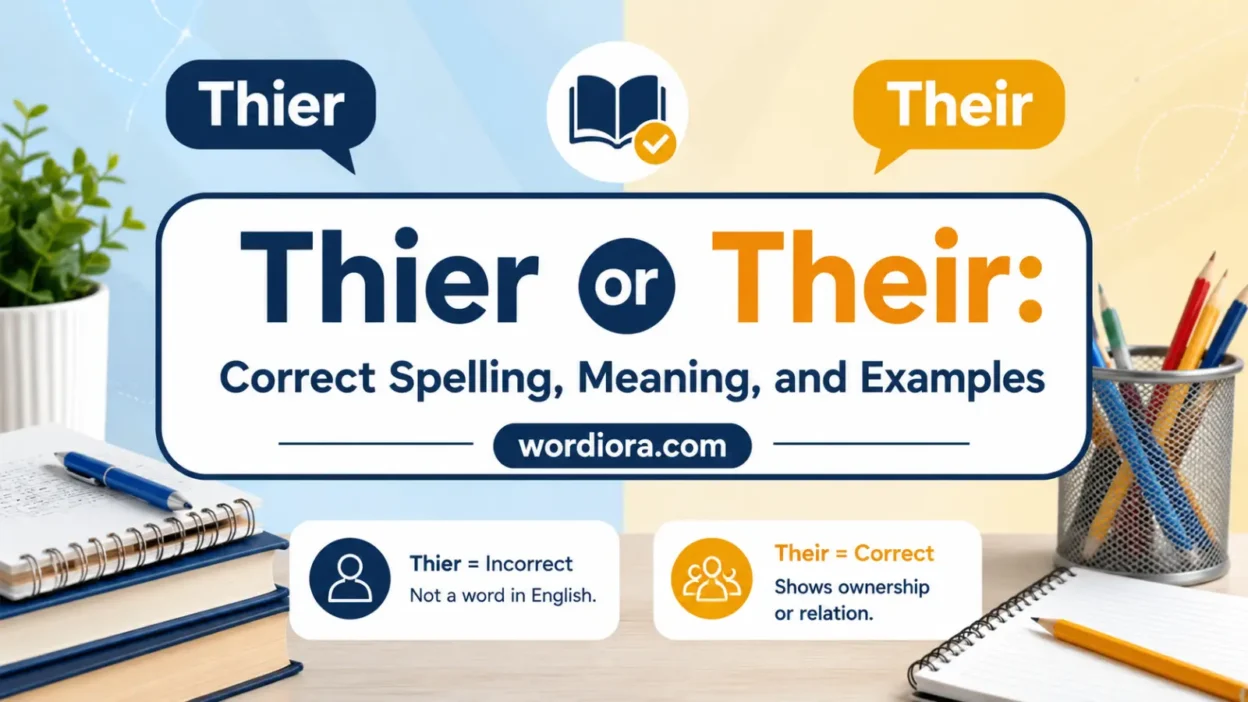
If you are choosing between thier or their, the correct choice is their. The spelling thier is a common mistake, but it is not the standard form in modern US English.
This mix-up happens because many English words with ie and ei patterns are hard to remember. However, this word has one safe spelling: their. Use it when something belongs to people, animals, groups, or a person whose gender is unknown or not important.
Quick Answer
Their is correct. Thier is incorrect in standard US English.
Use their before a noun to show possession, connection, or association: their house, their idea, their schedule. Do not write thier in school papers, emails, resumes, reports, captions, or any polished writing.
Why People Confuse Them
People confuse thier and their because the letters i and e often switch places in English words. A familiar spelling rhyme may also mislead writers, since their does not follow the simple version of that rhyme.
Another reason is speed. When someone types quickly, thier can appear as a letter-order typo. The reader usually understands the intended word, but the mistake still looks unpolished.
The best memory clue is this: their contains heir. An heir is connected with inheritance, and inheritance involves possession. That can help you remember that their is the spelling used for ownership.
Key Differences At A Glance
| Context | Best Choice | Why |
|---|---|---|
| Showing ownership | their | It means belonging to them. |
| Talking about a group’s item | their | It comes before the owned noun. |
| Referring to one unknown person | their | It can be used when gender is unknown or not relevant. |
| Formal writing | their | It is the standard spelling. |
| Casual texts | their | Even casual writing should use the correct form. |
| Typing “thier house” | their house | “Thier” is a misspelling. |
| School or work documents | their | “Thier” looks like an error. |
Compact comparison:
• thier: incorrect spelling; not a standard word for possession.
• their: correct possessive form; used before a noun.
• Easy check: if you mean “belonging to them,” write their.
Meaning and Usage Difference
Their means “belonging to them” or “connected with them.” It usually appears before a noun.
Correct examples:
Their car is parked outside.
The students opened their laptops.
The company changed their policy.
It can also refer to one person when the person’s gender is unknown, not important, or already expressed with they/them pronouns.
Someone left their jacket in the lobby.
Each guest should bring their ticket.
Thier does not have a separate standard meaning in this comparison. It is simply the wrong spelling when the intended word is their.
Pronunciation does not need much attention here because the issue is written, not spoken. Their usually sounds like “thair” in careful speech and may sound lighter in fast speech. Thier has no standard pronunciation as a separate word.
Tone, Context, and Formality
Their is neutral. You can use it in casual, professional, academic, and creative writing. It does not sound too formal or too relaxed.
Thier, on the other hand, looks like a typo in every normal context. It can make an otherwise clear sentence seem rushed or careless.
Use their in:
emails
school assignments
business pages
work messages
resumes
captions
reports
product descriptions
blog posts
Avoid thier everywhere unless you are directly discussing the misspelling itself.
Which One Should You Use?
Use their every time you need the possessive form connected to they.
Write:
their home
their children
their favorite restaurant
their account
their final answer
their own decision
Do not write:
thier home
thier children
thier favorite restaurant
thier account
thier final answer
thier own decision
A quick test can help. Ask yourself, “Do I mean belonging to them?” If yes, the answer is their.
When One Choice Sounds Wrong
Thier does not usually “sound” wrong because most readers mentally correct it to their. The problem appears on the page.
This sentence looks wrong:
The kids forgot thier lunch boxes.
This version is correct:
The kids forgot their lunch boxes.
The same problem appears in professional writing:
Incorrect: The team shared thier notes after the meeting.
Correct: The team shared their notes after the meeting.
Even if the meaning is clear, the misspelling can distract readers. In serious writing, that distraction matters.
Common Mistakes (and Quick Fixes)
Mistake 1: Writing thier because of the “i before e” pattern.
Fix: Remember that their has heir inside it.
Mistake 2: Using thier in fast typing.
Fix: Slow down on this word and check the letter order: t-h-e-i-r.
Mistake 3: Thinking thier is an accepted variant.
Fix: Treat it as a misspelling, not an alternate spelling.
Mistake 4: Replacing their with there.
Fix: Use their for ownership. Use location wording only when you mean a place.
Mistake 5: Avoiding singular their when the sentence needs it.
Fix: In modern US English, their can refer to one person when the person is unknown, general, or uses they/them pronouns.
Everyday Examples
Correct: Their dog barked when the mail arrived.
Incorrect: Thier dog barked when the mail arrived.
Correct: The neighbors cleaned their yard.
Incorrect: The neighbors cleaned thier yard.
Correct: Everyone should bring their ID.
Incorrect: Everyone should bring thier ID.
Correct: The players packed their uniforms.
Incorrect: The players packed thier uniforms.
Correct: Someone left their phone on the counter.
Incorrect: Someone left thier phone on the counter.
Correct: The parents signed their child up for camp.
Incorrect: The parents signed thier child up for camp.
Correct: The employees updated their passwords.
Incorrect: The employees updated thier passwords.
Correct: The band finished their sound check.
Incorrect: The band finished thier sound check.
Dictionary-Style Word Details
Verb
thier: Not used as a verb in standard US English. If you see it where a verb should be, it is not functioning as a standard verb.
their: Not used as a verb. Their is used before a noun to show possession or connection.
Noun
thier: Not commonly used as a noun in standard US English. In this comparison, it is a misspelling of their.
their: Not a noun. It is commonly described as a possessive determiner or possessive adjective-like word because it appears before a noun, as in their house or their plan.
Synonyms
thier: No true synonyms apply because thier is not a standard word in this usage.
their: Exact one-word synonyms do not fit cleanly because their is a grammar word. Closest plain alternatives include belonging to them, connected with them, or owned by them.
Clear antonyms do not work well for either form. The opposite depends on the sentence. For example, their car could contrast with our car, his car, or her car, depending on context.
Example Sentences
thier: The spelling is incorrect when you mean their.
Example: The students brought thier books should be The students brought their books.
their: Use it before the noun that belongs to or relates to someone.
Example: The students brought their books to class.
thier: Do not use this spelling in polished writing.
Example: The team lost thier files should be The team lost their files.
their: It can refer to a group or to one person in a general sentence.
Example: Each person should check their email before the meeting.
Word History
thier: In this comparison, thier has no separate standard word history as a correct English word. It is best understood as a letter-order mistake.
their: Their comes through older forms of English connected with the pronoun family of they. Its long-standing job is to show possession or connection.
Do not treat thier as an older, British, formal, or alternate version of their. That would be misleading.
Phrases Containing
thier: Standard phrases do not use thier. If you see thier own, thier way, or thier choice, correct them to their own, their way, and their choice.
their: Common phrases include:
their own
their way
their best
their choice
their turn
their fault
their idea
their side of the story
In each phrase, their points to the person or group connected with the noun that follows.
FAQs
Is “thier” or “their” correct?
Their is correct. Thier is a common misspelling and should not be used in standard English. If you mean something belongs to people, a group, or someone referred to with “they,” use their. For example, write, “They forgot their keys,” not “They forgot thier keys.”
Is “thier” a real word?
No, thier is not a standard English word. It usually appears when someone accidentally switches the letters e and i in their. Readers may understand what you mean, but the spelling still looks incorrect in school, work, and professional writing.
What does “their” mean?
Their means “belonging to them” or “connected with them.” It comes before a noun, such as their house, their teacher, their opinion, or their plans. It can refer to more than one person, and it can also refer to one person when the person’s gender is unknown or not important.
Why do people write “thier” instead of “their”?
Many people write thier because English spelling patterns can be confusing. The letters i and e often cause mistakes in words like this. Fast typing also makes the error more common. A useful memory trick is that their contains heir, and an heir is connected with ownership.
Can “their” be used for one person?
Yes. In modern English, their can refer to one person when the person is unknown, general, or uses they/them pronouns. For example, “Someone left their phone on the table” is natural and widely accepted.
How can I remember the correct spelling?
Remember the spelling order: t-h-e-i-r. You can also remember that their includes heir, which can remind you of possession. If the sentence means “belonging to them,” the correct spelling is always their.
Conclusion
The correct choice is their, not thier. Use their when you mean something belongs to, relates to, or is connected with people, animals, groups, or a person referred to with they.
The spelling thier is not a standard alternative. It is a common typo. When in doubt, remember the order: t-h-e-i-r. If the sentence means “belonging to them,” the word you want is always their.