
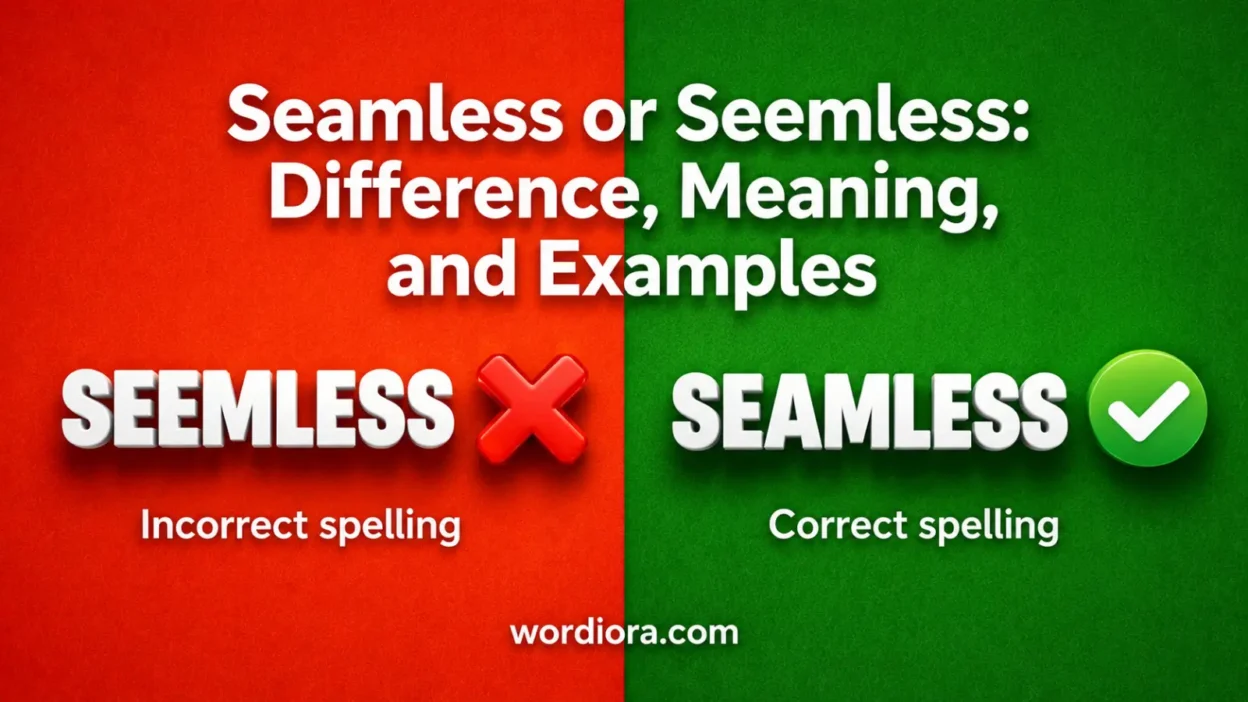
Seamless or seemless is a common spelling question because both forms sound almost the same. The correct choice in modern US English is seamless when you mean smooth, continuous, well-connected, or free from awkward breaks.
Seemless is usually a spelling mistake when someone means seamless. It can appear as an old word with a different meaning, but that use is not normal in everyday writing. For clear modern English, write seamless transition, seamless experience, seamless process, and seamless design.
Quick Answer
Use seamless when something has no visible seams, no awkward breaks, or no rough interruptions. Use seemless only if you are discussing its rare old meaning, not when you mean smooth or connected. In almost every modern sentence, seamless is the correct word and seemless will look like a typo.
Why People Confuse Them
People confuse these words because seam and seem sound alike. The word seamless is pronounced like “seem-liss,” so many writers assume the spelling should start with seem.
That guess makes sense by sound, but it is not the right spelling. Seamless comes from seam, which means a line where two pieces of fabric, leather, or material are joined. If something is seamless, it has no seam or no noticeable join.
The word does not come from seem, which means to appear. A smooth app experience does not “seem less.” It has fewer visible breaks. That is why seamless is the correct spelling.
Key Differences At A Glance
| Context | Best Choice | Why |
|---|---|---|
| Smooth transition | seamless | It means the change happens without awkward breaks. |
| Clothing with no visible joins | seamless | It comes from seam, meaning a stitched join. |
| Business process | seamless | It describes a process that feels smooth and connected. |
| App or website experience | seamless | It means the user can move through steps easily. |
| Modern school or work writing | seamless | It is the standard spelling. |
| Meaning “unseemly” in old usage | seemless | This is rare and archaic, not normal modern use. |
| Meaning “smooth” or “continuous” | seamless | Seemless is not the right modern form for this meaning. |
Meaning and Usage Difference
Seamless is an adjective. It describes something that has no seams, no obvious joins, or no rough changes. It can be literal or figurative.
Literal use:
The dress had a seamless finish.
This means the dress did not show visible stitched lines or joins.
Figurative use:
The team made a seamless move to the new system.
This means the move felt smooth and well-managed. There were no major problems, delays, or awkward gaps.
Seemless is different. In modern writing, it usually appears when someone misspells seamless. Some dictionaries list seemless as an archaic adjective meaning unseemly, or improper, but that meaning is not common today.
So the real choice is simple: use seamless for smooth, continuous, connected, or uninterrupted. Avoid seemless unless you are writing about old vocabulary.
Tone, Context, and Formality
Seamless is neutral and polished. It works in casual writing, business writing, product descriptions, school essays, technical documents, and everyday speech.
You can say:
The checkout process was seamless.
The new manager made the handoff feel seamless.
The software update created a seamless experience for users.
These sentences sound natural in American English. The word often gives a professional tone because it suggests planning, quality, and smooth performance.
Seemless does not work in normal modern contexts. If you write seemless experience or seemless transition, many readers will see it as a spelling error. It can make polished writing look careless.
Use this compact comparison:
- Seamless: standard, modern, smooth, connected, professional.
- Seemless: rare old word or modern spelling mistake when used for “smooth.”
Which One Should You Use?
Use seamless almost every time. It is the correct word for modern writing when you mean smooth, easy, continuous, or free from visible joins.
Choose seamless in phrases like:
Seamless transition
Seamless experience
Seamless process
Seamless design
Seamless service
Seamless handoff
Seamless workflow
Seamless fit
Do not write seemless transition or seemless experience. Those spellings may sound logical, but they are not accepted for the meaning most writers want.
A simple memory trick helps: seamless means “without seams.” If the sentence is about something smooth with no visible break, use seam, not seem.
When One Choice Sounds Wrong
Seemless sounds wrong when it tries to mean smooth, easy, or connected.
Wrong: The company offered a seemless onboarding process.
Right: The company offered a seamless onboarding process.
Wrong: The video needs a seemless transition.
Right: The video needs a seamless transition.
Wrong: The app gives customers a seemless checkout.
Right: The app gives customers a seamless checkout.
The wrong spelling can be especially noticeable in professional writing. A resume, product page, client email, or report should use seamless.
The only time seemless may not be a typo is when someone is discussing old or rare vocabulary. That situation is unusual. Most readers will not understand it unless you explain it.
Common Mistakes (and Quick Fixes)
Mistake 1: Choosing by sound only
Wrong: The update made the process seemless.
Right: The update made the process seamless.
Fix: Remember that the word comes from seam, not seem.
Mistake 2: Thinking seemless means “does not seem”
Wrong: The change was seemless because no one noticed it.
Right: The change was seamless because no one noticed it.
Fix: A smooth change has no visible seams or breaks.
Mistake 3: Misspelling the adverb
Wrong: The teams worked together seemlessly.
Right: The teams worked together seamlessly.
Fix: If the adjective is seamless, the adverb is seamlessly.
Mistake 4: Using seamless for every good result
Weak: The lunch was seamless.
Better: The service was seamless.
Fix: Use seamless for flow, connection, transition, design, service, or process.
Mistake 5: Overusing seamless in business writing
Weak: We provide seamless solutions with seamless support.
Better: We provide smooth setup, clear support, and a seamless handoff.
Fix: Use the word once, then explain what makes the experience smooth.
Everyday Examples
The new payment system made checkout seamless.
Her move from assistant manager to store manager was seamless.
The hotel offered a seamless check-in experience.
The editor created a seamless transition between scenes.
Our goal is to give customers a seamless return process.
The fabric looks clean because the design is seamless.
The two teams built a seamless handoff plan.
This app connects messages, payments, and receipts in one seamless flow.
The presentation felt seamless because each speaker knew when to begin.
A seamless service experience can make customers trust a brand faster.
Do not use seemless in these examples. In each sentence, the meaning is smooth, connected, or uninterrupted, so seamless is correct.
Dictionary-Style Word Details
Verb
Seamless: Not commonly used as a verb in standard US English. It is an adjective.
Example: The process was seamless.
Seemless: Not commonly used as a verb. The old adjective form is not a normal modern verb.
Noun
Seamless: Not normally used as a common noun. The related noun is seamlessness, which means the quality of being smooth, continuous, or free from breaks.
Example: The team focused on the seamlessness of the customer experience.
Seemless: Not commonly used as a noun in standard modern English.
Synonyms
Seamless: closest plain alternatives include smooth, continuous, uninterrupted, connected, flawless, coherent, and well-integrated. The best synonym depends on the sentence.
Examples:
A seamless transition can mean a smooth transition.
A seamless design can mean a clean, well-connected design.
A seamless process can mean an easy, uninterrupted process.
Clear opposites include rough, interrupted, disjointed, uneven, clumsy, and fragmented.
Seemless: For its rare old meaning, the closest plain alternative is unseemly, meaning improper or unsuitable. This is not the meaning people usually want when they type seemless today.
Example Sentences
Seamless: The company made the switch to online billing feel seamless.
Seamless: The jacket has a seamless look from the front.
Seamless: Good training creates a seamless first week for new employees.
Seamless: The new layout gives shoppers a seamless path from search to checkout.
Seemless: In modern writing, seemless usually looks like a mistake when the intended meaning is smooth or uninterrupted.
Seemless: You would rarely use seemless unless discussing archaic vocabulary.
Word History
Seamless is built from seam plus -less. A seam is a join, stitch line, or place where parts meet. The suffix -less means “without.” So seamless literally means “without seams.”
Over time, the word also came to describe anything that feels smooth, whole, or uninterrupted. That is why people now use it for transitions, service, software, design, teamwork, and customer experience.
Seemless comes from a different idea and has been listed as an old form meaning unseemly. That history does not make it the right spelling for seamless in modern writing.
Phrases Containing
Seamless:
Seamless transition means a smooth change from one thing to another.
Seamless experience means an experience with no awkward steps or interruptions.
Seamless process means a process that works smoothly from start to finish.
Seamless design means a design that feels clean, connected, and unified.
Seamless integration means two or more parts work together smoothly.
Seamless handoff means one person or team passes work to another without confusion.
Seemless:
No common modern phrases use seemless for the meaning “smooth” or “without breaks.” Write seamless transition, not seemless transition.
FAQs
Is seamless or seemless correct?
Seamless is correct when you mean smooth, continuous, or free from awkward breaks. Seemless is usually a misspelling in modern English.
Is seemless a real word?
It can appear as an archaic word meaning unseemly, but that is not the normal modern meaning people want. In everyday writing, seemless usually looks incorrect.
What does seamless mean?
Seamless means without seams, without visible joins, or without awkward interruptions. It can describe fabric, design, service, teamwork, technology, or a process.
Is seamless transition correct?
Yes. Seamless transition is correct. It means a change that happens smoothly, with little or no disruption.
Is seemless transition ever correct?
No, not for the normal meaning. Write seamless transition.
How can I remember the spelling?
Connect the word to seam. If something has no visible seam, break, or rough join, it is seamless.
Conclusion
The correct modern choice is seamless, not seemless, when you mean smooth, continuous, connected, or free from interruptions. Use seamless for transitions, experiences, processes, designs, service, and clothing with no visible seams.
Seemless is usually a spelling mistake in today’s English. Although it exists as an old word with a different meaning, it is not the form you want in normal writing. The easiest rule is simple: if something has no rough break or visible join, spell it with seam: seamless.