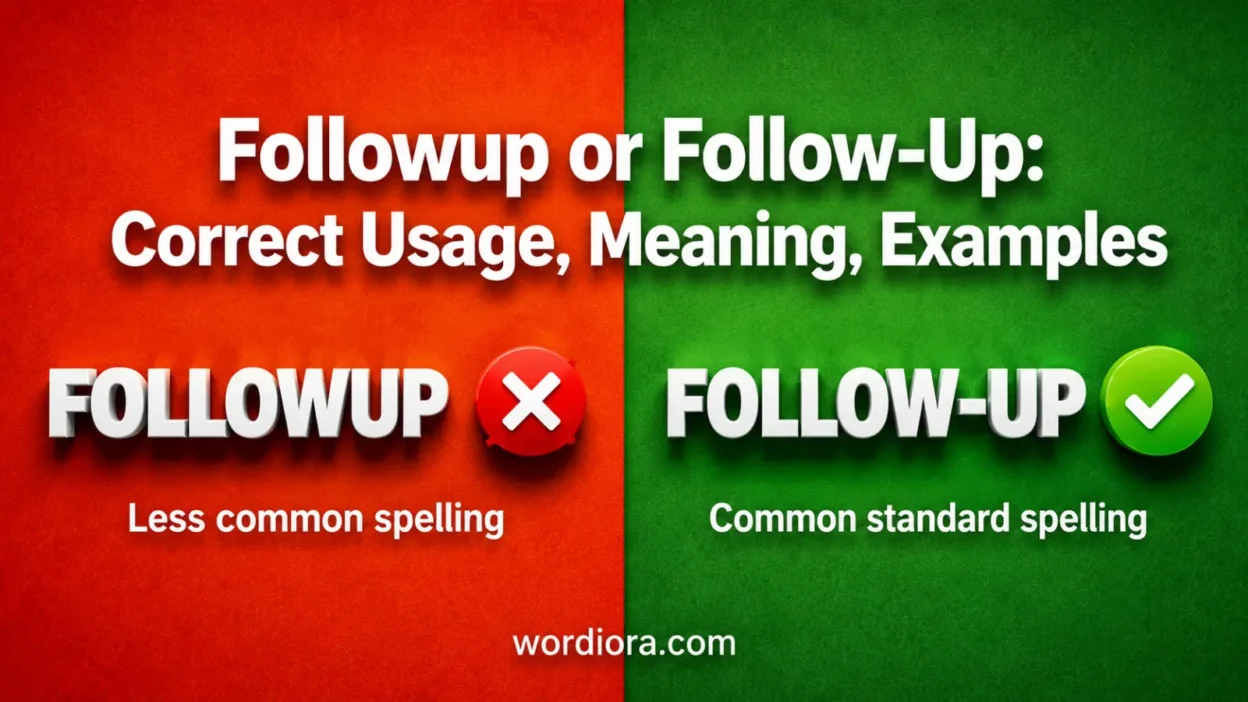
Is it followup or follow-up? In standard English, follow-up is the correct spelling when the term functions as a noun or adjective, while follow up is written as two words when used as a verb. This guide explains the difference clearly, provides practical examples, and helps you choose the right form in every context.
Quick Answer
Use follow-up as a noun or adjective. Write “I sent a follow-up” or “We had a follow-up meeting.” Avoid followup in standard US writing because it looks informal or nonstandard. Also remember that the verb is follow up with a space, as in “I will follow up tomorrow.”
Why People Confuse Them
People confuse followup and follow-up because they sound the same when spoken. The hyphen is silent, so you cannot hear the difference in conversation.
Another reason is that English compounds can be tricky. Some words close up over time, while others stay open or hyphenated. For this term, modern standard writing still favors follow-up for the noun and adjective.
Digital writing also adds confusion. In file names, app labels, search boxes, and short notes, people often remove spaces and hyphens. That can make followup look normal, even though it is not the safest form in edited writing.
Key Differences At A Glance
| Context | Best Choice | Why |
|---|---|---|
| A second email | follow-up | It describes the email. |
| A later appointment | follow-up | It works as an adjective before “appointment.” |
| A later action or check-in | follow-up | It works as a noun. |
| Professional writing | follow-up | It is the standard polished form. |
| Informal file name or label | followup | It may appear, but it is not the best grammar choice. |
| The action of checking again | follow up | This is the verb form, not followup or follow-up. |
Meaning and Usage Difference
Follow-up means something done after an earlier action, message, event, visit, or meeting. It can be a second email, a later appointment, a new question, a check-in, or an added step.
Examples:
- I sent a follow-up after the interview.
- The doctor scheduled a follow-up for next month.
- We need a follow-up report after the meeting.
As an adjective, follow-up describes a noun.
Examples:
- She wrote a follow-up email.
- The team planned a follow-up call.
- He asked a follow-up question.
Followup has the same intended meaning when people use it, but it is not the preferred form in standard US English. It can make writing look rushed, informal, or unedited.
Extra comparison:
| Feature | followup | follow-up |
| Standard noun form | Not recommended | Correct |
| Standard adjective form | Not recommended | Correct |
| Professional tone | Weak | Strong |
| Best for articles and emails | No | Yes |
| Pronunciation | Same sound | Same sound |
Pronunciation does not change the meaning here. Both forms are said like “FAH-loh-up.” The difference is spelling, grammar role, and writing style.
Tone, Context, and Formality
Follow-up sounds clean, professional, and standard. It fits business emails, medical writing, job applications, school papers, news writing, and everyday messages.
Use follow-up in phrases like:
- follow-up email
- follow-up call
- follow-up appointment
- follow-up meeting
- follow-up question
- follow-up survey
Followup looks less formal. It may appear in short labels, internal tags, product names, or casual notes, but it is not the form most readers expect in careful writing.
For a US audience, the safest choice is simple: use follow-up when you need a noun or adjective.
Which One Should You Use?
Use follow-up almost every time you are choosing between followup and follow-up.
Choose follow-up when you mean:
- a later message
- a second meeting
- a return appointment
- an added question
- a continued action
- a later check-in
Examples:
- Correct: I sent a follow-up this morning.
- Correct: We need a follow-up meeting next week.
- Correct: Her follow-up question was helpful.
Avoid followup in normal sentences.
- Weak: I sent a followup this morning.
- Better: I sent a follow-up this morning.
One important note: when you mean the action, use follow up with a space.
- Correct: I will follow up tomorrow.
- Incorrect: I will follow-up tomorrow.
- Incorrect: I will followup tomorrow.
When One Choice Sounds Wrong
Followup sounds wrong when it appears in polished writing because readers expect the hyphenated form.
Incorrect: Please send a followup email after the meeting.
Correct: Please send a follow-up email after the meeting.
Incorrect: The clinic scheduled a followup visit.
Correct: The clinic scheduled a follow-up visit.
Incorrect: I have a followup with my manager.
Correct: I have a follow-up with my manager.
However, follow-up also sounds wrong if you use it as a verb.
Incorrect: I will follow-up with the client.
Correct: I will follow up with the client.
So, the real pattern is clear:
Use follow-up for the thing or description.
Use follow up for the action.
Avoid followup in standard writing.
Common Mistakes (and Quick Fixes)
A common mistake is using followup as a noun in a professional email.
Incorrect: Thanks for the followup.
Correct: Thanks for the follow-up.
Another mistake is using follow-up as a verb.
Incorrect: I wanted to follow-up on my application.
Correct: I wanted to follow up on my application.
Writers also forget the hyphen when the term comes before a noun.
Incorrect: We had a follow up call.
Correct: We had a follow-up call.
The quick fix is to check the job of the words in the sentence. If it names a thing, use follow-up. If it describes a noun, use follow-up. If it shows an action, use follow up.
Everyday Examples
I sent a follow-up after the job interview.
The dentist asked me to schedule a follow-up.
She wrote a follow-up email to thank the client.
We had a follow-up meeting on Friday.
The reporter asked one final follow-up question.
Our teacher gave us a follow-up assignment.
The sales team planned a follow-up call.
His second video was a follow-up to the first one.
The doctor recommended a follow-up visit in two weeks.
Please send a follow-up note after the event.
I will follow up with the customer tomorrow.
Did you follow up after the conference?
Dictionary-Style Word Details
Verb
Followup: Not commonly used as a verb in standard US English. Do not write “I will followup tomorrow” in polished writing.
Follow-up: Not used as a hyphenated verb in standard sentences. Do not write “I will follow-up tomorrow.”
Use follow up as the verb phrase.
Example: I will follow up after the meeting.
Noun
Followup: Not the recommended standard noun form. It may appear in informal or technical contexts, but it is not the best choice for normal writing.
Follow-up: The standard noun form. It means a later action, message, visit, question, or continuation connected to something earlier.
Example: The client requested a follow-up.
Synonyms
Followup: No separate standard synonym list is needed because it is not the preferred form. If you mean the noun, use follow-up instead.
Follow-up: Closest plain alternatives include continuation, next step, later check, additional review, return visit, and second message.
Clear antonyms are limited because follow-up depends on context. In some sentences, a useful contrast may be first message, initial visit, or original meeting, but these are not exact opposites in every use.
Example Sentences
Followup: Avoid this spelling in standard sentences.
Weak: I sent a followup to the hiring manager.
Better: I sent a follow-up to the hiring manager.
Follow-up: Use this form as a noun or adjective.
Correct: The nurse scheduled a follow-up.
Correct: We received a follow-up email.
Correct: That was a smart follow-up question.
Word History
Followup: This closed form reflects a common pattern in English, where some compounds become one word over time. However, for this term, the closed spelling is not the best standard choice for everyday edited writing.
Follow-up: This hyphenated form keeps the two parts connected when they work together as a noun or adjective. The hyphen helps readers see that the words form one unit.
Phrases Containing
Followup: Not recommended in standard phrases.
Better forms:
- follow-up email
- follow-up call
- follow-up visit
- follow-up report
Follow-up: Common phrases include:
- follow-up appointment
- follow-up meeting
- follow-up interview
- follow-up question
- follow-up survey
- follow-up care
- follow-up message
- follow-up note
FAQs
Is followup or follow-up correct?
Follow-up is correct in standard US English when you need a noun or adjective. Use it in phrases like “a follow-up,” “follow-up email,” or “follow-up appointment.” Avoid followup in polished writing.
Is follow-up one word or hyphenated?
Follow-up is hyphenated. The hyphen belongs there when the term works as a noun or adjective. For example, write “a follow-up” and “a follow-up meeting.”
When should I use follow up with a space?
Use follow up with a space when it works as a verb. Example: “I will follow up with the client tomorrow.” In that sentence, “follow up” shows the action.
Is followup ever acceptable?
Followup may appear in informal notes, file names, internal labels, or technical names. Still, it is not the safest choice for professional writing. Use follow-up in normal sentences.
What is a follow-up email?
A follow-up email is a message sent after an earlier email, meeting, interview, request, or conversation. It usually reminds someone, asks for an update, adds information, or continues the discussion.
What is the easiest way to remember the difference?
Remember this: follow up is the action, and follow-up is the thing or description. Write “I will follow up,” but “I sent a follow-up email.”
Conclusion
The best choice between followup and follow-up is follow-up in standard US English. Use it when the word works as a noun or adjective, such as “a follow-up,” “follow-up call,” or “follow-up appointment.”
Avoid followup in polished writing because it looks informal or nonstandard. Also, do not use follow-up as a verb. When you mean the action, write follow up with a space: “I will follow up tomorrow.”