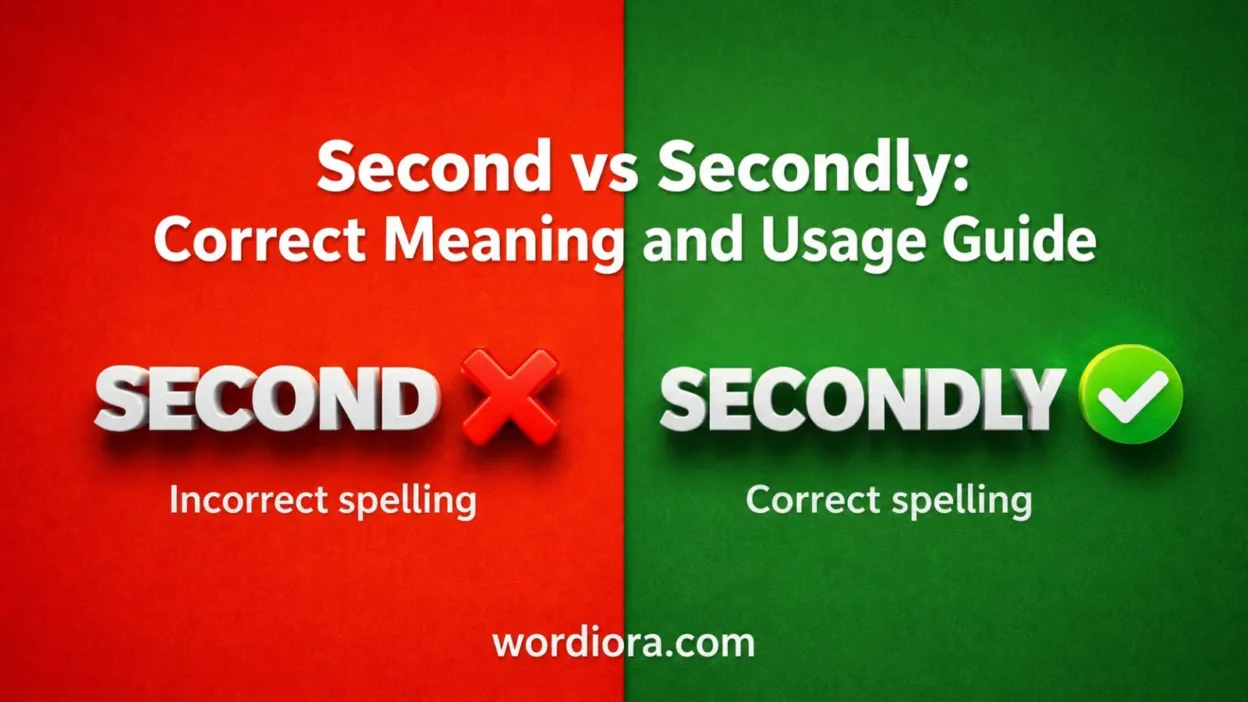
Second vs secondly can confuse writers because both words can introduce the next point in a list. The good news is simple: second is usually the better choice in modern US writing, while secondly is also correct when you want a more formal list marker.
Use second in everyday writing, business emails, essays, instructions, and most articles. It sounds clean and direct.
Use secondly when you are clearly listing reasons, arguments, or points in a formal style. It is not wrong, but it can sound heavier than needed.
The main difference is not meaning. In list order, both can mean “in the second place.” The real difference is grammar range, tone, and naturalness.
Quick Answer
Both second and secondly are correct, but second is usually more natural in modern US English.
Correct: First, review the budget. Second, approve the timeline.
Also correct: Firstly, review the budget. Secondly, approve the timeline.
For most readers, second feels shorter, clearer, and more direct. Secondly sounds more formal and works best when you are listing points in a structured argument.
Do not use secondly for meanings where only second works.
Correct: She finished second in the race.
Wrong: She finished secondly in the race.
Correct: I second the motion.
Wrong: I secondly the motion.
Why People Confuse Them
People confuse second and secondly because both can appear after first in a list. A writer may start with “First,” then wonder whether the next word should be “second” or “secondly.”
The confusion also comes from the -ly ending. Many adverbs end in -ly, so secondly looks like the more “adverb-like” choice. However, second can also work as an adverb.
That means this sentence is correct:
First, we tested the form. Second, we fixed the error.
This sentence is also correct:
Firstly, we tested the form. Secondly, we fixed the error.
The key is consistency. A clean list usually uses one pattern, not a mix of styles.
Key Differences At A Glance
| Context | Best Choice | Why |
|---|---|---|
| Everyday writing | second | Shorter and more natural |
| Business emails | second | Clear and direct |
| School essays | second | Safe and widely accepted |
| Formal arguments | secondly | Correct if the whole list uses that style |
| Race or contest result | second | “Secondly” does not fit |
| Supporting a motion | second | “Second” can be a verb |
| A time unit | second | “Secondly” cannot mean a unit of time |
| A second helping of food | second | “Secondly” is not a noun |
Compact comparison:
• Second can work as an adjective, noun, adverb, or verb.
• Secondly works only as an adverb.
• Second is the better everyday list marker.
• Secondly is correct, but it sounds more formal.
• Second has many meanings beyond list order.
• Secondly mainly means “in the second place.”
Meaning and Usage Difference
Second has several common meanings. It can mean “number two in order,” as in the second chapter. It can mean a place or result, as in She came in second. It can mean a unit of time, as in Wait one second. It can also mean to support a proposal, as in I second the motion.
Secondly has a much narrower use. It means in the second place and usually introduces the second point in a list.
Use second when you want the broad word for position, order, time, support, or list order.
Use secondly only when you are introducing a second point.
Correct: Second, we need a backup plan.
Correct: Secondly, we need a backup plan.
Wrong: Please wait a secondly.
Tone, Context, and Formality
In US writing, second usually sounds more natural. It works well in articles, emails, school writing, instructions, reports, and everyday explanations.
Secondly sounds more formal. It may fit a speech, debate, academic-style paragraph, or formal list of reasons. Still, many writers prefer second because it is shorter and easier to read.
Compare these:
Natural: First, the app is easy to use. Second, it saves time.
More formal: Firstly, the app is easy to use. Secondly, it saves time.
Neither sentence is grammatically wrong. The first one simply sounds cleaner and more modern.
Pronunciation is not a major issue here. Second sounds like “SEK-und,” and secondly sounds like “SEK-und-lee.”
Which One Should You Use?
Choose second in most situations. It is the safest choice for modern US writing because it is clear, short, and accepted in both formal and informal contexts.
Use secondly when you want a formal list marker and your sentence pattern supports it.
Good pattern:
Firstly, the plan reduces costs. Secondly, it improves service.
Better for most writing:
First, the plan reduces costs. Second, it improves service.
If your list continues, keep the pattern steady.
Good: First, second, third.
Good: Firstly, secondly, thirdly.
Awkward: First, secondly, third.
A mixed list is not always a grammar error, but it can look uneven. Readers notice the shift more than the rule.
When One Choice Sounds Wrong
Secondly sounds wrong when the sentence does not introduce a second point. It cannot replace every meaning of second.
Wrong: He was the secondly person in line.
Correct: He was the second person in line.
Wrong: Give me a secondly to answer.
Correct: Give me a second to answer.
Wrong: The board will secondly the motion.
Correct: The board will second the motion.
Wrong: She bought a secondly car.
Correct: She bought a second car.
Second rarely sounds wrong as a list marker. It may sound too plain only if the surrounding style is very formal and already uses firstly, thirdly, and similar words.
Common Mistakes
Mistake 1: Using secondly for a noun.
Wrong: I need a secondly.
Correct: I need a second.
Mistake 2: Using secondly before a noun.
Wrong: This is my secondly reason.
Correct: This is my second reason.
Mistake 3: Mixing list styles too much.
Uneven: First, we checked the data. Secondly, we updated the chart.
Better: First, we checked the data. Second, we updated the chart.
Mistake 4: Thinking secondly is always more correct.
Wrong idea: Secondly is better because it ends in -ly.
Quick fix: Second is already correct as a list adverb.
Mistake 5: Using second where a smoother transition would help.
Plain: Second, we need to ask why.
Smoother: Second, we need to ask why this happened.
Everyday Examples
Second in a list:
First, wash your hands. Second, dry them with a clean towel.
Second as an adjective:
This is the second email I sent today.
Second as a noun:
She finished second in the spelling bee.
Second as a time word:
Wait a second while I find the file.
Second as a verb:
I second the request for a longer deadline.
Secondly in a formal list:
Firstly, the rent is too high. Secondly, the commute is too long.
Secondly in a speech:
Secondly, we must protect the budget for student programs.
Secondly in an essay:
Secondly, the evidence does not support that claim.
Dictionary-Style Word Details
Verb
• second: Used as a verb when someone formally supports a motion, proposal, or suggestion. Example: I second the motion.
• secondly: Not used as a verb in standard US English. Do not write I secondly the motion.
Noun
• second: Used as a noun in several ways. It can mean a unit of time, a second-place finish, a helper in certain contexts, or an extra helping of food in plural form. Example: I need one second.
• secondly: Not used as a noun in standard US English. Do not write a secondly.
Synonyms
• second: Closest plain alternatives depend on the meaning. For list order, use next or in the second place. For rank, use runner-up only when a competition is involved. For support as a verb, use support, back, or endorse.
• secondly: Closest plain alternatives include second, next, and in the second place.
Clear antonyms do not always fit because the meaning changes by context. For order, first can be the opposite of second in a sequence, but it is not an opposite in every use.
Example Sentences
• second: Second, we should compare the final prices.
• second: My second choice is the blue jacket.
• second: She came in second after a close race.
• second: Can you wait one second?
• second: I second your idea.
• secondly: Secondly, the new policy may reduce delays.
• secondly: Firstly, the room is small; secondly, it has no windows.
• secondly: Secondly, we need to think about long-term costs.
Word History
• second: The word has a long history in English and is tied to the idea of following the first or coming next in order. It also developed several everyday meanings, including time, rank, and support.
• secondly: The word is formed from second plus -ly. Its main role is to introduce the second item in a list or argument.
Avoid making strong history claims unless you are using a trusted dictionary source. For normal writing, the useful point is simple: second is broader, while secondly is narrower.
Phrases Containing
• second: second chance, second place, second opinion, second thought, second to none, second in line, second helping, split second, second nature
• secondly: No common fixed phrases are built around secondly in everyday US English. It mainly appears at the start or middle of a sentence to introduce a second point.
FAQs
Is secondly wrong?
No. Secondly is not wrong. It is a standard adverb that means in the second place. However, second is usually more natural in modern US writing.
Should I write second or secondly in an essay?
Use second for a clean, direct style. Use secondly only if your essay uses a formal list pattern such as firstly, secondly, thirdly.
Can I start a sentence with second?
Yes. You can start a sentence with second when listing points.
Example: Second, we need to check the final cost.
Can I start a sentence with secondly?
Yes. Secondly can start a sentence when you introduce the second point in a list.
Example: Secondly, the plan needs more testing.
Which sounds better in American English?
Second usually sounds better in American English because it is shorter and more direct. Secondly can sound formal or a little stiff, depending on the sentence.
Should I use a comma after second or secondly?
Often, yes, when the word introduces a point.
Example: Second, check the address.
Example: Secondly, check the address.
Conclusion
The choice between second vs secondly is mostly about style and sentence role. Second is the best choice in most modern US writing because it is clear, short, and flexible. It can work as a list marker, adjective, noun, adverb, and verb.
Secondly is also correct, but it has a narrower job. Use it when you want to introduce the second point in a formal list.
For everyday writing, remember this simple rule: use second unless you have a clear reason to use secondly.