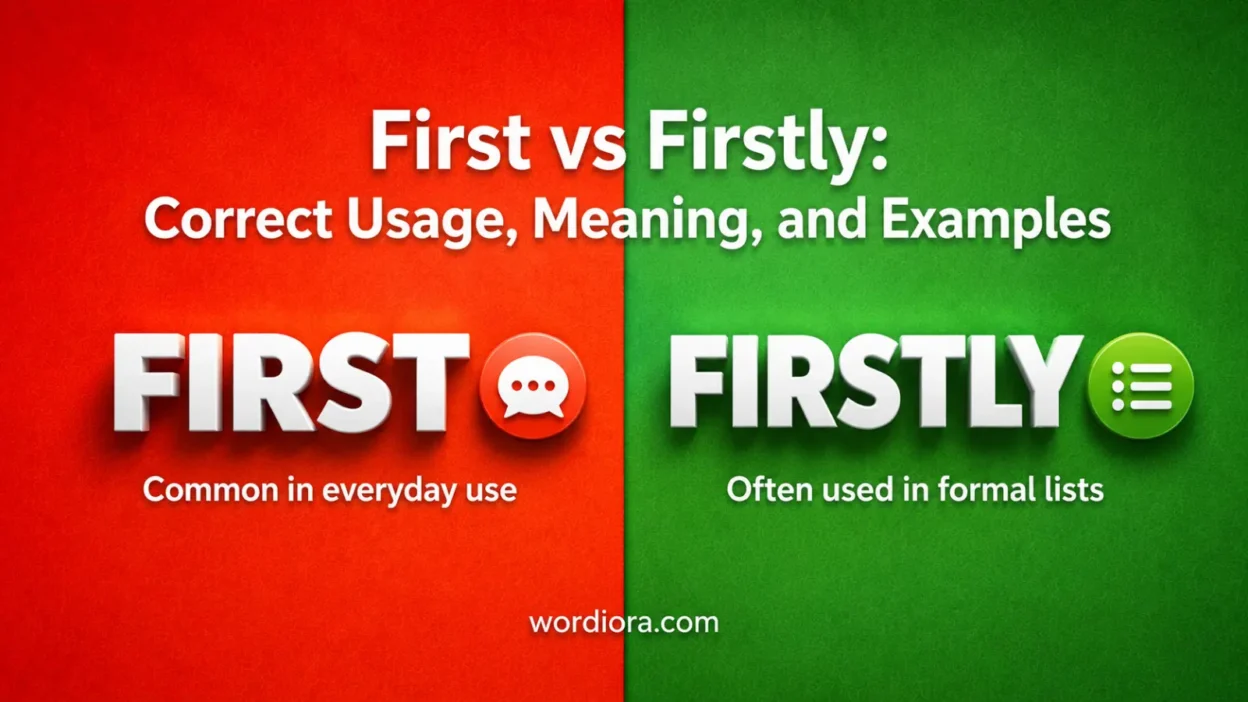
First vs firstly is a common word-choice question because both words can introduce the first point in a list. The simple answer is this: use first in most US writing. It is shorter, more natural, and widely accepted in formal and informal contexts.
Firstly is not wrong. It is a real word, and it can mean “in the first place” or “as the first point.” However, it often sounds more formal, heavier, or less natural to American readers. It also works in fewer sentence patterns than first.
So, the best rule is practical: use first unless you have a clear reason to use firstly. This keeps your writing smooth, direct, and easy to read.
Quick Answer
Both first and firstly can be correct when introducing the first point in a list.
Use first when you want the most natural choice in modern US English:
Correct: First, we need to review the budget.
Correct: First, open the app and sign in.
Use firstly when you want a more formal list-opening word:
Correct: Firstly, we should consider the cost.
Correct: Firstly, the report does not include last month’s sales.
However, first works in more situations. You can say first of all, at first, first place, first row, and I got there first. You cannot replace those with firstly.
Best everyday choice: first
Still correct, but more formal: firstly
Why People Confuse Them
People confuse first and firstly because both can begin a list of points. For example, both of these sentences are acceptable:
First, let’s check the schedule.
Firstly, let’s check the schedule.
The confusion grows because many adverbs end in -ly, such as quickly, clearly, and carefully. That makes firstly look like the “proper” adverb form. But English does not always work that neatly. First can already work as an adverb.
Another reason is school writing. Some students learn list patterns like firstly, secondly, finally. That pattern is understandable, but it can sound stiff in everyday American writing. In most modern sentences, first, second, third sounds cleaner.
Key Differences At A Glance
| Context | Best Choice | Why |
|---|---|---|
| Starting a list in US writing | first | It sounds natural and direct. |
| Formal essay or speech | first or firstly | Both can work, but first is still smoother. |
| “First of all” | first | “Firstly of all” sounds wrong. |
| Order in time or place | first | First works as an adverb of order. |
| Adjective before a noun | first | Firstly cannot describe a noun. |
| Noun use | first | Firstly is not used as a noun. |
| Very formal list style | firstly | It can introduce the first point in a formal sequence. |
Meaning and Usage Difference
First has several uses. It can describe something that comes before all others in time, order, rank, or importance.
First as an adjective:
She took the first seat by the window.
First as an adverb:
We arrived first.
First as a list marker:
First, check your email.
First as a noun:
That win was a first for our team.
Firstly is narrower. It is an adverb used mainly to introduce the first point in a list, argument, explanation, or set of reasons.
Firstly, we need more time.
Firstly, the plan is too expensive.
The key difference is range. First works in many grammar roles. Firstly mainly works as a formal list-opening adverb.
Tone, Context, and Formality
First sounds natural in almost every setting. It works in emails, essays, instructions, blog posts, reports, speeches, and everyday conversation.
First, I want to thank everyone for coming.
First, wash your hands.
First, we need to solve the login issue.
Firstly sounds more formal. It may fit a speech, debate, academic paragraph, or structured argument. Still, many US readers find first cleaner.
Firstly, the evidence is incomplete.
Firstly, the proposal does not explain the cost.
In American English, firstly can sometimes feel too heavy for a simple sentence. That does not make it incorrect. It only means the tone may not match the situation.
For most US readers, first is the safer and more natural choice.
Which One Should You Use?
Use first when you want clear, natural US English. It is the best choice for most sentences.
First, save your file.
First, let me explain the problem.
First, we should call the client.
Use firstly only when you are writing a formal list and want the rhythm of firstly, secondly, finally.
Firstly, the deadline is too short. Secondly, the budget is too low. Finally, the team needs more support.
Even there, first, second, finally often sounds better.
Better for most readers: First, the deadline is too short. Second, the budget is too low. Finally, the team needs more support.
A simple rule works well: when in doubt, choose first.
When One Choice Sounds Wrong
Firstly sounds wrong when the sentence needs first as an adjective, noun, or general adverb.
Incorrect: This is my firstly job.
Correct: This is my first job.
Incorrect: She finished firstly in the race.
Correct: She finished first in the race.
Incorrect: Firstly of all, thank you.
Correct: First of all, thank you.
Incorrect: I firstly met him in college.
Correct: I first met him in college.
First rarely sounds wrong when introducing a list. That is why it is the better default choice.
Correct: First, we need a plan.
Correct: First, check the address.
Correct: First, let’s talk about the price.
Common Mistakes
One common mistake is using firstly anywhere you see the idea of “first.” That does not work because firstly has a limited role.
Wrong: The firstly chapter is short.
Right: The first chapter is short.
Another mistake is writing firstly of all. The correct phrase is first of all.
Wrong: Firstly of all, I’m sorry.
Right: First of all, I’m sorry.
Writers also mix list styles in a way that feels uneven.
Weak: Firstly, we need funding. Second, we need staff. Thirdly, we need time.
Better: First, we need funding. Second, we need staff. Third, we need time.
Choose one pattern and keep it consistent.
Everyday Examples
Here are natural examples with first:
First, turn off the oven.
I need to finish this report first.
She was the first person to reply.
We sat in the first row.
First of all, thank you for your help.
Here are correct examples with firstly:
Firstly, we need to understand the problem.
Firstly, the contract does not mention delivery dates.
Firstly, I appreciate your feedback.
Firstly, the data is incomplete.
Firstly, this plan requires more time.
Compact comparison:
• First is broader, shorter, and more natural.
• Firstly is narrower, longer, and more formal.
• First can describe order, time, place, rank, and list position.
• Firstly mainly introduces the first point in a list or argument.
Dictionary-Style Word Details
Verb
First: Not commonly used as a verb in standard everyday US English. In normal writing, use it as an adjective, adverb, or noun.
Firstly: Not used as a verb in standard US English.
Noun
First: Can be a noun when it means the first person, first thing, first place, or first occurrence.
Example: Winning the award was a first for the company.
Firstly: Not used as a noun. It works as an adverb.
Synonyms
First: Closest plain alternatives include initial, earliest, before anything else, first of all, and to begin with. The best choice depends on the sentence.
Firstly: Closest plain alternatives include first, in the first place, and to begin with.
Clear opposites only fit in some contexts. For list order, last or finally can work as opposites. For rank or order, last is often the clearest opposite of first.
Example Sentences
First: First, we need to confirm the address.
First: I saw her first at the conference.
First: This is the first time I’ve tried that restaurant.
First: Safety comes first.
Firstly: Firstly, the price is too high.
Firstly: Firstly, I want to thank the volunteers.
Firstly: Firstly, the instructions are unclear.
Firstly: Firstly, we should review the facts.
Word History
First: This is the older base word and has long been used for order, time, rank, and importance.
Firstly: This word was formed from first plus -ly. It is an established English word, not a mistake. The useful point for writers is not age, but fit: first works in more places, while firstly works mainly as a formal list marker.
Phrases Containing
First: Common phrases include first of all, at first, first things first, first come, first served, first place, first choice, and put first.
Firstly: Commonly appears in list patterns such as firstly, secondly, finally. It does not form many everyday fixed phrases.
FAQs
Is first or firstly more correct?
First is usually the better choice in modern US writing, but firstly is also correct when it introduces the first point in a list. The difference is mostly style and context, not basic grammar.
Is firstly a real word?
Yes, firstly is a real word. It means in the first place or as the first point. However, it sounds more formal than first and works in fewer sentence patterns.
Should I use first or firstly in an essay?
Use first in most essays because it is clear and natural. You can use firstly if your essay has a very formal tone, but keep your list style consistent.
Can I say firstly of all?
No. The natural phrase is first of all, not firstly of all.
Wrong: Firstly of all, thank you.
Right: First of all, thank you.
Should I write first, second, third or firstly, secondly, thirdly?
For most US writing, use first, second, third. It sounds cleaner and more direct. If you choose firstly, secondly, thirdly, use the pattern consistently.
Conclusion
First and firstly can both introduce the first point in a list, but they are not equal in everyday use. First is shorter, more flexible, and more natural in American English. It works as an adjective, adverb, noun, and list marker.
Firstly is correct, but it is narrower. Use it mainly when you want a formal list-opening word. Avoid it in phrases like first of all, order sentences like I arrived first, and adjective uses like the first page.
The safest choice is simple: use first for most writing. Use firstly only when its formal tone fits the sentence.