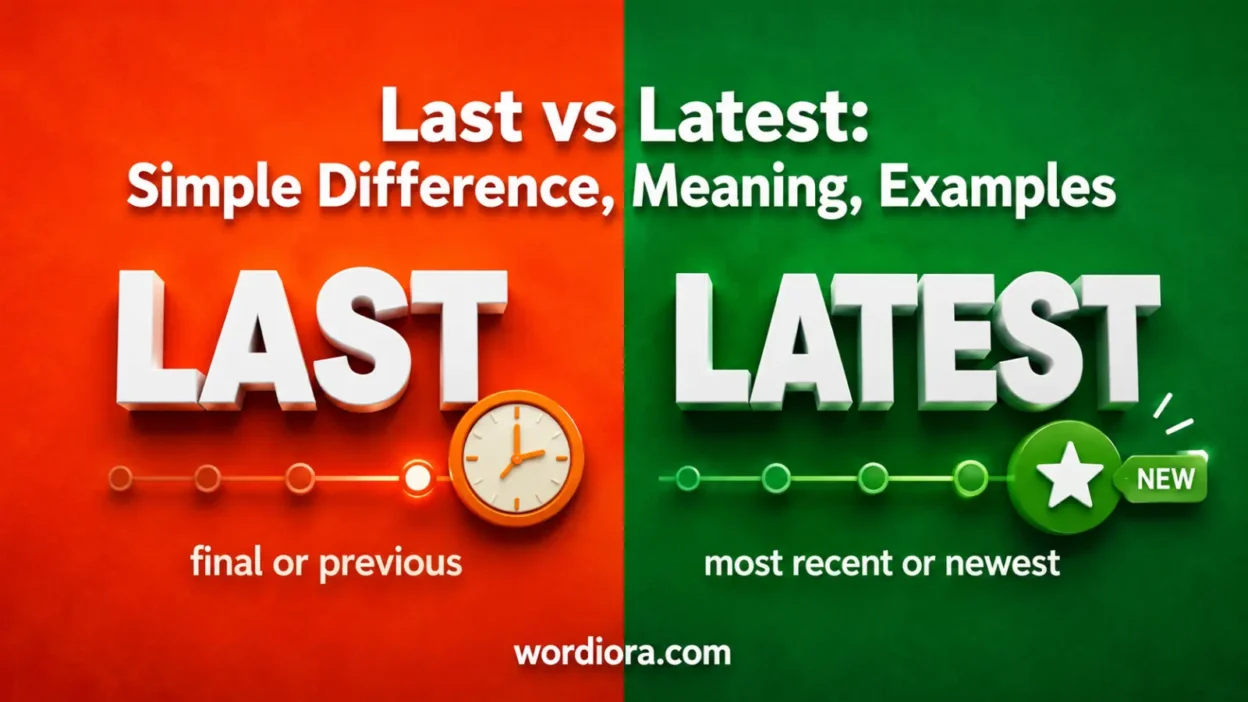
Last vs latest can be confusing because both words can point to something recent. The key difference is this: last often means final, previous, or most recent in time, while latest means newest, most current, or most up-to-date.
Use last when you mean the final item in a series, the one before now, or a recent time period. Use latest when you mean the newest version, newest information, newest style, or most current development.
That is why last week sounds natural, but latest week usually does not. It is also why latest news sounds correct, while last news usually sounds wrong in standard American English.
Quick Answer
Use last for something final, previous, or most recent in time: last night, last month, the last chapter, my last appointment. Use latest for the newest or most current thing: the latest news, the latest update, her latest album, the latest version.
A simple guide: last looks back or marks an end. Latest points to what is newest right now.
Why People Confuse Them
People confuse last and latest because last can mean more than one thing. It can mean final, as in the last page. It can mean previous, as in last Friday. It can also mean most recent, as in the last time I checked.
That overlap makes it tempting to use last anytime you mean “recent.” Sometimes that works. Sometimes it does not.
The problem appears when the sentence is about newness, current status, or updates. In those cases, latest is usually clearer. For example, the latest report means the newest report available now. The last report may mean the final report, the previous report, or the most recent report, depending on context.
Key Differences At A Glance
| Context | Best Choice | Why |
|---|---|---|
| A past time period | last | Say last week, last night, last year. |
| The final item in a series | last | Last can mean no item comes after it. |
| The newest version | latest | Latest means most current or up-to-date. |
| News or updates | latest | Latest news means the newest information. |
| A deadline phrase | latest | Use at the latest, not just latest alone. |
| The previous time something happened | last | Say the last time we met. |
| Fashion, trends, technology | latest | These contexts focus on what is newest now. |
Compact comparison:
- Last: final, previous, most recent in time, only remaining.
- Latest: newest, most current, most modern, most up-to-date.
- Last can sound final.
- Latest usually suggests more may come later.
Meaning and Usage Difference
Last has several common uses. It can mean the final one: the last episode of the season. It can mean the one before now: last Thursday. It can also mean the only one left: the last slice of pizza.
Latest is narrower. It usually means the newest or most current. You might say the latest phone model, the latest weather update, or the latest research summary. These examples point to the newest available item or information.
The difference matters most when both words seem possible. His last book may mean the final book he ever wrote or the most recent book he wrote. His latest book clearly means his newest book so far.
Tone, Context, and Formality
Both words are standard in American English. Neither one is slang. The difference is not about formal versus informal language. It is about meaning and context.
Last sounds natural in everyday time expressions: last night, last summer, last semester, last weekend. It also works in serious or final contexts: last chance, last warning, last will, last request.
Latest sounds natural when the focus is current information, new releases, or fresh developments. Use it with words like news, update, version, trend, fashion, model, report, release, and details.
Pronunciation does not usually cause confusion. In American English, last sounds like “last,” and latest sounds like “LAY-tist.”
Which One Should You Use?
Choose last when you mean a time before now.
Correct:
I saw her last week.
Not natural:
I saw her latest week.
Choose last when you mean final.
Correct:
This is the last question on the test.
Not natural:
This is the latest question on the test.
Choose latest when you mean newest or most current.
Correct:
Have you read the latest update?
Less clear:
Have you read the last update?
Choose latest for news, trends, and releases.
Correct:
The latest news changed the plan.
Not natural:
The last news changed the plan.
When One Choice Sounds Wrong
Latest week usually sounds wrong because weeks are time periods, not new products or updates. Say last week.
Last fashion usually sounds wrong when you mean the newest style. Say latest fashion.
Latest chance usually sounds wrong when you mean final opportunity. Say last chance.
Latest night usually sounds wrong when you mean the previous night. Say last night.
Last version can be correct, but it may sound unclear. If you mean the newest version available now, use latest version. If you mean the final version ever made, use last version or final version, depending on the sentence.
Common Mistakes
Mistake: I watched the latest episode last night.
This sentence is correct. Latest episode means the newest episode. Last night means the previous night.
Mistake: I watched the last episode last night.
This can be correct, but it may mean the final episode, not the newest one. Use latest episode if you mean the newest released episode.
Mistake: Send me the report latest by Friday.
Fix: Send me the report by Friday at the latest.
Mistake: What is the last news?
Fix: What is the latest news?
Mistake: I met him latest Monday.
Fix: I met him last Monday.
Everyday Examples
Last examples:
- I missed the bus last night.
- She was the last person to leave the office.
- We used the last clean towel.
- The last meeting ran over by twenty minutes.
- I saw him last summer.
- This is your last reminder before the deadline.
- The last chapter explains the ending.
- I liked her last presentation.
Latest examples:
- Did you install the latest version?
- The latest update fixed the issue.
- I have not heard the latest news yet.
- His latest song came out this morning.
- The latest report includes new numbers.
- She follows the latest fashion trends.
- What is the latest on the flight delay?
- This laptop has the latest features.
Dictionary-Style Word Details
Verb
Last: Commonly used as a verb. It means to continue, remain, or stay usable for a period of time.
Example: The battery should last all day.
Latest: Not commonly used as a verb in standard American English. It is mainly an adjective or noun.
Noun
Last: Can work as a noun in phrases such as the last, meaning the final person or thing, the final part, or the most recent one.
Example: That was the last of the coffee.
Latest: Can work as a noun in the latest, meaning the newest news, newest information, or newest version.
Example: Have you heard the latest?
Synonyms
Last: Closest plain alternatives include final, previous, most recent, remaining, and closing, depending on context.
Clear opposites include first, next, and sometimes earliest.
Latest: Closest plain alternatives include newest, most recent, current, up-to-date, and most modern.
Clear opposites include earliest, oldest, and sometimes outdated.
Example Sentences
Last:
- I called her last Friday.
- He took the last seat on the train.
- This is the last step in the process.
- The last time we talked, you were moving to Dallas.
Latest:
- The latest forecast says rain is possible.
- Her latest book is already popular.
- Please download the latest version.
- The team shared the latest numbers this morning.
Word History
Last: The word has long been used for what comes after all others, what remains, or what happened most recently. It also developed common time uses such as last week and last year.
Latest: The word comes from the idea of being most late in time, but in modern use it usually means newest, most recent, or most up-to-date. Avoid claiming exact first-use dates unless checking a specialist historical dictionary.
Phrases Containing
Last:
- last night
- last week
- last year
- last time
- last chance
- last minute
- last call
- last but not least
- at last
- the last straw
Latest:
- latest news
- latest update
- latest version
- latest report
- latest trend
- latest fashion
- latest release
- the latest
- at the latest
- latest model
FAQs
Is “last vs latest” about grammar or meaning?
It is mostly about meaning and context. Both words are correct, but they fit different situations.
Can last mean latest?
Sometimes, yes. Last can mean most recent, as in last week or the last time I checked. Still, latest is clearer when you mean newest or most current.
Is “latest news” correct?
Yes. Latest news is the natural phrase because news focuses on the newest information available now.
Is “last news” correct?
Usually no. In standard American English, last news sounds unnatural when you mean current information. Use latest news.
Should I say “last update” or “latest update”?
Use latest update when you mean the newest update. Use last update only when context makes it clear that you mean the previous update or the final update.
What does “at the latest” mean?
At the latest means “no later than.” Example: Please arrive by 9 a.m. at the latest.
Can I say “latest week”?
Usually no. Say last week when you mean the week before this one.
Which phrase is better: “his last book” or “his latest book”?
Use his latest book for his newest book so far. Use his last book if you mean his final book or if context clearly means his most recent book.
Conclusion
The difference between last and latest is simple once you look at context. Use last for final things, previous time periods, the only remaining item, or the most recent event in a time-based expression.
Use latest for what is newest, current, modern, or up-to-date. That is why last night, last chance, and the last page sound right, while latest news, latest version, and latest update sound right.
When you are unsure, ask one question: do I mean “final or previous,” or do I mean “newest right now”? If you mean final or previous, choose last. If you mean newest or most current, choose latest.