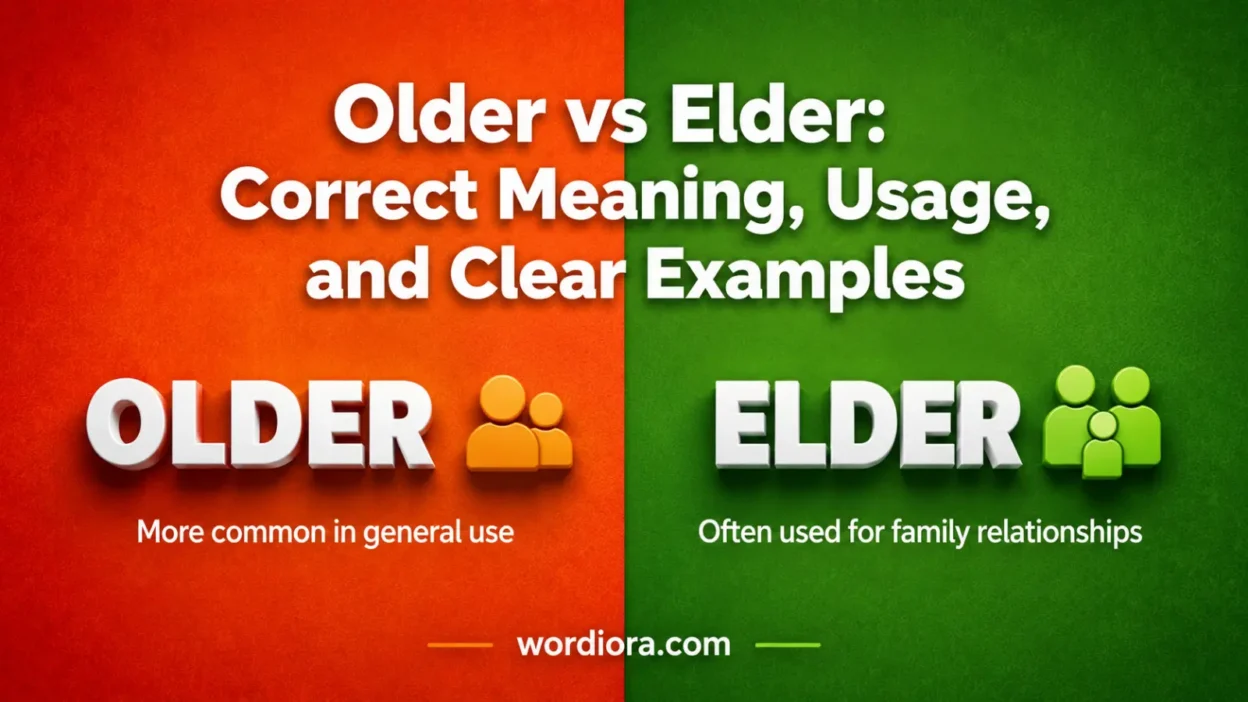
Older and elder both compare age, but they do not work in every sentence the same way. In everyday US English, older is the safer and more common choice. You can use it for people, animals, objects, places, ideas, and almost any normal age comparison.
Elder is narrower. It often sounds more formal, traditional, or family-based. It can describe a family member, as in “my elder sister,” and it can also be a noun, as in “respect your elders.” The key is not just meaning. Sentence position and context matter too.
Quick Answer
Use older for most age comparisons: “My brother is older than me,” “This house is older,” or “We need older data.” Use elder mainly before a family noun or as a noun for a respected older person: “my elder brother” or “community elders.” Do not say “elder than.”
Why People Confuse Them
People confuse these words because both connect to age. In some family sentences, they can even point to the same person. “My older sister” and “my elder sister” can both mean the sister who is higher in age.
The trouble starts when the sentence changes. Older works after verbs and with than. You can say, “She is older,” and “She is older than her cousin.” Elder usually does not work that way in modern standard usage. “She is elder” sounds incomplete or stiff, and “elder than” is not the normal choice.
Another reason for confusion is that elder has a noun use. An elder is not just someone who is older in a comparison. It can mean a respected older person or a leader in a group.
Key Differences At A Glance
Use this compact comparison as a fast memory guide:
- Older: general, neutral, common, works for people and things, works with “than.”
- Elder: narrower, more formal or traditional, mostly for people, often family-based as an adjective, also works as a noun.
- Best everyday choice: older.
- Best formal/family choice: elder, when it appears before the noun.
- Common error to avoid: elder than.
Meaning and Usage Difference
Older means greater in age or earlier in time. It is the regular comparative form of old. You can use it for a person, animal, building, product, file, tradition, or idea.
Examples:
“My older brother lives in Denver.”
“This laptop is older than my phone.”
“She looked older after years of stress.”
Elder also means greater in age when used as an adjective, but its use is more limited. It usually appears before a noun, especially in family relationships.
Examples:
“My elder sister helped me move.”
“The elder son spoke first.”
As a noun, elder means an older person, often one respected for age, experience, or position.
Example:
“The village elders met to discuss the issue.”
Tone, Context, and Formality
Older sounds natural in everyday American speech and writing. It is clear, flexible, and rarely feels too formal. A teacher, journalist, student, doctor, or parent can use it without sounding unusual.
Elder has a more formal or traditional feel. In US English, it is common in set phrases like “elder brother,” “elder sister,” “respect your elders,” “church elder,” and “community elder.” It may sound too stiff in casual sentences if a plain age comparison is all you need.
For example, “my older sister” sounds normal in everyday conversation. “My elder sister” is correct, but it may sound more formal, old-fashioned, or family-order focused.
Which One Should You Use?
| Context | Best Choice | Why |
|---|---|---|
| Comparing two people with “than” | older | It works naturally with “than.” |
| Talking about a building, object, file, or place | older | Elder is not the normal choice for things. |
| Casual US conversation | older | It sounds plain and natural. |
| Family order before a noun | older or elder | Both can work, but older is more common and neutral. |
| Formal family wording | elder | It can sound more traditional before brother, sister, son, or daughter. |
| A respected older person or leader | elder | Elder works as a noun in this meaning. |
| General age group language | older | “Older adults” sounds more neutral than “elders” in many modern contexts. |
When One Choice Sounds Wrong
Elder sounds wrong when you use it where older is required.
Wrong: “She is elder than me.”
Correct: “She is older than me.”
Wrong: “This car is elder than mine.”
Correct: “This car is older than mine.”
Wrong: “My dog is elder now.”
Correct: “My dog is older now.”
Wrong: “That is an elder building.”
Correct: “That is an older building.”
The safest rule is simple: when you use than, choose older. When the sentence is about a thing, choose older. Save elder for family wording before a noun or for the noun meaning “respected older person.”
Common Mistakes and Quick Fixes
A common mistake is using elder after a linking verb.
Weak: “My sister is elder.”
Better: “My sister is older.”
Also possible: “She is my elder sister.”
Another mistake is using elder for objects.
Weak: “This phone is elder.”
Better: “This phone is older.”
Writers also sometimes use elders when they simply mean older adults. Elders can be respectful in some cultural, family, religious, or community settings. Still, it may not fit every general sentence.
Weak: “The store offers discounts for elders.”
Better: “The store offers discounts for older adults.”
Use elder when respect, role, or family order is part of the meaning. Use older when age alone is the point.
Everyday Examples
“My older brother is visiting this weekend.”
“My elder brother is visiting this weekend.”
Both can be correct, but the first sounds more casual.
“She is older than her roommate.”
This is correct because older works with than.
“She is elder than her roommate.”
This is not the normal standard form.
“We moved into an older apartment near campus.”
Use older because the sentence describes a place.
“The elder members of the family sat together.”
This can work when the tone is formal or respectful.
“The committee asked the elders for advice.”
Here elders means respected older people, not just people who are a few years older.
Dictionary-Style Word Details
Verb
- Older: Not used as a verb in standard US English. Use verbs such as “age,” “grow older,” or “get older” instead.
- Elder: Not commonly used as a verb in standard US English. Use “age,” “advise,” “lead,” or another precise verb depending on the sentence.
Noun
- Older: Not normally a standalone count noun. It can appear in noun-like phrases such as “the older of the two,” where the noun is understood from context.
- Elder: A standard noun. It can mean an older person, a respected older member of a family or community, or an official in some religious groups.
Synonyms
- Older: Closest plain alternatives include “more advanced in age,” “earlier,” “longer-standing,” and “more senior in age,” depending on context. Clear antonyms include “younger” and, for things, “newer.”
- Elder: Closest plain alternatives include “older,” “senior,” “respected older person,” or “community leader,” depending on context. Clear opposites are not always exact, but “younger” or “junior” may fit in family or rank-based contexts.
Example Sentences
- Older: “My older cousin taught me how to drive.”
- Older: “This version is older, but it still works.”
- Older: “He is older than most students in the class.”
- Elder: “Her elder sister gave the toast at the wedding.”
- Elder: “The elders shared stories about the town’s early years.”
- Elder: “The elder of the two brothers took over the family business.”
Word History
- Older: This is the regular comparative form of old in modern English.
- Elder: This is an older comparative form related to old. In modern use, it has become more limited than older, especially as an adjective. It remains common in family terms, respectful references, and certain role-based nouns.
Phrases Containing
- Older: older than, older brother, older sister, older adults, older home, older model, the older of the two.
- Elder: elder brother, elder sister, elder son, elder daughter, community elder, church elder, respect your elders, the elder of the two.
FAQs
Is it older or elder?
Use older for most everyday age comparisons. It works for people, animals, objects, places, and ideas. Use elder mainly for family relationships, respectful references to older people, or formal roles, such as “elder sister,” “community elder,” or “church elder.”
What is the difference between older and elder?
Older is the general comparative form of “old.” It means greater in age or earlier in time. Elder also refers to greater age, but it is more limited. It usually sounds more formal, traditional, or respectful, especially in family or community contexts.
Is “older brother” or “elder brother” correct?
Both can be correct. Older brother is more common and natural in everyday US English. Elder brother is also correct, but it sounds more formal or traditional. For casual writing or conversation, “older brother” is usually the safer choice.
Can I say “elder than”?
No. In standard modern English, use older than, not elder than.
Correct: “She is older than me.”
Incorrect: “She is elder than me.”
Can elder be used for things?
Usually, no. Use older for objects, buildings, places, files, products, and ideas. For example, say “an older car,” “an older house,” or “an older version.” “An elder car” sounds wrong because elder is mainly used for people.
Is elder more respectful than older?
Sometimes. Elder can sound respectful when used as a noun, such as “respect your elders” or “community elders.” But older is not rude. In many modern contexts, “older adults” sounds more natural and neutral than “elders.”
Is elder formal or informal?
Elder is usually more formal, traditional, or role-based than older. It often appears in family order, religious roles, community leadership, or respectful references. Older is more common in everyday speech and writing.
Can elder be used as a noun?
Yes. Elder can be a noun. It can mean an older person, a respected senior member of a group, or a person with a leadership role in some religious communities. Example: “The elders gave advice to the younger members.”
Which is better: older adults or elders?
In general US English, older adults is often the better neutral choice. Elders can work when the context is cultural, family-based, religious, or respectful. For example, “community elders” sounds natural, but “discounts for elders” may sound less natural than “discounts for older adults.”
What is the easiest rule for older vs elder?
Use older almost everywhere, especially with than and for things. Use elder mainly before family nouns or as a noun for respected older people. A simple rule is: say older than, not elder than.
Conclusion
The best everyday choice is older. It is clear, modern, and flexible. Use it for people, things, and direct comparisons with than.
Use elder when the sentence has a family, formal, respectful, or role-based meaning. It works well in phrases like “elder sister,” “the elder son,” “community elders,” and “respect your elders.” The main mistake to avoid is simple: do not use elder than. Say older than instead.