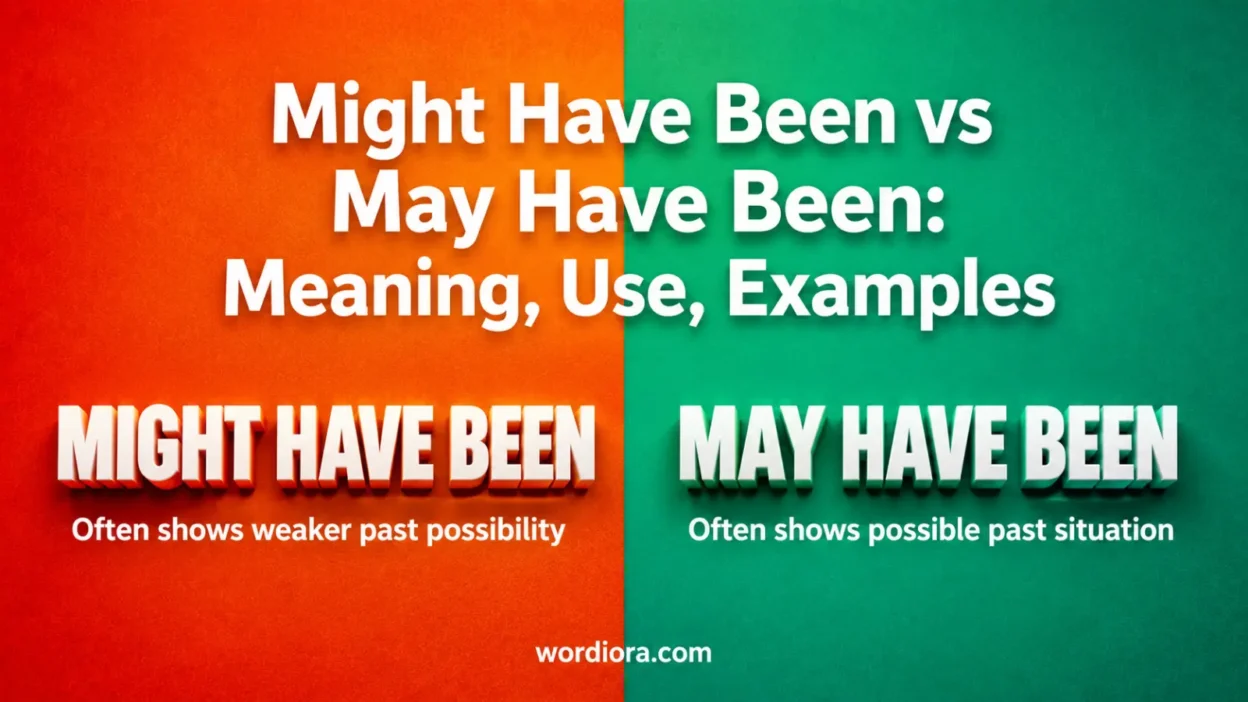
“Might have been” and “may have been” are both correct phrases in English. You can use either one when you are talking about something that was possible in the past but not certain.
The difference is mostly about tone and situation. “May have been” often sounds more formal or careful. “Might have been” sounds more natural in everyday speech and is usually better when you are talking about something that could have happened but did not.
For a simple past guess, both phrases can work. For an unreal past result, “might have been” is usually the stronger and clearer choice.
Quick Answer
Use “may have been” or “might have been” when you are unsure about something in the past.
Examples:
- The package may have been delivered to the wrong address.
- The package might have been delivered to the wrong address.
Both examples mean the same basic thing: the speaker does not know for sure where the package was delivered.
Choose “might have been” when the sentence talks about a different past result that did not happen.
Example:
- If we had left earlier, we might have been on time.
This sentence means we did not leave earlier, and we were not on time. The phrase “might have been” shows an unreal past possibility.
Why People Confuse Them
These phrases are easy to confuse because they share the same structure:
modal verb + have been
The modal verb is either “may” or “might.” The phrase “have been” points to the past. Together, the phrase shows possibility about a past state, action, or situation.
Examples:
- He may have been tired.
- He might have been tired.
- She may have been at work.
- She might have been at work.
- They may have been waiting outside.
- They might have been waiting outside.
In many sentences, the meaning is almost the same. That is why people often use both phrases without thinking much about the difference.
The useful distinction is this: “may have been” is often used for a real past possibility, while “might have been” also works for a real possibility and is usually better for an unreal or imagined past result.
Key Differences At A Glance
| Feature | May Have Been | Might Have Been |
|---|---|---|
| Basic meaning | Possibly was or possibly happened | Possibly was, possibly happened, or could have happened |
| Tone | More formal or careful | More natural or conversational |
| Best use | Careful guesses about the past | Casual guesses or unreal past results |
| Works for real past possibility | Yes | Yes |
| Works for unreal past possibility | Sometimes, but less natural | Yes, usually best |
| Example | The report may have been delayed. | The report might have been delayed. |
| Unreal example | Less natural in many cases | If we had acted sooner, the result might have been better. |
The easiest way to remember the difference is simple: use either phrase for a normal past guess, but use “might have been” for something that could have happened but did not.
Meaning and Usage Difference
“May have been” means something was possibly true in the past.
Example:
- The caller may have been from the school office.
The speaker is not sure who called. The caller possibly worked at or represented the school office.
“Might have been” can carry the same meaning.
Example:
- The caller might have been from the school office.
This sentence also shows uncertainty about the past. In everyday speech, many people would understand both examples the same way.
The difference becomes clearer when the sentence talks about an unreal result.
Example:
- Without the seat belt, the injury might have been worse.
This means the injury was not worse, but it could have been worse under different conditions.
In this type of sentence, “might have been” is usually the better choice because it points to a possible result that did not actually happen.
Tone, Context, and Formality
“May have been” often sounds more formal, especially in business, school, legal, technical, or official writing.
Examples:
- The delay may have been caused by a system issue.
- The payment may have been processed twice.
- The form may have been submitted after the deadline.
This wording sounds careful and neutral. It works well when you do not want to sound too casual.
“Might have been” feels more natural in everyday conversation.
Examples:
- I might have been too tired to notice.
- She might have been joking.
- The dog might have been scared by the thunder.
This phrase sounds normal in speech, messages, stories, and casual writing.
“Might have been” also works better when the sentence carries regret, imagination, or a missed chance.
Example:
- With more time, the project might have been stronger.
That sentence suggests the project was not as strong as it could have been.
Which One Should You Use?
| Context | Best Choice | Why |
| Normal guess about the past | Either | Both can mean “possibly was” |
| Formal report or notice | May have been | It sounds more careful |
| Casual conversation | Might have been | It sounds more natural |
| Unreal past result | Might have been | It shows something could have happened but did not |
| Missed chance or regret | Might have been | It fits imagined past outcomes |
| Past continuous action | Either | Both can work before an -ing verb |
A good rule is this: use “may have been” when you want a polished or formal tone. Use “might have been” when you are speaking naturally or describing an unreal past possibility.
When One Choice Sounds Wrong
“May have been” can sound awkward when the sentence clearly describes something that did not happen.
Less natural:
- If I had studied harder, I may have been accepted.
Better:
- If I had studied harder, I might have been accepted.
The second sentence is clearer because the speaker was not accepted. “Might have been” fits the unreal past result.
Here is another example:
Less natural:
- If we had booked earlier, the tickets may have been cheaper.
Better:
- If we had booked earlier, the tickets might have been cheaper.
The better version shows that the cheaper tickets were only a possible result in a different past situation.
“Might have been” usually works well in both casual guesses and unreal past sentences. In formal writing, though, “may have been” can sometimes sound more polished.
Casual:
- The issue might have been caused by a login error.
More formal:
- The issue may have been caused by a login error.
Both are correct. The better choice depends on the tone you want.
Common Mistakes And Quick Fixes
Mistake 1: Using “may have been” for every past possibility
Weak:
- If she had left sooner, she may have been safe.
Better:
- If she had left sooner, she might have been safe.
Why: The sentence is about an unreal past result, so “might have been” is more natural.
Mistake 2: Writing “might of been”
Incorrect:
- He might of been late.
Correct:
- He might have been late.
In speech, “might have” can sound like “might of,” but “might of been” is not correct in standard writing.
Mistake 3: Writing “may of been”
Incorrect:
- She may of been confused.
Correct:
- She may have been confused.
Always use “have,” not “of,” after “may” or “might.”
Mistake 4: Using “have been” when you mean the present
Weak:
- My keys may have been on the counter.
Better if the keys may still be there:
- My keys may be on the counter.
Use “may have been” or “might have been” for the past. Use “may be” or “might be” for the present.
Mistake 5: Treating one phrase as always more certain
Some people think “may have been” always means a stronger possibility than “might have been.” That is not a reliable rule.
Better approach:
- Use tone and context to choose.
- Pick “may have been” for formal uncertainty.
- Pick “might have been” for casual uncertainty or unreal past results.
Everyday Examples
Use “may have been” when the wording sounds careful, formal, or official:
- The payment may have been processed twice.
- A spam filter may have caught the email.
- The meeting may have been moved to another room.
- One witness may have been mistaken.
- The file may have been deleted by accident.
Use “might have been” when the sentence sounds natural or conversational:
- I might have been too tired to notice.
- Jake might have been the person at the door.
- She might have been upset about the comment.
- We might have been looking at the wrong schedule.
- That noise might have been coming from upstairs.
Choose “might have been” for unreal past results:
- The tickets might have been cheaper if we had booked earlier.
- With more practice, the speech might have been stronger.
- Without that warning, the damage might have been worse.
- Things might have been different if I had answered the call.
Dictionary-Style Word Details
Verb
Might have been: This is a verb phrase. It uses the modal “might” with “have been” to show past possibility or an unreal past result.
Examples:
- The answer might have been correct.
- If I had checked twice, the answer might have been correct.
May have been: This is also a verb phrase. It uses the modal “may” with “have been” to show that something was possibly true in the past.
Examples:
- The answer may have been correct.
- The delay may have been caused by traffic.
Neither phrase is a single verb by itself. Each one works as a full verb phrase that adds possibility to the past.
Noun
Might have been: The full phrase is not normally used as a noun. A related form, “might-have-been,” can be used as a noun to mean a missed possibility.
Example:
- The old photo reminded him of all his might-have-beens.
May have been: This phrase is not commonly used as a noun in standard American English.
For normal writing, treat both “might have been” and “may have been” as verb phrases.
Synonyms
These phrases do not have perfect one-word synonyms because they express both grammar and meaning. Still, a few close alternatives can help.
Closest plain alternatives for “may have been”:
- possibly was
- perhaps was
- could have been
- may have happened as
Closest plain alternatives for “might have been”:
- possibly was
- perhaps was
- could have been
- could have turned out to be
For unreal past meanings, “could have been” is often the closest alternative to “might have been.”
Example:
- It might have been worse.
- It could have been worse.
Clear antonyms are hard to give because these phrases show possibility, not a simple opposite idea. Depending on the sentence, phrases like “was not,” “could not have been,” or “definitely was” may work, but they are not exact opposites in every context.
Example Sentences
- The message may have been sent before the update was saved.
- The message might have been sent before the update was saved.
- The noise may have been the heater turning on.
- That sound might have been the heater turning on.
- She may have been nervous during the interview.
- During the interview, she might have been nervous.
- If the road had been icy, the crash might have been worse.
- With a better ending, the movie might have been great.
Word History
“May” and “might” are modal verbs with a long history in English. “Might” developed as the past form of “may,” but modern English does not always keep them separated by a simple present-and-past rule.
That is why both “may have been” and “might have been” can refer to the past. The “have been” part already gives the phrase a past meaning. The words “may” and “might” add uncertainty or possibility.
The most useful modern rule is not about age or history. It is about meaning: both phrases can show past possibility, but “might have been” is usually clearer for unreal or missed possibilities.
Phrases Containing
May have been: Used for careful past guesses.
Example:
- The charge may have been added by mistake.
Might have been: Used for guesses, regrets, missed chances, and unreal past results.
Examples:
- That might have been the best option.
- It might have been worse.
- Things might have been different.
May have been waiting: Used for a possible past continuous action.
Example:
- She may have been waiting outside.
Might have been waiting: Also used for a possible past continuous action.
Example:
- She might have been waiting outside.
Both phrases can be followed by an adjective, a noun phrase, a place phrase, or an -ing verb.
FAQs
Is “might have been” correct?
Yes. “Might have been” is correct when you are talking about something that was possible in the past.
Example:
- She might have been tired after the long drive.
It is also the better choice when you mean something could have happened but did not.
Example:
- If we had left earlier, we might have been on time.
Is “may have been” correct?
Yes. “May have been” is correct. It means something was possibly true in the past.
Example:
- The email may have been sent to the wrong address.
This phrase often sounds a little more formal than “might have been.”
What is the difference between “might have been” and “may have been”?
Both phrases can mean “possibly was” or “possibly happened” in the past. The main difference is that “might have been” is better for unreal or imagined past results.
Example:
- The delay may have been caused by traffic.
- If we had taken a different road, the delay might have been avoided.
The first sentence is a guess. The second sentence describes a result that did not happen.
Can I use “may have been” and “might have been” interchangeably?
In many past-possibility sentences, yes.
Examples:
- The noise may have been the heater.
- The noise might have been the heater.
Both sentences are correct. However, when the meaning is “could have happened but did not,” “might have been” is usually better.
Which phrase is more formal?
“May have been” usually sounds more formal.
Example:
- The payment may have been processed twice.
“Might have been” sounds more conversational.
Example:
- I might have been too tired to notice.
Should I write “might have been” or “might of been”?
Write “might have been.”
Correct:
- He might have been late.
Incorrect:
- He might of been late.
The same rule applies to “may have been.” Do not write “may of been.”
When should I use “might have been”?
Use “might have been” for a past guess, a missed chance, or an unreal past result.
Examples:
- She might have been busy.
- The test might have been easier with more study time.
- If I had practiced more, the presentation might have been better.
When should I use “may have been”?
Use “may have been” when you want a careful or formal way to describe a possible past event.
Examples:
- The account may have been closed by mistake.
- The document may have been updated yesterday.
- The notice may have been sent to the wrong address.
Is “might have been” less certain than “may have been”?
Not always. Some people hear “might have been” as slightly less certain, but that is not a strict rule in modern American English.
Examples:
- He may have been confused.
- He might have been confused.
Both sentences mean the speaker is unsure.
What is the easiest rule to remember?
Use either phrase for a normal guess about the past. Use “might have been” when the sentence talks about something that could have happened but did not.
Examples:
- Normal guess: The call may have been from work.
- Unreal past: If I had answered, the result might have been different.
Conclusion
“Might have been” and “may have been” are both correct. When you are making a simple guess about the past, either phrase can work.
For a more formal tone, “may have been” is often the better choice. For everyday speech, “might have been” usually sounds natural. When the sentence is about an unreal past result, a missed chance, or something that could have happened but did not, “might have been” is usually the clearest option.
The simple rule is this: use either phrase for ordinary past possibility, but choose “might have been” for unreal past possibility.