
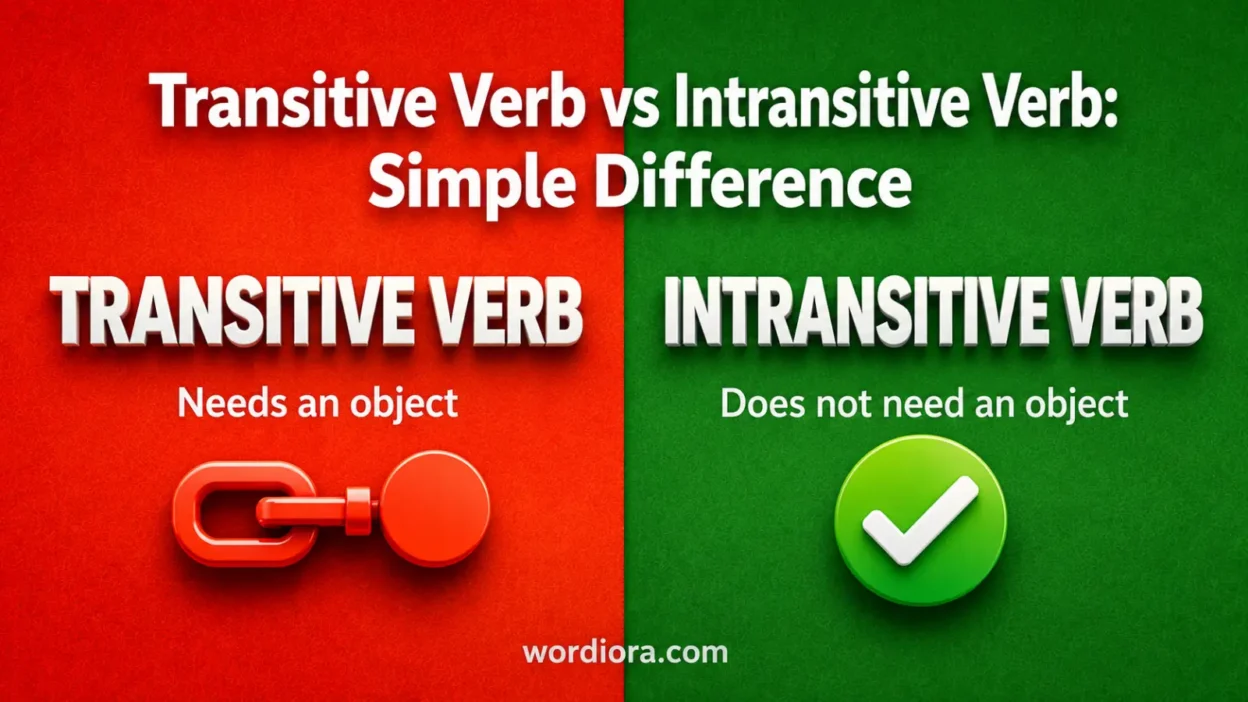
Transitive verb vs intransitive verb is not about which term is “better.” Both are correct grammar terms. The right choice depends on how a verb works in a sentence.
A transitive verb takes a direct object. An intransitive verb does not take a direct object.
That is the main difference. The tricky part is that many verbs can be both, depending on the sentence.
Quick Answer
Use transitive verb when the verb’s action goes directly to someone or something.
Example:
Nina mailed the package.
Mailed what? The package. That makes mailed transitive.
Use intransitive verb when the verb does not act on a direct object.
Example:
Nina laughed loudly.
Laughed what? There is no direct object. That makes laughed intransitive.
Why People Confuse Them
People confuse these terms because they sound technical. They also both describe verbs, so the difference can feel small at first.
Another reason is that the same verb can change roles.
Example:
We ate dinner.
Ate what? Dinner. Transitive.
We ate at 7.
Ate what? No direct object. Intransitive.
So the question is not always “What kind of verb is this word forever?” The better question is “How is this verb being used in this sentence?”
Key Differences At A Glance
| Context | Best Choice | Why |
|---|---|---|
| The verb has a direct object | Transitive verb | The action goes to someone or something |
| The verb has no direct object | Intransitive verb | The action is complete without a direct object |
| You can ask “what?” or “whom?” after the verb and get an answer | Transitive verb | That answer is usually the direct object |
| The words after the verb tell where, when, how, or how long | Intransitive verb | Those words are not direct objects |
| The same verb appears with an object in one sentence but not another | Depends on the sentence | Many verbs can work both ways |
Meaning and Usage Difference
A transitive verb needs a direct object to complete the action.
Example:
The manager approved the request.
Approved what? The request.
An intransitive verb does not need a direct object.
Example:
The meeting ended.
Ended what? Nothing. The sentence is complete.
A phrase after an intransitive verb may still add information.
Example:
The meeting ended at noon.
“At noon” tells when the meeting ended. It is not a direct object.
Compact comparison:
• Transitive verb: subject + verb + direct object
• Intransitive verb: subject + verb, often with words that tell where, when, how, or why
• Key test: Ask “what?” or “whom?” right after the verb
• Main warning: A prepositional phrase after a verb is not the same as a direct object
Tone, Context, and Formality
There is no strong tone difference between transitive verb and intransitive verb. Both are standard grammar terms.
You will see them in school lessons, writing handbooks, grammar notes, and dictionaries. They sound more formal than everyday wording, but they are not old-fashioned or rare.
In casual speech, people usually do not say, “That is an intransitive verb.” They may say, “That verb does not need an object.” In a grammar article, class, or editing note, both terms are normal.
Pronunciation is not usually the main problem. Still, readers may find these plain guides useful:
transitive verb: TRAN-si-tiv verb
intransitive verb: in-TRAN-si-tiv verb
Which One Should You Use?
Use transitive verb when you are naming a verb use that takes a direct object.
Correct:
“Bought” is a transitive verb in “She bought a laptop.”
Use intransitive verb when you are naming a verb use that does not take a direct object.
Correct:
“Arrived” is an intransitive verb in “The train arrived.”
If you are not sure, find the verb and ask:
What?
Whom?
If the answer appears right after the verb as the thing or person receiving the action, you probably have a transitive verb.
When One Choice Sounds Wrong
One choice sounds wrong when you label the sentence without checking the direct object.
Wrong:
“Slept” is transitive in “The baby slept.”
Better:
“Slept” is intransitive in “The baby slept.”
“Slept” does not act on a direct object.
Wrong:
“Fixed” is intransitive in “Marcus fixed the sink.”
Better:
“Fixed” is transitive in “Marcus fixed the sink.”
Fixed what? The sink.
Some verb pairs also cause trouble:
Raise usually takes an object:
They raised the price.
Rise does not take a direct object:
The price rose.
Common Mistakes (and Quick Fixes)
Mistake 1: Treating every word after the verb as an object.
Wrong idea:
In “She waited at the curb,” “at the curb” is the object.
Quick fix:
“At the curb” tells where she waited. Waited is intransitive here.
Mistake 2: Forgetting that one verb can work both ways.
Example:
He runs every morning.
Intransitive.
He runs a small store.
Transitive.
Mistake 3: Using an intransitive verb with a direct object when standard English expects a different verb.
Awkward:
The company rose prices.
Better:
The company raised prices.
Better in another structure:
Prices rose.
Everyday Examples
Transitive verb examples:
Ava opened the email.
Opened what? The email.
The team finished the report.
Finished what? The report.
Mom packed the lunches.
Packed what? The lunches.
Intransitive verb examples:
Ava smiled.
Smiled what? No direct object.
The team worked late.
Worked what? No direct object.
The kids slept upstairs.
Slept what? No direct object.
Now compare a verb used both ways:
Jordan read the article.
Read what? The article. Transitive.
Jordan read for an hour.
Read what? No direct object. Intransitive.
Dictionary-Style Word Details
Verb
• transitive verb: This phrase names a verb type. A verb is transitive when it takes a direct object, as in “She carried the groceries.”
• intransitive verb: This phrase names a verb type. A verb is intransitive when it does not take a direct object, as in “She sneezed.”
Noun
• transitive verb: A noun phrase used for a grammar category. Example: A transitive verb needs a direct object.
• intransitive verb: A noun phrase used for a grammar category. Example: An intransitive verb does not take a direct object.
Synonyms
• transitive verb: Closest plain alternatives include object-taking verb and verb used with a direct object.
• intransitive verb: Closest plain alternatives include verb without a direct object and verb used without a direct object.
In this grammar sense, the two terms are direct counterparts. A transitive use has a direct object; an intransitive use does not.
Example Sentences
• transitive verb: In “Leah cleaned the kitchen,” cleaned is a transitive verb because the kitchen receives the action.
• intransitive verb: In “Leah laughed,” laughed is an intransitive verb because it has no direct object.
• transitive verb: “The driver stopped the car.”
• intransitive verb: “The car stopped.”
Word History
• transitive verb: The word transitive is tied to the idea of action passing across to an object. That meaning fits the grammar use: the action reaches a direct object.
• intransitive verb: Intransitive adds the idea of “not” to the same base idea. In grammar, it means the verb’s action does not pass to a direct object.
These history notes help explain the terms, but they are not the best way to identify them in a sentence. The direct-object test is more useful.
Phrases Containing
• transitive verb: transitive use, transitive construction, transitive phrasal verb, transitive meaning.
• intransitive verb: intransitive use, intransitive construction, intransitive phrasal verb, intransitive meaning.
These phrases usually appear when a lesson or entry is explaining how a verb behaves in a specific sentence.
Linking verbs describe the subject, while action verbs show what the subject does. Learn the difference clearly in this guide on action verb vs linking verb
FAQs
What is the difference between a transitive verb and an intransitive verb?
A transitive verb takes a direct object. An intransitive verb does not take a direct object.
Example:
She carried the bag.
“Carried” is transitive because the bag receives the action.
She smiled.
“Smiled” is intransitive because there is no direct object.
How do I know if a verb is transitive?
Find the verb and ask what? or whom? after it.
Example:
Mark fixed the bike.
Fixed what? The bike.
So, fixed is a transitive verb in this sentence.
How do I know if a verb is intransitive?
A verb is intransitive when it does not have a direct object.
Example:
The baby slept.
Slept what? There is no answer. So, slept is intransitive.
Can the same verb be both transitive and intransitive?
Yes. Many verbs can be transitive in one sentence and intransitive in another.
Example:
She reads novels.
Transitive, because novels is the direct object.
She reads every night.
Intransitive, because there is no direct object.
Is a prepositional phrase the same as a direct object?
No. A prepositional phrase may give extra information, but it is not a direct object.
Example:
He waited at the station.
“At the station” tells where he waited. It is not a direct object. So, waited is intransitive here.
Is “raise” transitive or intransitive?
Raise is usually transitive because it takes a direct object.
Example:
The store raised prices.
Raised what? Prices.
Is “rise” transitive or intransitive?
Rise is intransitive because it does not take a direct object.
Example:
Prices rose.
You should not say “The store rose prices.” Say “The store raised prices.”
Do intransitive verbs ever have words after them?
Yes. Intransitive verbs can have words after them, but those words are not direct objects.
Example:
The kids played outside.
“Outside” tells where they played. It is not a direct object.
Are transitive and intransitive verbs grammar terms?
Yes. Both are standard grammar terms. They describe how a verb works in a sentence.
A transitive verb needs a direct object. An intransitive verb does not.
Which is correct: transitive verb or intransitive verb?
Both are correct. Use transitive verb when the verb has a direct object. Use intransitive verb when the verb does not have a direct object.
Conclusion
Both transitive verb and intransitive verb are correct terms. They do not compete with each other. They describe two different ways verbs work.
A transitive verb takes a direct object:
She baked a cake.
An intransitive verb does not take a direct object:
She laughed.
The safest way to choose is simple: find the verb, then ask what? or whom? If the sentence gives a direct answer, the verb is transitive. If it does not, the verb is intransitive.