“Be used to” and “used to” look similar, but they mean very different things in English. Many writers confuse them because both phrases involve habits, routines, or familiarity. The difference comes down to this:
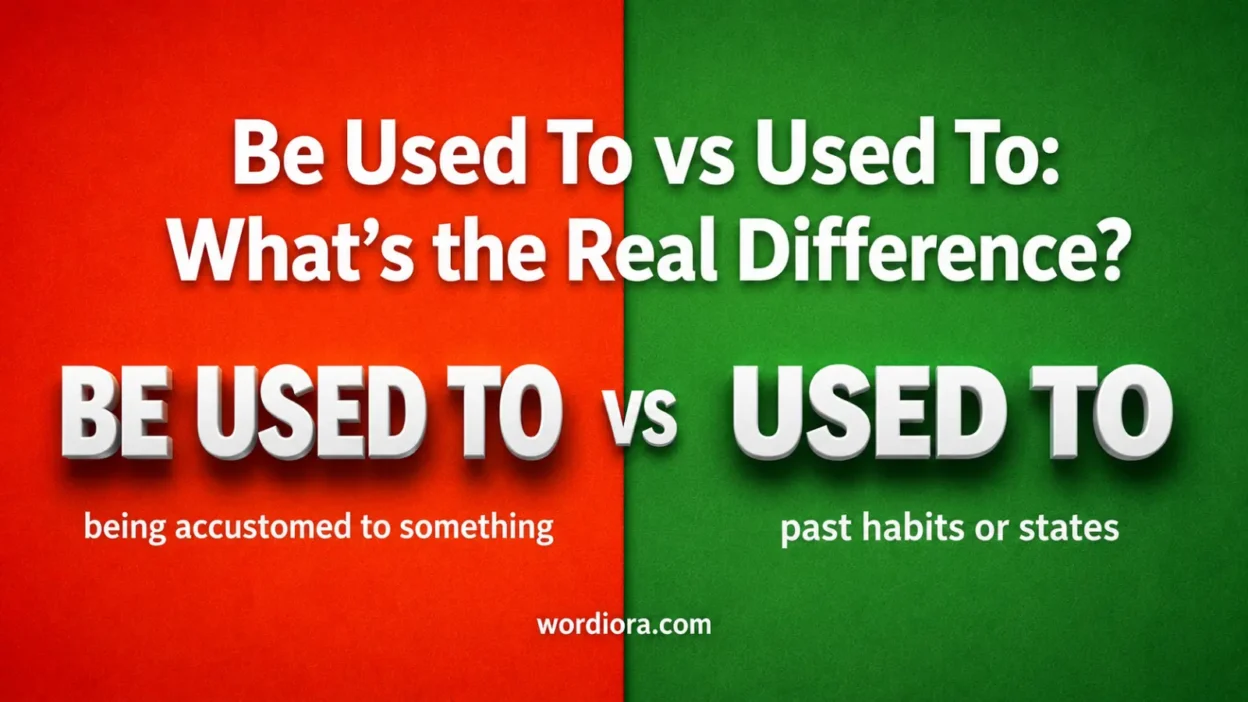
- “Used to” describes a past habit or past state.
- “Be used to” describes being familiar or comfortable with something.
Even advanced English speakers mix them up because the structures are close, but the grammar and meaning are not interchangeable.
Quick Answer
Use “used to” when talking about something that happened regularly in the past but does not happen now.
- “I used to live in Chicago.”
Use “be used to” when talking about being accustomed to something.
- “I am used to cold weather.”
The first talks about a past reality. The second talks about present or past familiarity.
Why People Confuse Them
The confusion happens because both phrases contain “used to,” but they work differently in a sentence.
Compare these:
- “She used to work nights.”
- “She is used to working nights.”
The first sentence means she worked nights in the past.
The second means night shifts feel normal to her now.
Another reason for confusion is that “be used to” is followed by a noun or an -ing verb, while “used to” is followed by a base verb.
- Correct: “I’m used to driving.”
- Correct: “I used to drive.”
- Incorrect: “I’m used to drive.”
Key Differences At A Glance
| Context | Best Choice | Why |
|---|---|---|
| A past habit that ended | used to | Shows something was true before but not now |
| Being comfortable with a situation | be used to | Shows familiarity or adjustment |
| Talking about childhood routines | used to | Refers to repeated past behavior |
| Describing adaptation | be used to | Shows someone has adjusted |
| Followed by a base verb | used to | “Used to play,” “used to eat” |
| Followed by a noun or -ing verb | be used to | “Used to traffic,” “used to working” |
Quick Structural Comparison
- used to + base verb
- “We used to travel every summer.”
- be used to + noun / pronoun / -ing verb
- “We are used to traveling every summer.”
Meaning and Usage Difference
“Used To”
“Used to” describes a repeated action, condition, or habit from the past that no longer exists.
Examples:
- “My dad used to smoke.”
- “They used to visit us every weekend.”
- “This neighborhood used to be quieter.”
It often suggests change over time.
“Be Used To”
“Be used to” means someone feels familiar, comfortable, or adjusted to something.
Examples:
- “I’m used to long commutes.”
- “She’s used to speaking in public.”
- “They were used to the noise.”
This phrase focuses on adaptation, not past habits.
Tone, Context, and Formality
Both expressions work in casual and formal English.
“Used to” appears often in storytelling, conversation, and reflective writing because it naturally contrasts past and present.
- “We used to stay out all night in college.”
“Be used to” appears frequently in everyday conversation because people often talk about adjustment.
- “I’m not used to this heat.”
In professional settings:
- “Employees are used to remote meetings.”
- “Our team used to operate from one office.”
Neither phrase sounds especially formal or informal.
Which One Should You Use?
Choose “used to” when the focus is on the past.
Ask yourself:
- Did this happen before but not anymore?
If yes, use “used to.”
- “I used to drink soda every day.”
Choose “be used to” when the focus is comfort or familiarity.
Ask yourself:
- Has the person adapted to this situation?
If yes, use “be used to.”
- “I’m used to waking up early.”
A quick test:
- Past habit → “used to”
- Familiarity or adjustment → “be used to”
When One Choice Sounds Wrong
Sometimes only one option makes sense.
Correct:
- “She used to play soccer.”
Wrong:
- “She is used to play soccer.”
Why? Because “be used to” must be followed by a noun or -ing form.
Correct:
- “She is used to playing soccer.”
Another common mistake:
Wrong:
- “I used to the traffic.”
Correct:
- “I’m used to the traffic.”
The sentence needs the verb “be.”
Common Mistakes (and Quick Fixes)
- Incorrect: “He is used to work late.”
- Correct: “He is used to working late.”
- Incorrect: “They used to living here.”
- Correct: “They used to live here.”
- Incorrect: “I am use to cold weather.”
- Correct: “I am used to cold weather.”
- Incorrect: “Did you used to go there?”
- Better in American English: “Did you use to go there?”
In questions and negatives, many American English writers prefer “use to” after “did.”
- “Did you use to play baseball?”
- “I didn’t use to like coffee.”
Everyday Examples
“Used To”
- “We used to order pizza every Friday.”
- “He used to hate public speaking.”
- “I used to work downtown.”
- “My grandparents used to own a farm.”
“Be Used To”
- “I’m used to busy airports.”
- “She’s used to dealing with deadlines.”
- “They aren’t used to small apartments.”
- “Are you used to driving in snow?”
If you still get confused between talking about past habits and becoming comfortable with a new situation, check out our detailed guide on Get Used To vs Used To to understand the difference with simple examples and everyday usage.
FAQ
Is “be used to” grammatically correct?
Yes. It is a standard English structure meaning “accustomed to.”
Can “used to” talk about the present?
No. “Used to” refers to the past.
Why does “be used to” use an -ing verb?
Because “to” in this phrase is a preposition, not part of an infinitive verb.
Which is more common in conversation?
Both are common, but they appear in different situations. “Used to” is common for discussing the past, while “be used to” is common for discussing adjustment and familiarity.
Is “didn’t used to” wrong?
Many American English writers prefer “didn’t use to,” although both forms appear in real-world usage.
Dictionary-Style Word Details
Verb
Used to
A phrase showing a repeated past action or condition that no longer exists.
Be used to
A phrase meaning to be familiar with or accustomed to something.
Noun
Neither expression functions as a standard noun phrase in normal English usage.
Synonyms
For “used to”:
- formerly
- once
- previously
For “be used to”:
- accustomed to
- familiar with
- comfortable with
Example Sentences
- “I used to stay up late.”
- “I’m used to staying up late now.”
- “She used to avoid meetings.”
- “She’s used to leading meetings.”
Word History
Both expressions developed from older English patterns connected to habitual action and familiarity. Over time, they became fixed grammatical structures with different meanings.
Phrases Containing
- “get used to”
- “become used to”
- “used to be”
- “never used to”
- “not used to”
Conclusion
“Used to” and “be used to” are closely related in appearance but completely different in meaning.
Use “used to” for past habits or situations that no longer happen.
Use “be used to” for familiarity, comfort, or adjustment.
The easiest way to remember the difference is this:
- Past routine → “used to”
- Comfort or adaptation → “be used to”
Once you focus on that distinction, choosing the correct phrase becomes much easier