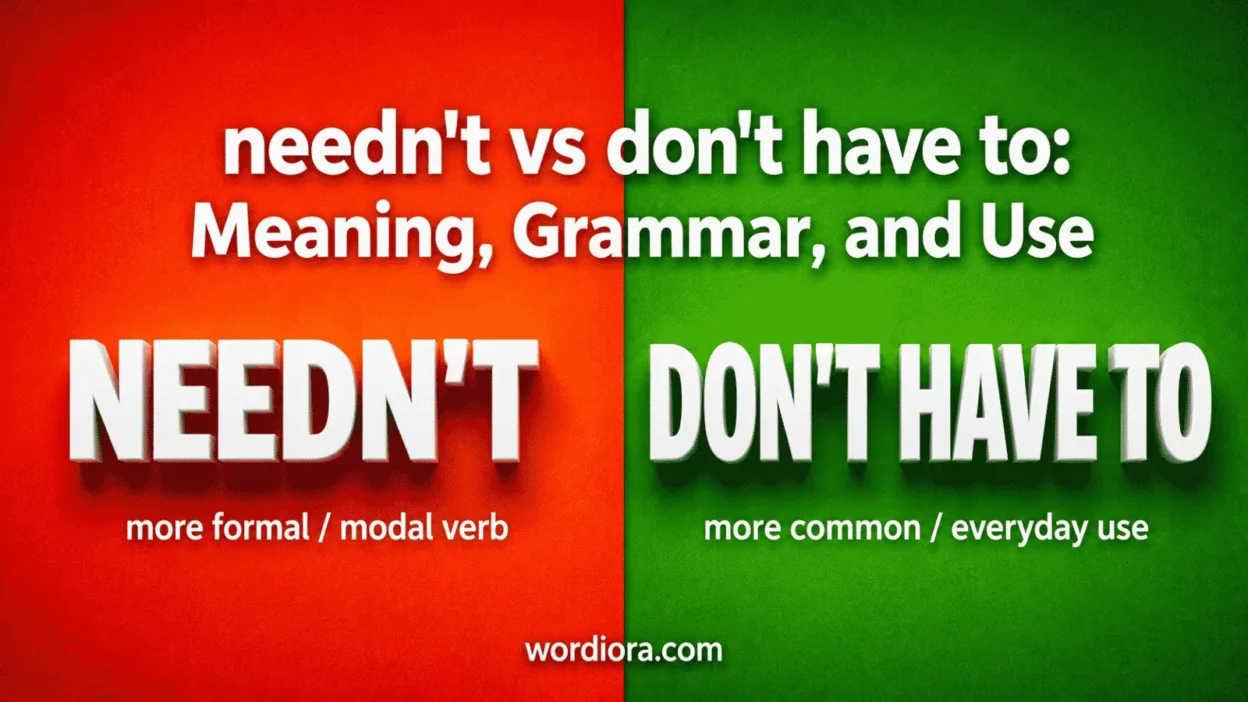
Needn’t and don’t have to can both mean that something is not necessary.
The best everyday choice in American English is usually don’t have to.
Use needn’t when you want a more formal, polished, old-fashioned, or British-sounding style. It is correct, but it is not the normal choice in most US conversations.
Quick Answer
Both are correct.
Use don’t have to when you mean “there is no need” or “it is not required.”
Example:
You don’t have to bring your laptop. We’ll use the conference room computer.
Use needn’t in the same basic meaning, but only when the tone fits.
Example:
You needn’t worry about the final page; I already fixed it.
For a US audience, don’t have to sounds more natural in everyday speech, emails, school writing, work messages, and customer-facing writing.
Why People Confuse Them
People confuse needn’t and don’t have to because both remove obligation.
They answer the same basic question:
“Is this required?”
If the answer is no, either form may express that idea.
But they do not work the same way in a sentence. Needn’t is a contraction of need not. It acts like a modal-style negative before a base verb.
Don’t have to is a verb phrase. It uses do support, so it changes with the subject and tense.
That grammar difference is where many mistakes start.
Many learners also confuse necessity with prohibition. Read our guide on don’t have to vs mustn’t to learn the difference between something optional and forbidden.dont-have-to-vs-mustnt/
Key Differences At A Glance
| Context | Best Choice | Why |
|---|---|---|
| Everyday US speech | don’t have to | It sounds normal and clear. |
| Work email | don’t have to | It is friendly and direct. |
| Formal or polished prose | needn’t | It can sound concise and refined. |
| Casual texting | don’t have to | Needn’t may sound stiff. |
| Rules and requirements | don’t have to | It clearly means “not required.” |
| Literary or old-fashioned tone | needn’t | The tone may be useful. |
| Past unnecessary action | needn’t have | It means the action happened but was unnecessary. |
| Simple past no requirement | didn’t have to | It is the normal US form. |
Meaning and Usage Difference
The main meaning is similar: not necessary.
Don’t have to means someone is not required to do something.
Examples:
You don’t have to RSVP today.
She doesn’t have to stay late.
We don’t have to print the tickets.
Needn’t also means something is not necessary.
Examples:
You needn’t RSVP today.
She needn’t stay late.
We needn’t print the tickets.
The sentence structure is different:
• needn’t + base verb
• don’t/doesn’t have to + base verb
Correct: You needn’t bring anything.
Correct: You don’t have to bring anything.
Wrong: You needn’t to bring anything.
That “to” is the common error. Use to after don’t have to, not after needn’t.
Tone, Context, and Formality
In American English, don’t have to is the safer everyday choice.
It sounds natural in speech:
You don’t have to call me back tonight.
It also sounds natural in emails:
You don’t have to attach the file again; I found it.
Needn’t is correct, but it often sounds more formal or less common to American ears.
You needn’t call me back tonight.
That sentence is clear, but many US speakers would not say it in casual conversation. It may fit better in formal writing, edited prose, or a sentence where you want a slightly elegant tone.
Pronunciation is worth a quick note because the apostrophe can make the word look harder than it is. Needn’t is usually said like NEED-unt. In fast speech, it may sound compressed.
Which One Should You Use?
Choose don’t have to for most US writing and speaking.
Use it when you want to sound clear, modern, and natural.
Examples:
You don’t have to make a new account.
We don’t have to decide right now.
He doesn’t have to attend both sessions.
Choose needn’t when the style calls for it.
Examples:
You needn’t be concerned.
The reader needn’t know every detail at once.
We needn’t assume the worst.
A simple rule works well:
In everyday US English, use don’t have to. In formal or literary style, needn’t may fit.
When One Choice Sounds Wrong
Needn’t can sound wrong when the rest of the sentence is very casual.
Awkward: You needn’t grab chips for the party.
Natural: You don’t have to grab chips for the party.
Awkward: I needn’t Venmo you today, right?
Natural: I don’t have to Venmo you today, right?
Don’t have to can sound less polished in a very formal sentence, but it is still correct.
Plain: The applicant doesn’t have to submit a second form.
More formal: The applicant needn’t submit a second form.
Be careful with past meaning. Needn’t have usually means the action happened, but it was unnecessary.
You needn’t have bought dessert.
Meaning: You bought dessert, but it was not necessary.
Didn’t have to usually means there was no requirement. It does not always prove whether the action happened.
I didn’t have to buy dessert.
Meaning: Buying dessert was not required.
Common Mistakes (and Quick Fixes)
Mistake: You needn’t to wait.
Fix: You needn’t wait.
Mistake: She don’t have to come.
Fix: She doesn’t have to come.
Mistake: You mustn’t pay if it’s free.
Fix: You don’t have to pay if it’s free.
Mustn’t means “must not” or “not allowed.”
Don’t have to means “not required.”
Mistake: We needn’t have to bring ID.
Fix: We don’t have to bring ID.
Fix: We needn’t bring ID.
Do not combine needn’t and have to in the same phrase.
Everyday Examples
Here are natural US examples with don’t have to:
I don’t have to be at the office until 10.
You don’t have to dress up for dinner.
They don’t have to take the test again.
Maya doesn’t have to drive; I can pick her up.
We don’t have to finish this tonight.
Here are examples where needn’t works, but sounds more formal:
You needn’t explain the delay.
We needn’t discuss that point again.
The team needn’t file a new request.
He needn’t worry about the invoice.
The report needn’t include every minor edit.
Compact comparison:
• Needn’t: correct, concise, more formal, less common in everyday US speech.
• Don’t have to: correct, clear, common, best for most US situations.
• Needn’t + base verb: You needn’t wait.
• Don’t have to + base verb: You don’t have to wait.
• Avoid: You needn’t to wait.
Dictionary-Style Word Details
Verb
• needn’t: Not a main verb by itself. It is a contraction of need not, used before a base verb: “You needn’t wait.” In this use, need works in a modal-like way.
• don’t have to: A negative verb phrase built from do + not + have to. It means “are not required to.” It changes by subject and tense: “She doesn’t have to wait,” “They didn’t have to wait.”
Noun
• needn’t: Not used as a noun in standard US English.
• don’t have to: Not used as a noun in standard US English. It is a phrase, not a noun.
Synonyms
• needn’t: Closest plain alternatives: do not need to, do not have to, are not required to.
• don’t have to: Closest plain alternatives: do not need to, are not required to, it is not necessary to.
Useful opposite idea for both: have to, must, need to, or are required to.
These are not always exact opposites in every sentence, but they express the opposite idea of requirement.
Example Sentences
• needn’t: You needn’t send another copy; this one is clear.
• needn’t: We needn’t rush if the meeting starts at noon.
• needn’t: The instructions needn’t be complicated.
• don’t have to: You don’t have to send another copy; this one is clear.
• don’t have to: We don’t have to rush if the meeting starts at noon.
• don’t have to: The instructions don’t have to be complicated.
Word History
• needn’t: It comes from need not. The apostrophe shows that letters have been left out in the contraction.
• don’t have to: It comes from the negative form of have to, a common way to express requirement or necessity. In the negative, it removes that requirement.
No special origin story is needed to use either one correctly.
Phrases Containing
• needn’t:
You needn’t worry.
You needn’t bother.
We needn’t rush.
Needn’t have done that.
• don’t have to:
You don’t have to worry.
You don’t have to bother.
We don’t have to rush.
They don’t have to decide today.
She doesn’t have to attend.
Conclusion
Needn’t and don’t have to are both correct when you mean something is not necessary.
For American English, don’t have to is usually the better choice. It sounds natural, clear, and current in everyday speech and writing.
Use needn’t when you want a more formal or polished tone. Just remember the grammar: say needn’t go, not needn’t to go.