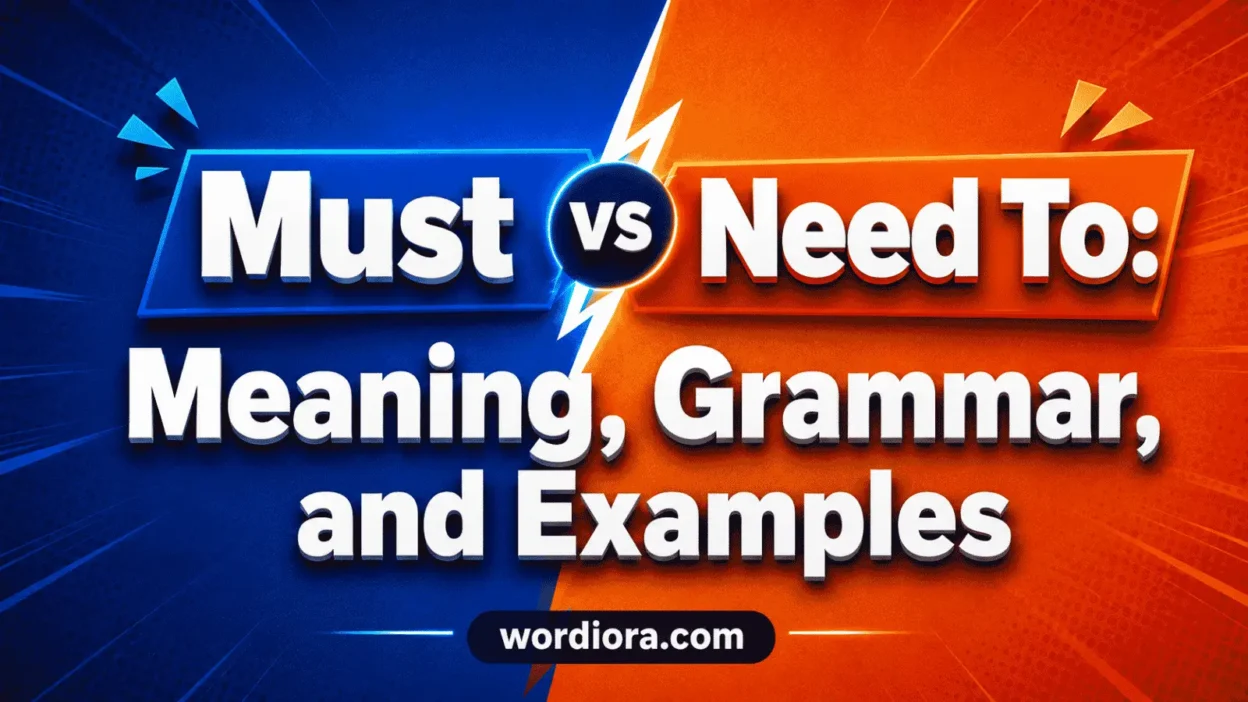
Both must and need to are correct in English.
The better choice depends on what you mean. Use must when something is required, strongly necessary, formally required, or logically certain. Use need to when something is necessary for a practical reason or goal.
In everyday American English, need to often sounds more natural and less forceful. Must can sound firm, official, urgent, or formal.
Quick Answer
Use must for strong obligation, rules, warnings, formal instructions, and logical conclusions.
Use need to for practical necessity, everyday tasks, plans, reminders, and normal instructions.
Examples:
Correct: You must show your ID before entering the building.
This sounds like a rule.
Correct: You need to show your ID before entering the building.
This sounds like a practical requirement.
Correct: I need to charge my phone before we leave.
This sounds natural and practical.
Correct: I must charge my phone before we leave.
This is correct, but it sounds stronger or more dramatic.
Why People Confuse Them
People confuse must and need to because both can mean that something is necessary.
These two sentences are both correct:
We must leave by 7.
We need to leave by 7.
The difference is not basic correctness. The difference is how the sentence feels.
Must makes the need sound stronger. It can sound like a rule, command, urgent duty, or firm personal decision.
Need to focuses more on the practical reason. It often means “this is required so something else can happen.”
Key Differences At A Glance
| Context | Best Choice | Why |
|---|---|---|
| Official rule | must | Sounds formal and firm |
| Everyday task | need to | Sounds natural and practical |
| Strong warning | must | Adds urgency |
| Friendly reminder | need to | Sounds less bossy |
| Logical conclusion | must | Means “surely” or “very likely” |
| Goal-based requirement | need to | Shows what is necessary to reach a result |
| Past necessity | needed to | “Must” is not normally used for past obligation |
| Negative: not allowed | must not | Means something is forbidden |
| Negative: not necessary | don’t need to | Means something is optional |
Meaning and Usage Difference
Must is a modal auxiliary verb. It is followed by the base form of a verb, with no to.
Correct: You must finish the form.
Incorrect: You must to finish the form.
Need to uses need as a main verb followed by to and another verb.
Correct: You need to finish the form.
Incorrect: You need finish the form.
The core difference is this:
Must says something is required in a strong, firm, official, or logical way.
Need to says something is necessary because of a situation, goal, problem, or practical reason.
Examples:
Employees must wear badges in the lab.
This sounds like a rule.
Employees need to wear badges so security can identify them.
This explains the practical reason.
She must be exhausted after that double shift.
Here, must does not mean obligation. It means the speaker is making a strong logical guess.
She needs to be exhausted after that double shift does not have the same meaning. It sounds odd unless you mean exhaustion is somehow required, which is rarely the point.
Want to learn everyday obligation phrases better? Read our guide on need-to-vs-have-tofor simple explanations and real-life examples.
Tone, Context, and Formality
In US English, need to is common in everyday speech and workplace messages.
We need to update the file by Friday sounds normal in a team chat.
We must update the file by Friday is correct, but it sounds more serious. It may fit a formal memo, a safety rule, or a firm warning.
Use must when you want a strong tone:
You must not share your password.
All visitors must check in at the front desk.
We must act quickly.
Use need to when you want a normal, practical tone:
You need to reset your password.
We need to check in before the meeting.
I need to reply to that email.
Be careful with direct instructions. You must can sound bossy in casual conversation. You need to can still be direct, but it usually feels less stiff.
Which One Should You Use?
Use must when:
- you are stating a rule
- you are giving a warning
- you are writing a formal requirement
- you want to show strong duty
- you mean “surely” or “very likely”
Examples:
Drivers must stop at a red light.
You must not enter this area without approval.
That must be the delivery driver.
Use need to when:
- you are talking about a practical task
- you are explaining what is necessary
- you are giving a normal reminder
- you are describing a goal-based step
- you are speaking in a natural everyday tone
Examples:
I need to buy groceries after work.
We need to test the link before we send it.
You need to bring your laptop tomorrow.
A good rule for US readers: choose need to for normal life and work tasks. Choose must when the sentence needs extra force, authority, or certainty.
When One Choice Sounds Wrong
Sometimes both choices are grammatically possible, but one sounds wrong for the meaning.
| Feature | must | need to |
|---|---|---|
| Basic meaning | Strong necessity or obligation | Practical necessity |
| Grammar | must + base verb | need/needs/needed to + base verb |
| Tone | Firm, formal, urgent, official | Natural, direct, practical |
| Past form | Usually use “had to” instead | Use “needed to” |
| Negative meaning | “Must not” = forbidden | “Don’t need to” = not necessary |
| Extra meaning | Can show logical certainty | Does not show logical certainty |
Do not use must with to.
Incorrect: You must to call your manager.
Correct: You must call your manager.
Do not use need to for a logical conclusion.
Awkward: He needs to be home by now if you mean “I’m sure he is home.”
Correct: He must be home by now.
Do not use must not when you mean something is optional.
Wrong meaning: You must not attend the meeting.
This means you are not allowed to attend.
Correct: You don’t need to attend the meeting.
This means attending is not required.
Common Mistakes (and Quick Fixes)
Mistake: You must to sign here.
Fix: You must sign here.
Mistake: She must worked late yesterday.
Fix: She had to work late yesterday.
Or, for a logical guess: She must have worked late yesterday.
Mistake: You don’t must bring a printed copy.
Fix: You don’t need to bring a printed copy.
Or: You do not have to bring a printed copy.
Mistake: You must not bring lunch when lunch is optional.
Fix: You don’t need to bring lunch.
Mistake: That needs to be our Uber when you mean you are almost sure.
Fix: That must be our Uber.
Mistake: He need to submit the form.
Fix: He needs to submit the form.
Everyday Examples
I need to leave early today for a doctor’s appointment.
Natural and practical.
I must leave early today.
Correct, but stronger. It may sound like a firm personal duty.
You need to update your payment method.
Normal customer-service tone.
You must update your payment method to keep access.
Stronger and more official.
We need to get gas before we hit the highway.
Practical necessity.
We must get gas before we hit the highway.
More urgent.
Students must submit the form by 5 p.m. Friday.
Formal rule.
Students need to submit the form by 5 p.m. Friday.
Still correct, but less formal.
That must be Maria at the door.
Logical conclusion.
That needs to be Maria at the door.
Not natural for this meaning.
Dictionary-Style Word Details
Verb
must: Used as a modal auxiliary verb. It is followed by the base form of another verb. It does not take to before the next verb.
Example: You must bring a photo ID.
It can show obligation, strong necessity, advice, warning, or logical certainty.
Example: He must be stuck in traffic.
need to: Built from the verb need plus to plus the base form of another verb. It changes with tense and subject.
Examples:
I need to call her.
She needs to call her.
They needed to call her.
It shows that an action is necessary.
Noun
must: Can be used as a noun in phrases like a must, meaning something that is essential or strongly recommended.
Example: A warm coat is a must in Chicago in January.
need to: Not commonly used as a noun phrase in standard US English. The noun is need, not need to.
Example: There is a need to improve the process.
Synonyms
must: Closest plain alternatives include have to, be required to, be obligated to, and ought to in some advice contexts. For logical certainty, close alternatives include surely and almost certainly.
Useful opposite ideas: must not means be forbidden to or not be allowed to.
need to: Closest plain alternatives include have to, be necessary to, be required to, and should in some softer advice contexts.
Useful opposite idea: don’t need to means do not have to or it is not necessary to.
Example Sentences
must:
All guests must check in at the front desk.
You must not open that file outside the secure system.
This must be the restaurant we’re looking for.
We must find a better way to handle this.
need to:
I need to stop by the pharmacy after work.
You need to save the receipt for reimbursement.
She needs to finish the slides before noon.
We don’t need to print the tickets.
Word History
must: The word has old roots in English and has long been used as a modal verb. For a word-choice article, the most important point is modern use: must now commonly marks strong obligation, formal requirement, or logical certainty.
need to: The key word is need, an old English word connected with necessity, lack, or requirement. In modern usage, need to is a common way to say that an action is necessary.
No special origin story is needed to choose between them today. The modern grammar and tone matter more.
Phrases Containing
must:
must-see
must-read
must-have
if you must
must not
a must
need to:
need to know
need to do
need to be
don’t need to
no need to
there is a need to
Conclusion
Must and need to are both correct, but they are not always the same.
Use must for strong rules, warnings, formal requirements, and logical certainty. Use need to for normal practical necessity.
For most everyday US English, need to sounds natural and clear. Use must when you want the sentence to sound stronger, more official, or more certain.