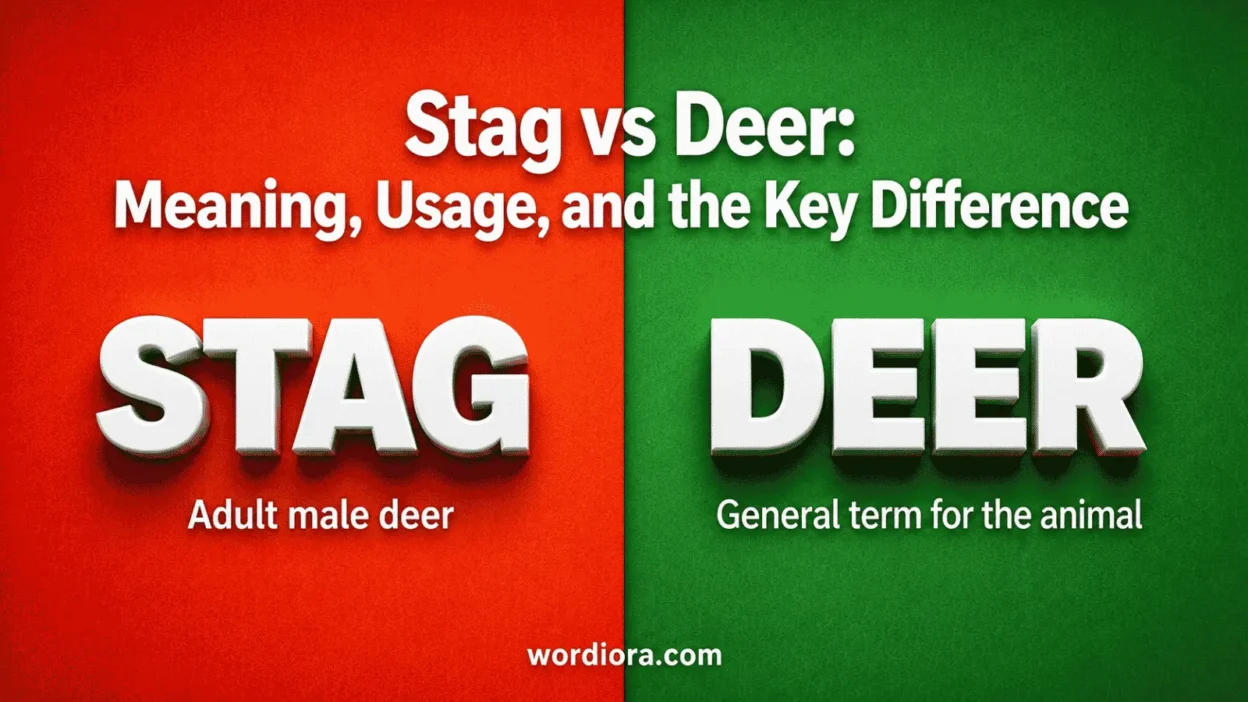
If you are choosing between stag and deer, the safest starting point is simple: deer is the broad everyday word, and stag is the narrower one.
In American English, people usually say deer when they mean the animal in general. They use stag only when they specifically mean an adult male deer, or when they want a more specialized, literary, or species-specific tone. That is why these two words are related but not interchangeable.
Quick Answer
Use deer for the animal as a general category.
Use stag only when you mean a male deer, usually an adult one, and the context clearly supports that level of precision. In most everyday American writing, deer is the better choice. Stag can sound too specific or slightly unnatural if the sex of the animal is unknown, irrelevant, or clearly not male.
Why People Confuse Them
People confuse these words because a stag is a deer, but not every deer is a stag.
That creates an easy trap. Since both words point to the same animal family, writers sometimes assume they are stylistic alternatives. They are not. One is general, and one is specific.
The confusion also grows because nature writing, fantasy writing, hunting language, and British-influenced usage often make stag feel more common than it is in ordinary American prose. In regular US usage, though, deer is still the default word.
Key Differences At A Glance
| Context | Best Choice | Why |
| You mean the animal in general | deer | It covers the whole category, without specifying sex |
| You saw several animals but do not know whether they were male or female | deer | Stag would add an unsupported detail |
| You specifically mean an adult male deer | stag | It gives the male meaning directly |
| You mean a doe, a fawn, or a mixed group | deer | Stag applies only to a male |
| You are writing plain everyday American English | deer | It sounds more natural and less specialized |
| You want a more dramatic, old-world, or hunting-style tone | stag | It can work when the male identity matters and the style supports it |
Meaning and Usage Difference
| Feature | Stag | Deer |
| Scope | Narrow | Broad |
| Usual meaning | Adult male deer | Any deer, or deer as a group |
| Sex implied | Male | Not specified |
| Everyday US tone | More specialized | More natural |
| Risk of sounding wrong | High when sex is unknown | Low in most contexts |
The core difference is not complexity. It is range.
Deer can refer to one animal, many animals, a species, or the whole group in ordinary language. Stag cannot do that job. It points to one kind of deer only: a male, usually understood as an adult male.
So if your sentence does not need that male detail, deer is usually the stronger word.
Tone, Context, and Formality
In plain American writing, deer sounds neutral and natural.
Stag sounds more marked. It can feel more vivid, more formal, more literary, or more tied to wildlife and hunting contexts. Sometimes that is exactly what you want. A sentence like “A stag emerged from the mist” has a dramatic quality that “A deer emerged from the mist” does not.
But style is not the same as accuracy. If you do not actually know it was a male deer, stag adds information you may not mean to add. That is why stag works best when the writer wants both precision and a slightly elevated tone.
Which One Should You Use?
Choose deer when:
You are naming the animal in general.
You do not know the animal’s sex.
The sentence is casual, practical, or informational.
You are talking about deer as a group, species, or common sight.
Choose stag when:
You clearly mean a male deer.
That male detail matters to the sentence.
The context is descriptive, literary, species-specific, or intentionally precise.
A useful test is this: if replacing the word with male deer keeps your meaning intact, stag may work. If that replacement sounds too narrow, use deer instead.
When One Choice Sounds Wrong
Sometimes stag is not technically impossible, but it still sounds off.
“A stag ran across the highway” may be fine if the speaker clearly saw an adult male. But if the speaker only caught a quick glimpse, deer sounds more believable.
“We saw a stag with her fawn” is plainly wrong because stag cannot refer to a female animal.
“The park is full of stags” sounds odd unless the park truly contains only adult males. In normal usage, “The park is full of deer” is the natural sentence.
The same rule applies in informative writing. If a heading says “How to keep stag out of your garden,” most readers will notice the wording as strange. “How to keep deer out of your garden” is broader and correct.
Common Mistakes (and Quick Fixes)
One common mistake is using stag as a fancier synonym for deer. Quick fix: use stag only when male sex matters.
Another mistake is using stag for a whole herd or local population. Quick fix: switch to deer unless you truly mean a group of males only.
A third mistake is choosing stag just because the animal has antlers in an image. Quick fix: only use it if you are confident the wording fits the species and the male meaning is relevant.
A fourth mistake is forcing stag into everyday practical sentences. Quick fix: in ordinary US English, default to deer unless you have a strong reason not to.
Everyday Examples
Use deer in broad, everyday sentences:
We saw three deer near the tree line at dusk.
Deer often move through this neighborhood in early morning.
The driver slowed down because a deer was standing near the road.
The preserve protects deer, birds, and small mammals.
Use stag when the male meaning matters:
The photographer waited for the stag to step into the clearing.
In the painting, the stag stands alone against a winter sky.
The story opens with a wounded stag deep in the forest.
That second set sounds more specific and more stylized. It is not automatically better. It is just doing a different job.
Dictionary-Style Word Details
Verb
Stag: As a verb, stag has other meanings in English, such as going somewhere without a partner, but that is unrelated to the deer comparison here.
Deer: Deer is not normally used as a verb in modern everyday English.
Noun
Stag: A stag is an adult male deer. In some reference works, the term is especially associated with red deer or other larger deer.
Deer: Deer is the general noun for animals in the deer family and is the normal everyday choice when sex is not the point.
Synonyms
Stag: male deer, buck in some contexts, hart in older or literary contexts.
Deer: cervid in technical writing, though deer is the ordinary word most readers expect.
These are not perfect swaps. For example, buck and hart bring their own usage limits, so they should not be treated as automatic replacements.
Example Sentences
Stag: A stag stood at the edge of the meadow just before sunrise.
Stag: The novel describes a white stag as a sign of pursuit and mystery.
Deer: Deer crossed the trail before we reached the lake.
Deer: This region has more deer than it did twenty years ago.
Word History
Stag: The word comes through Middle English and is tied to older Germanic forms for a male animal in its prime. Its history helps explain why the word still feels pointed and specific.
Deer: The word goes back to Old English, where it once had a much broader meaning closer to “animal” or “beast.” Over time, it narrowed into the modern sense.
That older history is one reason deer feels like the base word and stag feels like a subset.
Phrases Containing
Stag: stag hunt, stag’s head, white stag, stag antlers.
Deer: deer crossing, deer season, mule deer, red deer, white-tailed deer.
These phrases also show the difference in scope. Stag appears in more specialized expressions, while deer appears in broad everyday naming.
FAQs
Is a stag the same as a deer?
A stag is a type of deer, but the words are not the same. Deer is the general word for the animal, while stag usually means an adult male deer.
Should I use stag or deer in everyday writing?
Use deer in most everyday writing. It is the safer and more natural choice when you are talking about the animal in general or when the animal’s sex does not matter.
When should I use stag?
Use stag when you specifically mean an adult male deer. It works well in wildlife writing, hunting contexts, literary descriptions, or any sentence where the male identity matters.
Can stag refer to a female deer?
No. Stag does not refer to a female deer. A female deer is usually called a doe.
Can stag refer to a baby deer?
No. A baby deer is called a fawn. Stag refers to a male deer, usually an adult one.
Is deer more common than stag in American English?
Yes. In American English, deer is much more common in everyday speech and writing. Stag sounds more specific, formal, literary, or nature-focused.
Is it wrong to say “I saw a stag”?
It is not wrong if you clearly saw an adult male deer. But if you do not know whether the animal was male, “I saw a deer” is the better sentence.
Can I use stag as a fancy word for deer?
No. Stag should not be used only to sound fancy. It adds a specific meaning: adult male deer. If that meaning is not needed, use deer.
What is the plural of deer?
The plural of deer is also deer. For example: “We saw one deer” and “We saw five deer.”
What is the plural of stag?
The plural of stag is stags. For example: “Two stags stood near the forest edge.”
Is a buck the same as a stag?
Sometimes they are close in meaning, but they are not always interchangeable. Buck can mean a male deer and is common in American usage, especially for some deer species. Stag often sounds more formal, literary, or associated with larger deer.
Which word is better for SEO: stag or deer?
For most general topics, deer is the better SEO keyword because it is broader and more commonly searched. Use stag when your article specifically discusses male deer or the difference between stag and deer.
Conclusion
The difference between stag and deer is mostly a difference in specificity.
Deer is the broad word and the right choice for most everyday American sentences. Stag is the narrower word for an adult male deer and works best when that male meaning is important or when the writing aims for a more specialized tone.