Last Updated: July 27, 2026
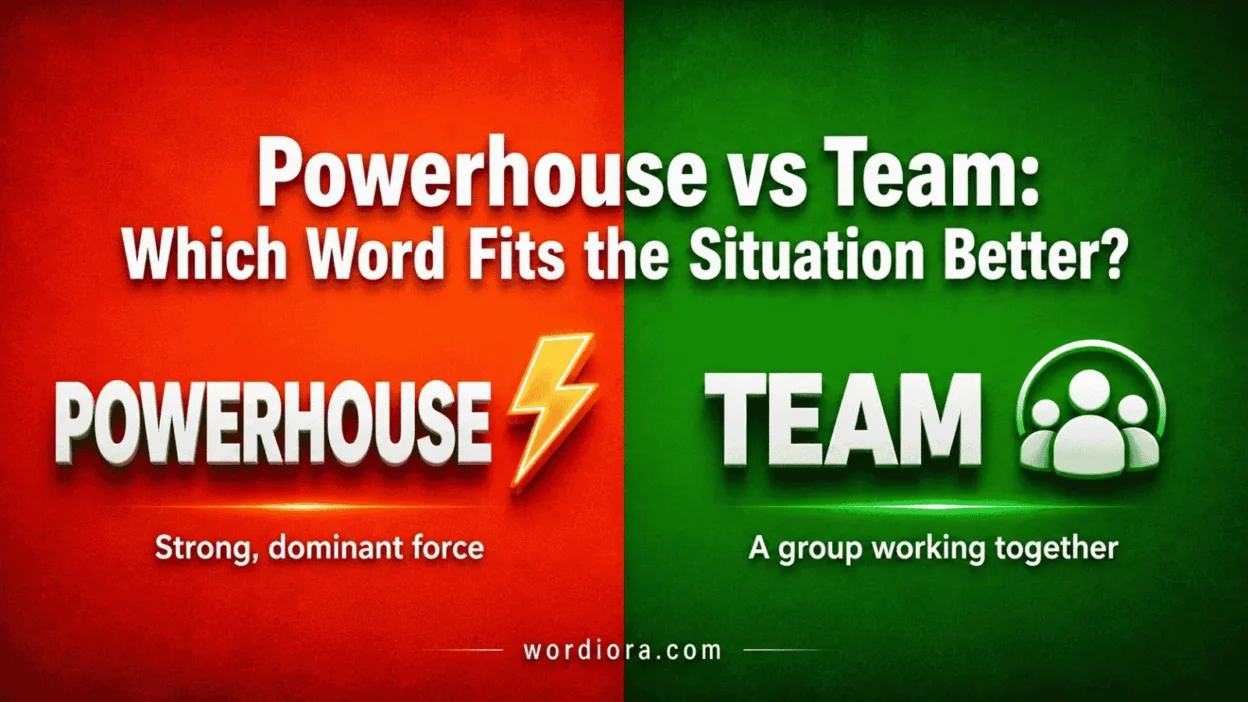
Powerhouse vs team is not a close synonym choice. Team is the basic word for a group of people working or playing together. Powerhouse is a stronger label for a person, group, company, or country with unusual power, influence, energy, or success. In plain American English, a team can be a powerhouse, but a powerhouse is never just the neutral word for any team.
Quick Answer
Use team when you simply mean a group acting together. Use powerhouse when you want to stress exceptional strength, dominance, influence, or output. If you are naming the group itself, team is usually right. If you are praising what that group has become, powerhouse is usually better.
Why People Confuse Them
Writers confuse these words because powerhouse can apply to a sports team or other group, while team can describe that same group in a neutral way. So both words may point to the same people, but they do different jobs in the sentence. One identifies the group. The other evaluates it.
That is why phrases like “a powerhouse program,” “a powerhouse company,” and “a powerhouse team” sound natural, while team stays the broader everyday label for the group itself.
Key Differences At A Glance
The simplest way to separate them is this: team names cooperation, while powerhouse signals exceptional force or results.
| Context | Best Choice | Why |
| Naming a group working together | team | It is the standard word for the group itself. |
| Describing a dominant sports group | powerhouse | It highlights unusual strength and repeated success. |
| Referring to staff in plain workplace writing | team | It sounds neutral, precise, and standard. |
| Praising a company, department, or performer | powerhouse | It adds force, influence, and standout energy. |
| Writing about collaboration without praise | team | It focuses on shared action, not status. |
Meaning and Usage Difference
A team is a group of people associated together in work, sport, or some other shared activity. The word does not tell you whether the group is average, weak, or excellent. It only tells you that the people are functioning together.
A powerhouse is different. It is a label for someone or something notably strong, influential, energetic, or effective. That can be a person, a company, a country, a band, or a sports group. The word almost always adds admiration, scale, or force.
A quick way to remember the contrast:
- Team = who is working together
- Powerhouse = how strong or influential that person or group is
- A team may be ordinary, struggling, or excellent
- A powerhouse is almost always presented as unusually strong or successful
That is why “the marketing team” and “the marketing powerhouse” do not mean the same thing. The first names a unit. The second elevates it.
Tone, Context, and Formality
Team is the safer word in most settings. It works in business, education, healthcare, law, sports, and everyday conversation because it is neutral and direct. You can say “the legal team,” “the sales team,” or “the home team” without adding any opinion.
Powerhouse is more charged. It sounds stronger, more vivid, and more promotional. It fits well when you want emphasis, especially in sports coverage, entertainment writing, business profiles, or enthusiastic praise. In flat informational writing, though, it can sound inflated if the group has not clearly earned that description. That judgment follows from the dictionary sense of unusual power, drive, influence, or aggressive strength.
Which One Should You Use?
Choose team when your main goal is clarity. This is the better word for job titles, workplace structure, rosters, project groups, school groups, and ordinary references to people working together.
Choose powerhouse when you want to spotlight exceptional performance or influence. It works best when the audience is supposed to feel the group’s strength right away. A college basketball team that regularly dominates its conference may fairly be called a powerhouse. A startup that shapes its industry may also be called a powerhouse.
If you are unsure, use team first. Then ask whether the sentence genuinely needs praise or intensity. If yes, powerhouse may be the better fit. If not, team is usually the cleaner choice. This follows from the broader neutral definition of team and the evaluative force built into powerhouse.
When One Choice Sounds Wrong
Calling every group a powerhouse can make your writing sound exaggerated. A new department, a routine committee, or a middling roster is usually just a team, not a powerhouse. The stronger word needs evidence in the context.
The reverse problem also happens. Sometimes team is too flat. If the whole point is that a program is dominant, influential, or unusually effective, team may undersell it. In that case, powerhouse gives the sentence the weight the situation deserves.
Common Mistakes (and Quick Fixes)
One common mistake is using powerhouse as if it were the ordinary name for any group. Better fix: use team for the group, and save powerhouse for standout groups or performers.
Another mistake is treating the words as direct substitutes in every sentence. “She joined the finance powerhouse” does not mean exactly the same thing as “She joined the finance team.” The first suggests a highly influential or impressive group. The second simply states membership.
A third mistake is forcing powerhouse into plain administrative writing. In a memo, org chart, or job description, team is usually more natural because it identifies the group without hype.
Everyday Examples
Here is the clean difference in action.
“The design team meets every Tuesday morning.”
This works because the sentence only names the working group.
“The design department has become a creative powerhouse.”
This works because the sentence praises output and influence.
“The school hired a new coaching team.”
This simply identifies a staff group.
“The school has built a basketball powerhouse.”
This suggests sustained strength and strong results.
“She loves being part of the emergency response team.”
The focus is participation.
“She is a powerhouse in the courtroom.”
The focus is force, skill, and impact.
Dictionary-Style Word Details
Verb
Powerhouse: Standard dictionary entries treat powerhouse as a noun, not a regular verb. In normal edited English, writers do not use it as a verb.
Team: Team can be a verb. It can mean to join together, pair people or things, or work in combination.
Noun
Powerhouse: As a noun, powerhouse can mean a literal power plant, but in modern everyday usage it often means a person, group, organization, or country with great energy, influence, strength, or success. It can also be used for an athletic team known for strong aggressive play.
Team: As a noun, team means a group of people working together or playing together on one side. In broader use, it also names professional groups such as a legal team or medical team.
Synonyms
Powerhouse: For person-focused uses, nearby options can include achiever, go-getter, and highflier, though none is a perfect fit in every sentence. When you mean a dominant organization or group, there is often no exact neutral substitute because powerhouse carries its own force.
Team: Nearby options include crew, squad, staff, and group, depending on context. These are often closer in tone because they stay descriptive rather than strongly evaluative.
Example Sentences
Powerhouse: “Their studio has become an animation powerhouse.” “She is a fundraising powerhouse.” These work because the word adds strength and impact. Merriam-Webster’s own examples also show uses such as a team that is winning easily or a company that became a powerhouse in its industry.
Team: “The audit team finished the review on Friday.” “Our team is presenting first.” These work because the word simply names a group acting together. Standard dictionary examples use the word the same way in both sports and workplace settings.
Word History
Powerhouse: Merriam-Webster traces powerhouse to a first known use in 1870, with the literal sense connected to a power plant. The figurative sense later broadened into the familiar modern idea of a highly strong or influential person, group, or organization.
Team: Etymonline traces team back through Middle and Old English, where earlier senses were connected with family, line, brood, and company. Modern English keeps the group-together idea most strongly. Merriam-Webster’s current definition reflects that collective sense in work and activity.
Phrases Containing
Powerhouse: Common combinations include economic powerhouse, media powerhouse, powerhouse team, and powerhouse performer. These all keep the idea of unusual force or influence.
Team: Common combinations include team effort, team captain, team player, team sport, and team up. These phrases stay centered on collaboration, membership, or organized group action.
Conclusion
Use team for the basic idea of people working or playing together. Use powerhouse when you want to stress standout strength, influence, or high performance. That is the real difference. Team is the neutral label. Powerhouse is the praise word. When you keep that split in mind, the choice becomes easy and your sentence sounds more exact.