
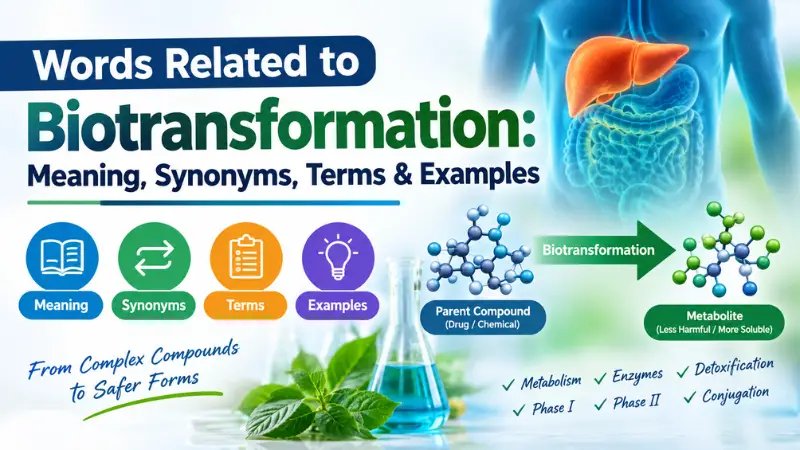
Biotransformation refers to the chemical modification of a substance by a living organism, cell, or biological system. Common words related to biotransformation include metabolism, biodegradation, bioconversion, enzymatic transformation, detoxification, oxidation, reduction, hydrolysis, and metabolism. Although these terms overlap, each describes a somewhat different biological process or context.
Understanding this vocabulary can make it easier to read scientific texts, write biology assignments, understand pharmacology, or describe how organisms transform chemicals.
What Does Biotransformation Mean?
Biotransformation is the process through which an organism or its enzymes chemically alter a compound.
The term is commonly used when discussing:
- Drugs and medications
- Environmental chemicals
- Food compounds
- Pollutants
- Natural products
- Metabolic compounds
- Industrial biotechnology
For example, the human body can chemically modify a drug after it is absorbed. Enzymes, particularly those found in the liver, can convert the drug into different chemical forms. These products are called metabolites.
In simple terms:
Biotransformation = biological conversion of one chemical substance into another form.
Words Related to Biotransformation
The best related word depends on the scientific context. Some terms are close synonyms, while others describe specific mechanisms or outcomes.
| Related word | Meaning | Common context |
|---|---|---|
| Metabolism | Chemical reactions occurring within living organisms | Biology, medicine |
| Bioconversion | Biological conversion of one compound into another | Biotechnology |
| Biodegradation | Breakdown of substances through biological activity | Environmental science |
| Enzymatic transformation | Chemical modification caused by enzymes | Biochemistry |
| Detoxification | Conversion of a potentially harmful substance into a less harmful form | Pharmacology, toxicology |
| Metabolite formation | Production of a new compound during metabolism | Medicine, biochemistry |
| Oxidation | A chemical process involving electron loss or oxidation-state change | Biochemistry |
| Reduction | A chemical process involving electron gain or reduction-state change | Biochemistry |
| Hydrolysis | Chemical breakdown involving water | Biochemistry, pharmacology |
| Conjugation | Attachment of another chemical group to a molecule | Drug metabolism |
| Biological transformation | General term for biologically driven chemical change | Biology |
| Microbial transformation | Chemical modification performed by microorganisms | Microbiology |
| Biocatalysis | Use of biological catalysts to facilitate chemical reactions | Biotechnology |
1. Metabolism
Metabolism is one of the most closely related terms to biotransformation.
Metabolism includes the complete set of chemical reactions occurring within an organism. It encompasses both:
- Catabolism: breaking molecules down
- Anabolism: building molecules up
Biotransformation, by contrast, often focuses specifically on the chemical modification of a particular compound.
2. Bioconversion
Bioconversion describes the conversion of a substance into another chemical form using biological systems.
For example, microorganisms may convert an organic compound into a different compound through enzymatic reactions.
The terms bioconversion and biotransformation are sometimes used interchangeably, although their precise usage can vary by scientific field.
3. Biodegradation
Biodegradation involves the biological breakdown of substances.
Microorganisms such as bacteria and fungi can degrade certain organic materials and pollutants.
Biodegradation is therefore related to biotransformation, but it generally emphasizes breakdown rather than chemical modification in general.
4. Enzymatic Transformation
Many biotransformation reactions are driven by enzymes.
Enzymes act as biological catalysts that accelerate specific chemical reactions. Depending on the enzyme and substrate, the reaction can involve oxidation, reduction, hydrolysis, or other types of chemical modification.
5. Detoxification
Detoxification is another related term, particularly in pharmacology and toxicology.
An organism may transform a compound into a form that is easier to eliminate or less biologically active. However, biotransformation does not always result in detoxification. Some metabolic reactions can produce metabolites with significant biological activity.
Important Biotransformation Terms in Biology
Several technical terms frequently appear alongside biotransformation.
Metabolite
A metabolite is a substance produced or used during metabolism.
When an organism transforms a compound, the resulting products may be called metabolites.
Enzyme
An enzyme is a biological catalyst that helps facilitate chemical reactions.
Enzymes play an important role in many biotransformation pathways.
Substrate
A substrate is a molecule upon which an enzyme acts.
In an enzymatic biotransformation reaction, the original compound may serve as the substrate.
Biocatalyst
A biocatalyst is a biological catalyst, such as an enzyme or whole cell, that facilitates a chemical reaction.
Biocatalysis is widely studied in biotechnology and industrial chemistry.
Metabolic Pathway
A metabolic pathway is a series of interconnected biochemical reactions.
A substance may undergo several transformations as it moves through a metabolic pathway.
Words Related to Biotransformation in Drug Metabolism
In pharmacology, biotransformation commonly describes how the body modifies drugs and other xenobiotics—substances that are foreign to the organism.
Drug metabolism is often discussed in terms of Phase I and Phase II reactions.
Phase I reactions
Phase I reactions commonly include:
- Oxidation
- Reduction
- Hydrolysis
These reactions can introduce or expose functional groups within a molecule.
Phase II reactions
Phase II reactions generally involve conjugation, in which the compound or its metabolite is linked with another molecule or chemical group.
Examples include:
- Glucuronidation
- Sulfation
- Acetylation
- Glutathione conjugation
These reactions can change a compound’s properties and may facilitate its elimination from the body.
Important terms in pharmaceutical biotransformation
If you’re studying drug biotransformation, useful related vocabulary includes:
- Drug metabolism
- Xenobiotic metabolism
- Drug clearance
- Metabolite
- Enzyme induction
- Enzyme inhibition
- Phase I metabolism
- Phase II metabolism
- Oxidation
- Reduction
- Hydrolysis
- Conjugation
Biotransformation in Microbiology
Microorganisms can transform chemicals through their metabolic activities.
Bacteria, fungi, algae, and other microorganisms can participate in biological transformations involving organic compounds and environmental contaminants.
For example, microorganisms may transform certain compounds through enzymatic reactions, producing simpler or chemically different substances.
This makes microbial biotransformation important in areas such as:
- Environmental biotechnology
- Waste treatment
- Bioremediation
- Industrial biotechnology
- Food science
- Pharmaceutical research
Microbial transformation vs. biodegradation
These terms are closely related but aren’t identical.
Microbial transformation emphasizes a chemical change caused by microorganisms.
Biodegradation generally emphasizes the biological breakdown of a substance.
A microbial transformation can therefore be part of a broader biodegradation process.
Biotransformation in Environmental Science
Environmental scientists study biotransformation to understand what happens to chemicals after they enter soil, water, or ecosystems.
Microorganisms and other organisms can modify substances through biological reactions.
Related environmental terms include:
- Bioremediation
- Biodegradation
- Microbial degradation
- Environmental transformation
- Contaminant degradation
- Natural attenuation
- Pollutant metabolism
- Xenobiotic transformation
Example
Suppose a chemical enters soil. Microorganisms may interact with that chemical and convert it into one or more different compounds.
The transformation can affect:
- Chemical persistence
- Mobility
- Bioavailability
- Toxicity
- Environmental fate
Importantly, transformation does not automatically mean that a chemical becomes harmless. Some transformation products can remain biologically active or have different environmental properties.
Biotransformation vs. Similar Terms
The following comparison can help distinguish frequently confused vocabulary.
| Term | Main idea | Relationship to biotransformation |
|---|---|---|
| Biotransformation | Biological chemical modification | Core term |
| Metabolism | Chemical reactions in living systems | Broader related concept |
| Bioconversion | Biological conversion of one substance to another | Very closely related |
| Biodegradation | Biological breakdown | A type or outcome of biological transformation in some contexts |
| Bioremediation | Using biological activity to address contaminants | Application of biological processes |
| Detoxification | Reduction or removal of harmful effects | Possible outcome, not a synonym |
| Biocatalysis | Biological catalysts drive chemical reactions | Mechanism/process related to transformation |
| Decomposition | Breakdown of materials into simpler components | Broader term |
| Conjugation | Attachment of a chemical group or molecule | Specific type of metabolic reacti |
Examples of Biotransformation
Here are some simple examples that illustrate the concept.
Example 1: Drug metabolism
A person takes a medication. Enzymes in the body chemically modify some of the drug molecules, producing metabolites.
This is an example of drug biotransformation.
Example 2: Microbial transformation
A microorganism uses an organic compound as part of its metabolism and converts it into another chemical compound.
This is microbial biotransformation.
Example 3: Environmental transformation
A chemical present in soil is modified by microorganisms through enzyme-mediated reactions.
This represents environmental biotransformation.
Example 4: Industrial biotechnology
An enzyme is used to convert one chemical compound into a desired product under controlled conditions.
This is an example of biocatalytic transformation or bioconversion.
Common Synonyms and Near-Synonyms for Biotransformation
If you’re looking for synonyms of biotransformation, context matters. Possible alternatives include:
- Biological transformation
- Biological conversion
- Bioconversion
- Biological modification
- Metabolic transformation
- Enzymatic transformation
- Microbial transformation
- Biocatalytic conversion
However, these aren’t always exact synonyms. Scientific terminology can be more precise than everyday language, so choose the term that matches the process you’re describing.
Related Words for Writing and Vocabulary Practice
If you’re looking for words related to biotransformation for an essay, assignment, research paper, or vocabulary exercise, consider this list:
Biology-related words
- Metabolism
- Metabolite
- Enzyme
- Substrate
- Biosynthesis
- Catabolism
- Anabolism
- Metabolic pathway
- Biochemistry
- Cellular metabolism
Chemical-process words
- Oxidation
- Reduction
- Hydrolysis
- Conjugation
- Conversion
- Modification
- Decomposition
- Synthesis
- Catalysis
- Transformation
Environmental words
- Biodegradation
- Bioremediation
- Microbial degradation
- Pollutant
- Contaminant
- Environmental fate
- Persistence
- Natural attenuation
Pharmaceutical words
- Drug metabolism
- Xenobiotic
- Metabolite
- Drug clearance
- Enzyme induction
- Enzyme inhibition
- Phase I reaction
- Phase II reaction
- Conjugation
- Detoxification
How to Choose the Right Related Word
The best term depends on what you are trying to describe.
Use biotransformation when you want to emphasize a biological chemical change.
Use metabolism when discussing the broader chemical processes occurring in an organism.
Use biodegradation when emphasizing biological breakdown.
Use bioconversion when focusing on the biological conversion of one compound into another.
Use bioremediation when biological processes are being applied to manage or reduce environmental contamination.
Use biocatalysis when the focus is on enzymes or other biological catalysts facilitating a chemical reaction.
This distinction is especially useful in scientific writing because closely related terms can have different technical meanings.
Why Biotransformation Matters
Biotransformation is important across several scientific fields because biological systems constantly interact with chemicals.
It helps scientists understand:
- How organisms process foreign compounds
- How drugs are metabolized
- How microorganisms modify environmental chemicals
- How pollutants behave in ecosystems
- How enzymes can be used in biotechnology
- How metabolic pathways produce chemical products
Studying these processes can also help researchers characterize metabolites and understand the fate of chemicals in biological systems.
Tips for Using “Biotransformation” Correctly
When writing about biotransformation, keep these points in mind:
- Identify the organism or biological system.
State whether the transformation occurs in humans, animals, plants, bacteria, fungi, or another system. - Name the substance being transformed.
Specify the drug, pollutant, nutrient, or other compound whenever possible. - Describe the reaction when relevant.
Terms such as oxidation, reduction, hydrolysis, and conjugation provide more detail. - Don’t automatically equate transformation with detoxification.
A chemical transformation can produce a compound with different biological properties. - Use precise terminology.
Biotransformation, metabolism, biodegradation, and bioremediation overlap but are not universally interchangeable.
FAQs
Common words related to biotransformation include metabolism, bioconversion, biodegradation, enzymatic transformation, biocatalysis, detoxification, oxidation, reduction, hydrolysis, and conjugation.
Not exactly. Metabolism generally refers to the chemical reactions occurring in living organisms as a whole, while biotransformation often focuses on the biological modification of a particular compound.
Depending on context, bioconversion, biological transformation, metabolic transformation, or enzymatic transformation may be appropriate alternatives. They are not always exact synonyms.
Biotransformation refers broadly to biological chemical modification. Biodegradation specifically emphasizes the biological breakdown of a substance.
Drug metabolism is commonly discussed using Phase I reactions, such as oxidation, reduction, and hydrolysis, and Phase II reactions, which commonly involve conjugation.
A metabolite is a substance produced, transformed, or used during metabolism. A drug’s biotransformation can produce one or more metabolites.
Biotransformation helps explain how organisms process chemicals, including medicines and environmental compounds. It is also important in pharmacology, toxicology, microbiology, environmental science, and biotechnology.
Microbial biotransformation is the chemical modification of a substance by microorganisms such as bacteria or fungi through biological or enzymatic activity.
Conclusion
The vocabulary surrounding biotransformation spans several areas of science. The most closely related terms include metabolism, bioconversion, biodegradation, enzymatic transformation, biocatalysis, oxidation, reduction, hydrolysis, and conjugation.
The important distinction is that these terms don’t all mean exactly the same thing. Biotransformation describes biological chemical modification broadly, while terms such as biodegradation, metabolism, and biocatalysis emphasize particular aspects of biological chemical processes.
Whether you’re studying biology, pharmacology, microbiology, or environmental science, learning these related terms can make technical material easier to understand and help you choose more precise language in your writing.
If you’re building your scientific vocabulary, use the comparison table above as a quick reference and pay attention to the context in which each term is used.
SEO Metadata
Meta title: Words Related to Biotransformation: Terms & Examples
Meta description: Explore words related to biotransformation, including metabolism, bioconversion, biodegradation, enzymes, drug metabolism, and examples.
URL slug: /words-related-to-biotransformation/


[…] is a useful collection of bishop-related words, synonyms, associated terms, descriptive vocabulary, and examples to help with writing, vocabulary […]