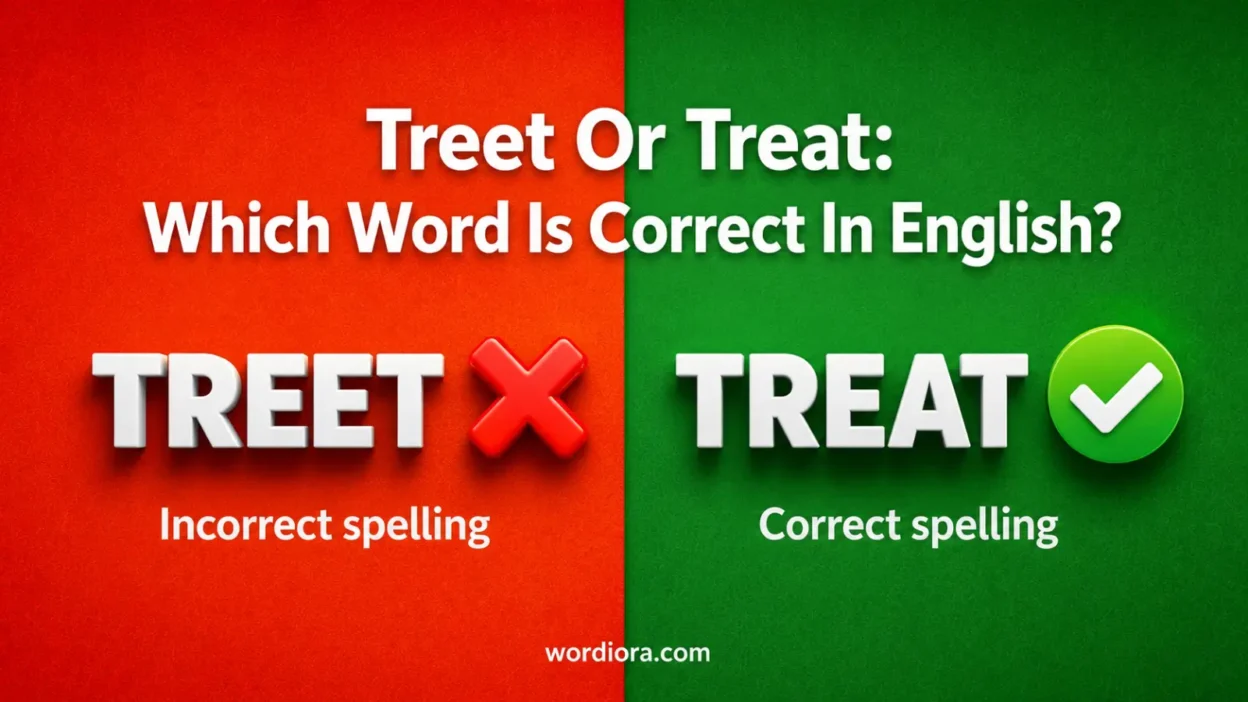
If you are choosing between treet or treat, the correct word in standard English is treat. The spelling treet is not used as a normal English word when you mean a reward, a nice thing, medical care, or the act of handling someone in a certain way.
This confusion usually happens because treat sounds like it could be spelled with ee, just like words such as tree, street, and sweet. However, English spelling does not always follow one simple sound pattern. In this case, treat is the accepted spelling.
Quick Answer
Use treat in standard English. A treat can mean something enjoyable, such as candy, dessert, or a special activity. As a verb, treat means to behave toward someone in a certain way, give medical care, or pay for something as a kind gesture. Treet is not the correct spelling for these meanings.
Why People Confuse Them
People confuse treet and treat mainly because of sound. The word treat has a long “ee” sound, so some writers guess that it should contain ee. That guess feels logical, but it is not correct.
English has many words with the long “ee” sound. Some use ee, as in tree and street. Others use ea, as in treat, meat, seat, and clean. Because both spellings can make the same sound, beginners often choose the wrong one.
Another reason is the Halloween phrase trick or treat. Many learners hear the phrase before they see it written. When they try to write it later, they may spell it as trick or treet. The correct phrase is always trick or treat.
Key Differences At A Glance
| Context | Best Choice | Why |
|---|---|---|
| A sweet reward | treat | “Treat” is the correct noun. |
| Paying for someone | treat | “My treat” means “I will pay.” |
| Medical care | treat | Doctors treat patients. |
| Behavior toward someone | treat | You treat people with respect. |
| Halloween phrase | treat | The correct phrase is “trick or treat.” |
| Standard writing | treat | “Treet” is not standard for this meaning. |
Meaning And Usage Difference
Treat is the correct word. It can be a noun or a verb. As a noun, it means something pleasant or enjoyable. For example, ice cream after dinner can be a treat. A weekend trip can also be a treat.
As a verb, treat has several common meanings. It can mean to behave toward someone in a certain way: “She treats everyone kindly.” It can mean to give medical care: “The doctor treated the injury.” It can also mean to pay for someone: “I’ll treat you to lunch.”
Treet does not carry these standard meanings in everyday English. In normal school, business, blog, and professional writing, treet should be corrected to treat.
A compact comparison is simple:
- Treat: correct spelling; standard noun and verb.
- Treet: not the correct spelling for the common English word.
- Trick or treat: correct Halloween phrase.
- Trick or treet: incorrect spelling.
Pronunciation is easy: treat sounds like treet, with a long “ee” sound. The sound is the same reason people misspell it, but the spelling must be treat.
Tone, Context, And Formality
Treat works in casual, formal, academic, medical, and professional writing. You can use it in everyday conversation, business emails, school assignments, recipes, health writing, and holiday content.
In casual speech, treat often means something fun or enjoyable:
“I bought myself a little treat.”
In polite conversation, it can mean paying for someone:
“Dinner is my treat.”
In serious writing, it can mean handling a person, topic, problem, or illness:
“The report treats the issue carefully.”
“The clinic treats patients with minor injuries.”
Treet does not fit these contexts. It looks like a spelling mistake when used in place of treat. Even if readers understand your meaning, the spelling can make the sentence look careless.
Which One Should You Use?
Use treat every time you mean the common English word. This includes food, rewards, kindness, medical care, payment, behavior, and Halloween.
Correct examples:
“I gave the dog a treat.”
“Please treat the equipment carefully.”
“The nurse treated the cut.”
“This coffee is my treat.”
“Kids shouted, ‘Trick or treat!’”
Do not use treet in these sentences. It is not the accepted spelling for the word.
If you are writing for a blog, school paper, social media caption, email, or article, choose treat. It is clear, correct, and widely understood.
When One Choice Sounds Wrong
Treet sounds wrong when readers see it in standard writing. The sound may be close, but the spelling is not accepted for the common word.
Incorrect: “I gave my cat a treet.”
Correct: “I gave my cat a treat.”
Incorrect: “The doctor will treet the patient.”
Correct: “The doctor will treat the patient.”
Incorrect: “Trick or treet!”
Correct: “Trick or treat!”
The mistake is especially noticeable in the Halloween phrase because trick or treat is a fixed expression. Changing the spelling to treet makes the phrase look incorrect.
Treat never sounds wrong when it is used with the right meaning. It is the safe choice in both casual and formal English.
Common Mistakes (And Quick Fixes)
One common mistake is using treet because the word sounds like tree. The quick fix is to remember this pattern: treat belongs with meat, seat, and neat in sound, even though not all of those words have the same spelling pattern.
Another mistake is using treat only for candy. Candy can be a treat, but the word has wider use. A treat can be any enjoyable thing, such as a movie night, a short break, or a special meal.
A third mistake is forgetting that treat can be a verb. You can treat someone kindly, treat a wound, treat a topic in an essay, or treat a friend to coffee.
A final mistake is writing trick-or-treeting instead of trick-or-treating. The correct form is based on treat, so the spelling must stay the same.
Everyday Examples
“I brought cookies as a treat for the class.”
“After a long week, a quiet dinner felt like a treat.”
“Please treat your coworkers with respect.”
“The dentist treated the problem before it got worse.”
“My brother treated me to lunch.”
“The teacher treated the question seriously.”
“The kids went trick-or-treating on Halloween.”
“Chocolate is an occasional treat, not an everyday snack.”
“The coach treated every player fairly.”
“That new bakery is a real treat.”
“Do not treat this warning lightly.”
“She treated herself to a new notebook.”
In each example, treat is the correct spelling. Treet would be incorrect in all of these everyday uses.
Dictionary-Style Word Details
Verb
Treet: Not commonly used as a verb in standard US English. Do not write “treet a patient,” “treet someone kindly,” or “treet a problem.”
Treat: A standard verb. It can mean to behave toward someone, deal with something, give medical care, or pay for someone.
Examples:
“Treat people with kindness.”
“The doctor treated the infection.”
“I’ll treat you to coffee.”
“The article treats the topic clearly.”
Noun
Treet: Not commonly used as a noun in standard US English for candy, reward, payment, pleasure, or kindness.
Treat: A standard noun. It means something pleasant, enjoyable, special, or given as a reward.
Examples:
“The puppy earned a treat.”
“That concert was a real treat.”
“Lunch is my treat.”
Synonyms
Treet: No standard synonyms apply because it is not the correct word for this meaning.
Treat: Closest plain alternatives depend on meaning.
For a pleasant thing: reward, delight, pleasure, bonus.
For paying for someone: gift, offer, courtesy.
For medical care as a verb: care for, help, tend to, manage.
For behavior: handle, deal with, act toward.
Antonyms also depend on meaning. For a pleasant treat, possible opposites include burden, problem, or disappointment. For kind treatment, possible opposites include mistreat or neglect.
Example Sentences
Treet: “Treet” should not be used in standard sentences when you mean treat.
Incorrect: “This cake is a treet.”
Correct: “This cake is a treat.”
Treat: “Treat” fits many normal English sentences.
“Give yourself a small treat after finishing the project.”
“They treat their guests warmly.”
“The hospital treats emergency cases.”
“Trick or treat is a common Halloween phrase.”
Word History
Treet: No useful standard word history applies when it is used as a mistaken spelling of treat.
Treat: The word has a long history in English and is connected with ideas of handling, dealing with, discussing, and later giving pleasure or refreshment. For everyday writers, the safest point is simple: modern standard English uses treat, not treet.
Do not invent a special history for treet as a form of treat. In this comparison, it is best understood as a misspelling.
Phrases Containing
Treet: No common standard phrases use treet for the meanings discussed here.
Treat: Common phrases include:
“Trick or treat”
“My treat”
“A special treat”
“In for a treat”
“Treat yourself”
“Treat someone with respect”
“Treat a patient”
“Treat the issue seriously”
These phrases all use treat, not treet.
FAQs
Is treet a correct English word?
No, treet is not the correct spelling when you mean a reward, candy, enjoyable thing, medical care, or kind behavior. The correct word is treat. In normal English writing, treet looks like a misspelling.
Which is correct, treet or treat?
Treat is correct. Use treat as a noun when you mean something enjoyable, such as candy, dessert, or a special reward. Use treat as a verb when you mean to handle, behave toward, care for, or pay for someone.
Is it trick or treat or trick or treet?
The correct phrase is trick or treat. This is the standard Halloween expression children say when they visit houses for candy. Trick or treet is incorrect spelling.
Why is treat spelled with ea instead of ee?
English has different spelling patterns for the same sound. The long “ee” sound can appear in words with ee, such as tree, and in words with ea, such as treat. The accepted spelling of this word is treat.
Can treat be a noun and a verb?
Yes. Treat can be a noun or a verb. As a noun, it means something pleasant or special. As a verb, it can mean to behave toward someone, give medical care, deal with a topic, or pay for someone.
What does my treat mean?
My treat means “I will pay.” For example, if someone says, “Coffee is my treat,” they mean they are offering to pay for the coffee. This phrase is friendly and common in everyday English.
What is a good sentence with treat?
A simple sentence is: “I gave my dog a treat after his walk.” Another example is: “Please treat everyone with respect.” Both sentences use treat correctly, but the word has a different role in each one.
Should I ever use treet in an article?
Do not use treet in an article unless you are explaining that it is an incorrect spelling of treat. For normal writing, grammar posts, schoolwork, captions, and professional content, use treat.
Conclusion
The correct choice is treat, not treet. Use treat for something enjoyable, a reward, medical care, kind behavior, payment, or the Halloween phrase trick or treat.
The spelling treet may seem possible because it matches the sound of the word, but it is not the standard spelling for these meanings. When you are unsure, remember the simple rule: if you mean candy, kindness, care, payment, or Halloween, write treat.