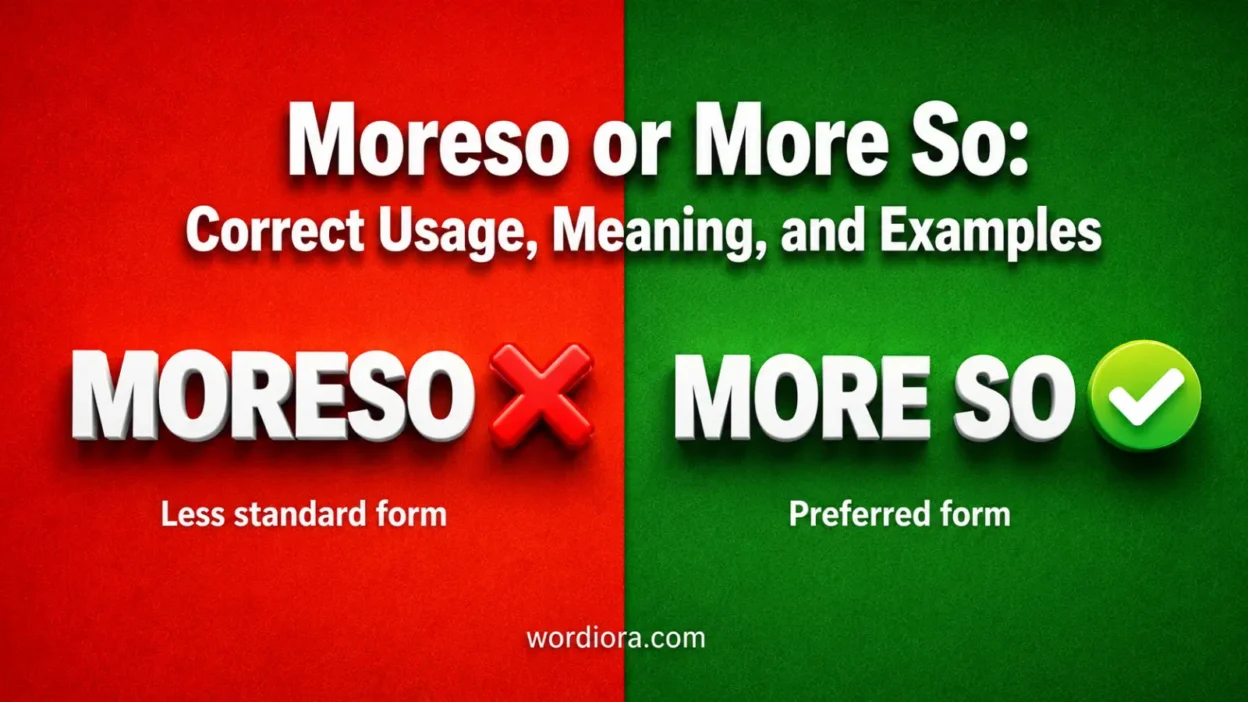
The correct standard choice is more so, written as two words. Moreso appears in informal writing, especially online, but many careful readers and editors still see it as nonstandard.
This comparison is not only about a missing space. The phrase more so works because so points back to an earlier idea, adjective, or condition. Once you understand that pattern, the choice becomes much easier.
Quick Answer
Use more so in standard US English. It means “to a greater extent” or “even more in that way.” Use moreso only if you are quoting informal writing or intentionally using a disputed casual form. For school, work, articles, emails, and edited writing, more so is the safer choice.
Why People Confuse Them
People confuse moreso and more so because the phrase sounds like one unit when spoken. Since English has many closed compounds, such as therefore and however, writers may assume moreso has also become one word.
Another reason is speed. In casual typing, people often join short phrases together. That does not make the form standard in careful writing.
The confusion also grows because more so can feel slightly formal. Writers sometimes replace it with moreso because the one-word form looks smoother. However, smooth does not always mean accepted.
Key Differences At A Glance
| Context | Best Choice | Why |
|---|---|---|
| Formal writing | more so | It is the standard form. |
| School essays | more so | Teachers and editors usually expect two words. |
| Business emails | more so | It looks cleaner and more professional. |
| Casual texting | more so | Still the safer spelling, even casually. |
| Quoting informal use | moreso | Use it only if the original text uses it. |
| Comparing degrees | more so | It means “to a greater extent.” |
| Replacing “especially” | usually not either | Use especially when that is the real meaning. |
| Replacing “more” | usually more | Do not add so unless it refers back clearly. |
Meaning and Usage Difference
More so means “to a greater degree” or “even more in that same way.”
Example:
The first draft was clear, and the final version was more so.
Here, more so means the final version was even more clear. The word so points back to clear.
Moreso is a one-word form that some people use with the same meaning. However, it is still disputed. It may appear in casual posts, comments, and quick online writing, but it is not the best choice for polished US English.
A useful way to test the phrase is to ask: “More what?” If the answer comes from an earlier adjective or idea, more so may work.
Example:
The policy was confusing, more so for new employees.
This means the policy was even more confusing for new employees.
Tone, Context, and Formality
More so sounds standard, careful, and natural in edited writing. It works in articles, essays, reports, emails, and professional messages.
Moreso sounds casual and disputed. Some readers may not notice it, but others may see it as an error. That makes it risky when your writing needs to look polished.
This is not a strong US vs UK difference for everyday writers. The better rule is simpler: use more so anywhere clarity and correctness matter.
Pronunciation does not need much attention here. Both forms are spoken the same way: more so. The confusion happens mainly in spelling and writing, not in sound.
Which One Should You Use?
Use more so almost every time.
Choose more so when you mean:
• to a greater extent
• even more in that way
• more true for one person, thing, or situation than another
Correct:
The app is helpful for beginners, and more so for visual learners.
Correct:
The room felt crowded, even more so after the chairs were added.
Avoid moreso in formal writing because it may distract readers. It does not add a useful meaning that more so cannot already express.
When One Choice Sounds Wrong
Moreso sounds wrong in careful writing because it joins two words that still work separately in the phrase.
Weak:
The training was useful, moreso for new hires.
Better:
The training was useful, more so for new hires.
Also, more so can sound wrong when you really need more, especially, or also.
Weak:
I like this plan more so than the old one.
Better:
I like this plan more than the old one.
Weak:
The rule affects employees, more so managers.
Better:
The rule affects employees, especially managers.
Common Mistakes (and Quick Fixes)
Mistake 1: Writing moreso in a formal sentence.
Fix: Use more so.
Incorrect:
The delay hurt small stores, moreso during the holiday rush.
Correct:
The delay hurt small stores, more so during the holiday rush.
Mistake 2: Using more so when more is enough.
Fix: Use more before than when making a direct comparison.
Incorrect:
She trusts him more so than anyone else.
Correct:
She trusts him more than anyone else.
Mistake 3: Using more so as a loose connector.
Fix: Use also, more importantly, or especially if that is what you mean.
Incorrect:
The hotel was clean; more so, it was affordable.
Correct:
The hotel was clean; more importantly, it was affordable.
Everyday Examples
Correct:
The new schedule is hard for parents, and even more so for single parents.
Correct:
The first interview was stressful; the second was more so.
Correct:
Online privacy matters to everyone, more so to people who work with sensitive data.
Correct:
The movie was funny, but the behind-the-scenes clips were more so.
Correct:
The rule applies to all contractors, and all the more so to new ones.
Not recommended:
The first interview was stressful; the second was moreso.
Better:
The first interview was stressful; the second was more so.
Compact Comparison
• More so: standard, preferred, safe in edited writing
• Moreso: disputed, informal, best avoided unless quoting or using a casual voice
• Best memory tip: if you can replace so with a previous idea, keep more so as two words
Dictionary-Style Word Details
Verb
• Moreso: Not commonly used as a verb in standard US English.
• More so: Not used as a verb. It is a phrase that works adverbially.
Noun
• Moreso: Not commonly used as a noun in standard US English.
• More so: Not used as a noun. It describes degree or extent.
Synonyms
• Moreso: Closest plain alternatives are more so, even more, and to a greater extent, but more so is the standard form.
• More so: Closest plain alternatives are even more, to a greater extent, all the more, and sometimes especially, depending on the sentence.
Clear antonyms are limited because this is a phrase of degree. In some sentences, less so works as the opposite.
Example:
The first plan was risky; the second was less so.
Example Sentences
• Moreso: Moreso appears in casual writing, but it is safer to revise it to more so.
• More so: The change helped remote workers, more so than office workers.
• Moreso: The issue became moreso urgent is not a good standard sentence. Use more urgent instead.
• More so: The issue became urgent, and even more so after the deadline changed.
Word History
• Moreso: The one-word form has appeared in writing, but it remains disputed and is often treated as informal or nonstandard. Do not present it as the safest modern form.
• More so: The two-word phrase is the established standard. It comes from the separate use of more plus so, where so refers back to something already stated or understood.
Phrases Containing
• Moreso: No widely preferred standard phrase requires moreso as one word.
• More so: Common phrases include even more so, much more so, all the more so, and more so than.
Examples:
The point matters today, even more so after the update.
That is true for students, all the more so for first-year students.
The second option is useful, much more so for small teams.
FAQs
Is moreso or more so correct?
More so is the correct standard form. Moreso appears in informal writing, but it is still disputed. Use more so in school, work, articles, and professional messages.
Is moreso one word?
Moreso is written as one word, but that does not make it the preferred form. In careful US English, the phrase should usually be written as more so, with a space.
What does more so mean?
More so means “to a greater extent” or “even more in that way.” It often refers back to an earlier adjective or idea.
Example:
The first task was difficult, and the second was more so.
Can I use moreso in casual writing?
You may see moreso in casual posts and comments, but it can still look wrong to many readers. More so is better because it works in both casual and formal writing.
Is more so the same as more?
Not always. More is often better in direct comparisons.
Correct:
I like this version more than the last one.
Use more so when so refers back to an earlier idea.
Correct:
The last version was useful, and this one is more so.
Is even more so correct?
Yes. Even more so is a common standard phrase. It means something is true to an even greater degree.
Example:
Clear instructions matter, even more so during an emergency.
Conclusion
Use more so, not moreso, when you want standard US English. The phrase means “to a greater extent,” and so usually points back to an earlier idea.
Moreso exists in informal writing, but it remains risky in polished work. When your sentence needs clarity, professionalism, or correctness, keep the phrase as two words: more so.