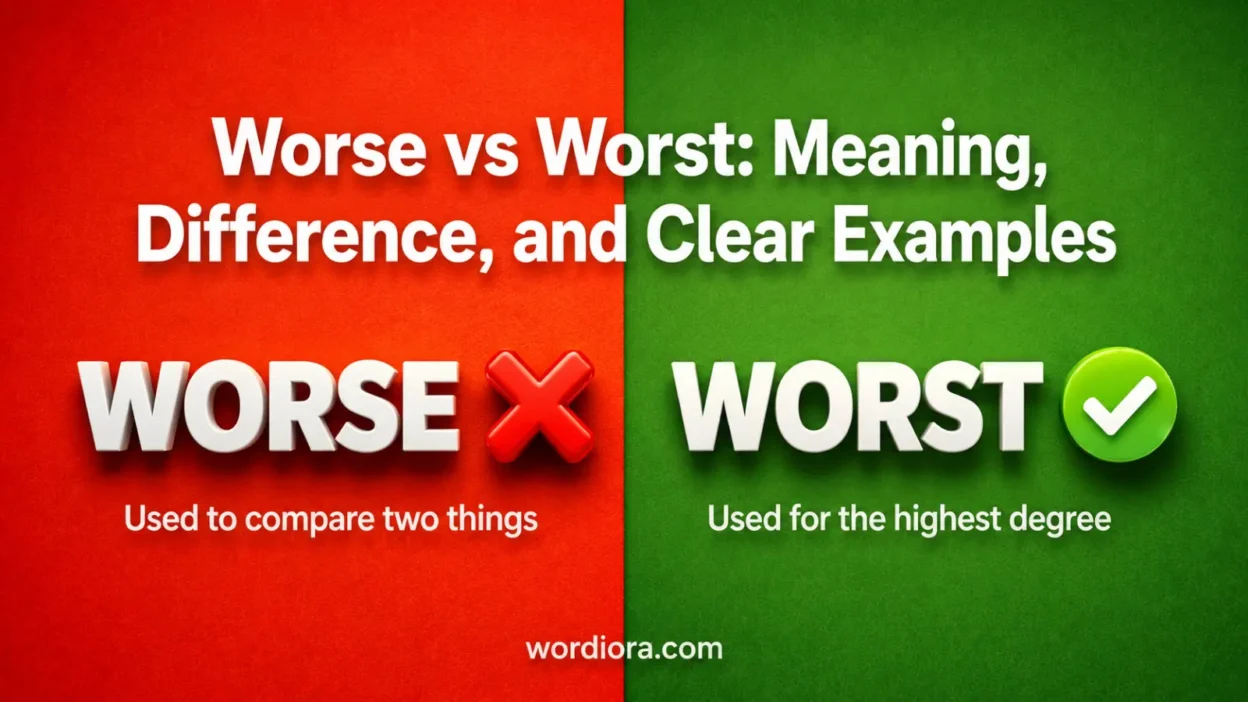
Worse vs worst is a common English confusion because the words look similar, sound similar, and both describe something bad. The difference is simple once you see the grammar pattern.
Use worse when something is more bad than another thing or more bad than before. Use worst when something is the most bad in a group, period, or situation.
Think of the pattern this way: bad, worse, worst. It works like good, better, best. You would not say “more better,” and you should not say “more worse.” You would not use “best” for a normal two-part comparison, and you should not use “worst” when you only mean “worse than.”
Quick Answer
Worse is the comparative form of bad. It means one thing is more unpleasant, lower in quality, or more serious than another. Worst is the superlative form of bad. It means something is the most unpleasant, lowest in quality, or most serious of all.
Use worse for comparison. Use worst for the extreme.
Why People Confuse Them
People confuse worse and worst because only one letter separates them. In fast speech, the final t in worst can also sound light, so the two words may seem almost the same.
Another reason is that both words come from the same idea: badness. They do not name different topics. Instead, they show different degrees of the same quality.
The confusion often appears in sentences like these:
- The pain is getting worst.
- This is the worse day ever.
- That movie was more worse than the first one.
Each sentence mixes the level of comparison. The fix is to ask: “Am I comparing, or am I naming the most extreme option?”
Key Differences At A Glance
| Context | Best Choice | Why |
|---|---|---|
| Comparing two things | worse | One thing is more bad than another. |
| Comparing now with before | worse | The condition has declined. |
| Naming the most bad option | worst | One thing is at the bottom of the group. |
| Using “than” | worse | “Than” usually signals comparison. |
| Using “the” before the word | worst | “The worst” often points to the extreme. |
| Talking about a possible bad outcome | worst | Use “worst-case scenario.” |
| Saying something became more serious | worse | The problem got worse. |
Meaning and Usage Difference
Worse means “more bad,” “less good,” “more unpleasant,” or “more serious.” It compares one thing with another thing, or one condition with an earlier condition.
Examples:
- Today’s traffic is worse than yesterday’s.
- Her headache got worse after lunch.
- This plan is worse than the first one.
Worst means “most bad,” “least good,” “most unpleasant,” or “most serious.” It points to the lowest point or the most negative option.
Examples:
- That was the worst traffic I’ve seen all year.
- This is the worst headache I’ve ever had.
- Of the three plans, this one is the worst.
A helpful memory trick: worse compares; worst crowns the loser.
Compact comparison:
- Worse: more bad than something else.
- Worst: the most bad of all.
- Worse: often pairs with than.
- Worst: often pairs with the.
- Worse: “Things got worse.”
- Worst: “That was the worst part.”
Tone, Context, and Formality
Both worse and worst are standard in American English. Neither word is more formal by itself. The difference is not tone; it is grammar and meaning.
In everyday speech, people often use worse for changes:
- My allergies are worse today.
- The line got worse after 5 p.m.
In writing, worst often appears when naming the strongest negative result:
- This was the worst delay of the season.
- The worst option is to ignore the issue.
Some phrases are more casual than others. If worse comes to worst is common in speech and casual writing. In formal writing, in the worst case is often cleaner.
Pronunciation is simple: worse sounds like “wurs,” while worst sounds like “wurst.” The final t in worst matters because it helps listeners hear the superlative form.
Which One Should You Use?
Use worse when your sentence compares two things, two people, two actions, or two moments in time.
Use worse with patterns like:
- worse than
- getting worse
- feel worse
- make it worse
- worse news
- worse situation
Examples:
- This laptop is worse than my old one.
- I feel worse today.
- Don’t make the problem worse.
Use worst when your sentence names the most negative thing in a set, even if the set is only implied.
Use worst with patterns like:
- the worst
- worst of all
- worst-case scenario
- my worst fear
- the worst part
- at worst
Examples:
- That was the worst meeting of the year.
- Worst of all, nobody told the client.
- In a worst-case scenario, we lose one day of work.
When One Choice Sounds Wrong
Worse sounds wrong when you need the highest degree.
Wrong: This is the worse restaurant in town.
Correct: This is the worst restaurant in town.
The sentence means no restaurant in town is lower in quality, so worst is correct.
Worst sounds wrong when you are only comparing one thing with another.
Wrong: My score was worst than yours.
Correct: My score was worse than yours.
The word than signals comparison, so worse is the right choice.
A simple test helps: if you can add than, choose worse. If you can add the and mean “the most bad,” choose worst.
Common Mistakes and Quick Fixes
One common mistake is more worse. Do not use it. Worse already means “more bad.”
Wrong: This version is more worse.
Correct: This version is worse.
Also correct: This version is much worse.
Another mistake is much worst. Use much worse for comparison, or by far the worst for the strongest negative option.
Wrong: That was much worst than expected.
Correct: That was much worse than expected.
Wrong: It was much worst of the three.
Correct: It was by far the worst of the three.
Also watch worst-case scenario. This phrase uses worst because it means the most negative possible case.
Correct: In the worst-case scenario, we start over.
Everyday Examples
Here are natural examples that show the difference clearly:
- The coffee is bad, but the sandwich is worse.
- That was the worst sandwich I’ve had in months.
- The weather got worse after we left home.
- Friday’s storm was the worst of the week.
- His first excuse was weak, and his second was worse.
- The worst part was that he blamed someone else.
- My old phone had a bad camera, but this one is worse.
- This is the worst camera on any phone I’ve owned.
- Missing the bus was bad. Losing my wallet was worse.
- The worst mistake would be ignoring the deadline.
In each pair, worse compares. Worst names the lowest or most negative point.
Dictionary-Style Word Details
Verb
- worse: Not commonly used as a verb in standard US English. Use worsen when you need a verb meaning “to become worse” or “to make worse.”
Example: The delay could worsen the problem. - worst: Can be used as a verb meaning “to defeat” or “to get the better of,” but this use is rare in everyday American English.
Example: The challenger worsted his opponent in the final round.
Noun
- worse: Can work as a noun in set phrases, especially for better or worse and a turn for the worse.
Example: The project took a turn for the worse. - worst: Can work as a noun meaning the worst thing, person, part, or condition.
Example: The worst is over.
Synonyms
- worse: Closest plain alternatives include poorer, less good, more serious, more unpleasant, and inferior. The best antonym is better.
- worst: Closest plain alternatives include poorest, lowest, least desirable, most serious, and most unpleasant. The best antonym is best.
These alternatives depend on context. For example, more serious fits an injury, while poorer fits quality.
Example Sentences
- worse: The second draft is worse than the first because it removed important details.
- worse: My cold felt worse this morning.
- worse: Waiting will only make the situation worse.
- worst: That was the worst call of the game.
- worst: The worst option is to ignore the warning.
- worst: At worst, we will have to reschedule.
Word History
- worse: Comes from older English forms connected with the comparative idea of “more bad” or “more evil.” The modern use is fixed as the comparative form of bad and ill.
- worst: Comes from older English forms connected with the superlative idea of “most bad” or “most evil.” The modern use is fixed as the superlative form of bad and ill.
The exact older forms are not needed for everyday choice. For modern writing, the key pattern is bad, worse, worst.
Phrases Containing
- worse:
- worse than
- getting worse
- make matters worse
- for better or worse
- a turn for the worse
- if worse comes to worst
- worst:
- the worst
- worst of all
- at worst
- worst-case scenario
- bring out the worst
- the worst of both worlds
- my worst fear
FAQs
What is the difference between worse and worst?
Worse means more bad than something else. Worst means the most bad of all. Use worse when comparing two things or showing that something has declined. Use worst when naming the lowest, most serious, or most unpleasant option.
Is it worse than or worst than?
The correct phrase is worse than. The word than shows comparison, so you need worse.
Example: This test was worse than the last one.
Is “more worse” correct?
No, more worse is not correct in standard English. Worse already means “more bad.” Say worse or much worse instead.
Correct: The problem got worse.
Correct: The problem got much worse.
When should I use worst?
Use worst when something is the most bad, most serious, or least desirable in a group or situation.
Example: That was the worst movie I watched this year.
Can worse and worst both describe feelings?
Yes. Use worse when your feeling has declined or is being compared. Use worst when it is the most negative feeling.
Example: I feel worse today.
Example: This is the worst I’ve felt all week.
Is it “the worse” or “the worst”?
Usually, the correct phrase is the worst when you mean the most bad option.
Example: That was the worst part of the trip.
Use the worse only in special comparison structures, such as “the worse of the two.”
What does “worst-case scenario” mean?
A worst-case scenario means the most negative possible result. It uses worst because it describes the extreme bad outcome, not just something worse than another thing.
Is “if worse comes to worst” correct?
Yes, if worse comes to worst is a common phrase. It means “if the situation becomes as bad as it can reasonably get.” Some people also say “if worst comes to worst,” but if worse comes to worst is a widely accepted form.
What is the opposite of worse?
The opposite of worse is better.
Example: My headache is worse today.
Opposite: My headache is better today.
What is the opposite of worst?
The opposite of worst is best.
Example: That was the worst answer.
Opposite: That was the best answer.
Conclusion
The difference between worse and worst is about degree. Worse compares one bad thing with another or shows that something has declined. Worst names the most bad option, condition, moment, or result.
Use worse when you mean “more bad.” Use worst when you mean “most bad.” If your sentence uses than, you probably need worse. If your sentence means “the most negative of all,” you probably need worst.
Remember the pattern: bad, worse, worst.