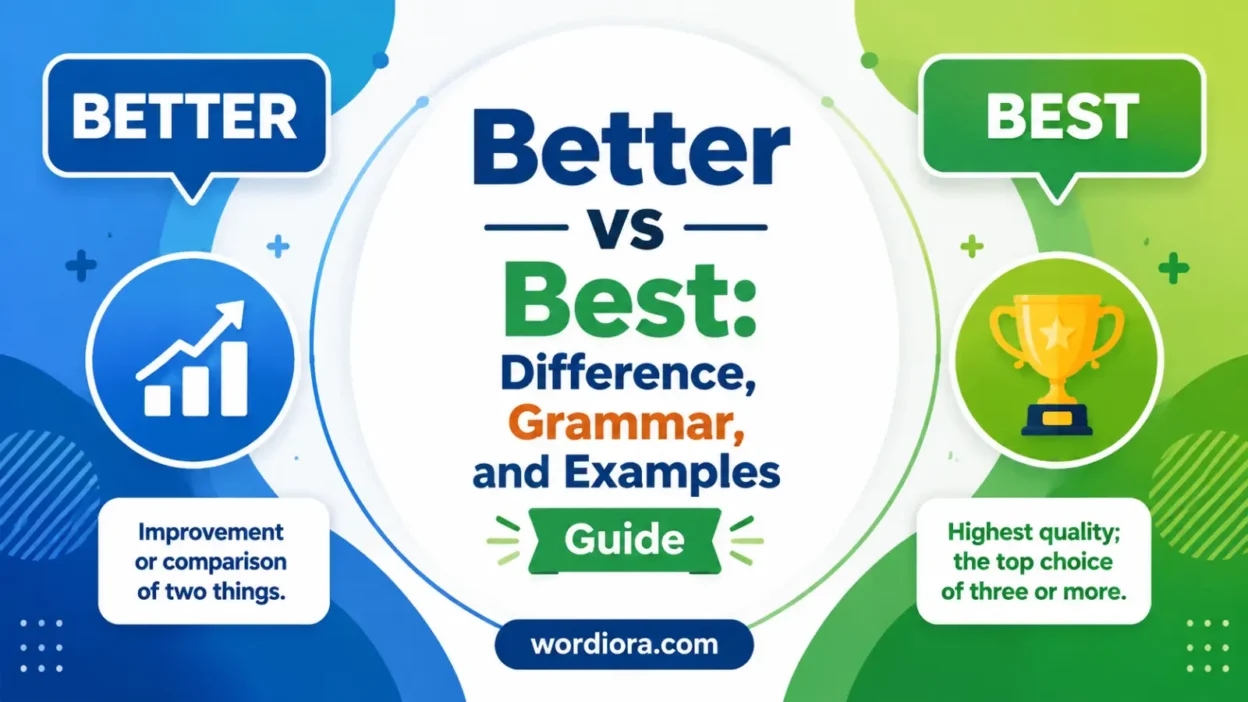
Better vs best is a common word-choice problem because both words point to something good. The difference is in the comparison.
Use better when you compare one thing with another thing, or when something improves. Use best when you mean the top choice, the highest quality, or the most suitable option in a group.
Both words are correct. The wrong choice depends on the sentence. “This plan is better than the old one” is correct because two plans are being compared. “This is the best plan for the team” is correct because one plan is being chosen as the strongest option.
Quick Answer
Better is the comparative form. It means one thing is more good, more useful, or more suitable than another. Best is the superlative form. It means one thing is the top choice in a set. In careful writing, use better for two direct choices and best for the top choice overall.
Why People Confuse Them
People confuse better and best because both are linked to good and well. They also appear in the same kinds of sentences: reviews, advice, school work, job feedback, sports, health, and everyday choices.
The sentence can also hide the comparison. If someone says, “This phone is better,” you may ask, “Better than what?” If someone says, “This phone is best,” the sentence usually needs a group or purpose, such as “best for travel” or “best in its price range.”
The biggest mistake is treating both words as simple synonyms. They are close in meaning, but they do different jobs.
Key Differences At A Glance
| Context | Best Choice | Why |
|---|---|---|
| Comparing two clear options | better | It shows one option is stronger than another. |
| Naming the top option in a group | best | It points to the highest or most suitable choice. |
| Showing improvement | better | It means something has become more good or more effective. |
| Giving a final recommendation | best | It sounds like the top recommendation. |
| Using “than” | better | “Better than” is the normal comparison pattern. |
| Using “of all” or “in the group” | best | These phrases point to the top item in a set. |
Meaning and Usage Difference
Better means “more good,” “more suitable,” “more effective,” or “improved.” It needs a comparison, even when that comparison is only understood from context.
Example: “This route is better.”
That means it is better than another route.
Best means “most good,” “most suitable,” or “highest in quality.” It names the top choice in a group, category, or situation.
Example: “This is the best route.”
That means it is the top route among the choices being considered.
A helpful comparison:
- Better: compares one option with another.
- Best: chooses the top option from a set.
- Better: often works with than.
- Best: often works with the, in, of, or a purpose phrase.
There is one nuance. In everyday English, people sometimes use best when the set has only two choices. That is not automatically wrong. Still, better is often clearer when the sentence directly compares two options.
Tone, Context, and Formality
Better and best are both normal in casual, professional, and academic writing. The difference is not formality. The difference is strength and structure.
Better sounds comparative. It suggests a choice has improved or is stronger than another choice, but it may not be perfect.
Example: “Email is better than texting for this update.”
Best sounds stronger and more final. It suggests the top answer, safest choice, or strongest fit.
Example: “Email is the best way to send the full update.”
In reviews, better is useful when weighing options. In recommendations, best is useful when giving a clear winner.
Which One Should You Use?
Use better when your sentence answers “better than what?”
Examples:
“This draft is better than the first one.”
“She feels better today.”
“The blue jacket fits better than the black one.”
Use best when your sentence answers “best among which choices?” or “best for what purpose?”
Examples:
“This is the best draft so far.”
“She gave the best answer in class.”
“The blue jacket is the best choice for the interview.”
For two direct choices, better is usually the cleaner choice:
Correct: “Of the two apartments, the second one is better.”
Also possible: “Of the two apartments, the second one is the best.”
Cleaner in careful writing: “the better choice.”
When One Choice Sounds Wrong
Better sounds wrong when the sentence clearly names the top item in a group.
Weak: “She is the better player on the team.”
Better: “She is the best player on the team.”
Why? “On the team” points to a group, so best fits better.
Best sounds wrong when the sentence uses than for a direct comparison.
Wrong: “This laptop is best than my old one.”
Correct: “This laptop is better than my old one.”
Why? The word than needs a comparative form, so better is the right choice.
Common Mistakes and Quick Fixes
One common mistake is more better.
Wrong: “This version is more better.”
Correct: “This version is better.”
Better already has the comparative meaning. You do not need more before it.
Another mistake is best than.
Wrong: “Her answer was best than mine.”
Correct: “Her answer was better than mine.”
A third mistake is using better of all.
Wrong: “That was the better of all the choices.”
Correct: “That was the best of all the choices.”
Use better for a direct comparison. Use best when the sentence points to all choices, a whole group, or the top result.
Everyday Examples
“Today’s meeting was better than last week’s meeting.”
“That was the best meeting we have had this month.”
“This coffee tastes better with less sugar.”
“This is the best coffee shop near the office.”
“Her second interview went better than her first.”
“She gave the best interview of the final three candidates.”
“The new schedule works better for parents.”
“The 8 a.m. schedule is the best option for the whole team.”
“He played better after halftime.”
“He was the best player on the court.”
“Texting is better for a quick note.”
“Calling is best when the topic is serious.”
Dictionary-Style Word Details
Verb
Better: Better can be a verb meaning to improve something, make something more complete, or surpass a previous result.
Example: “The program helped better the community.”
Best: Best can be a verb meaning to defeat or outdo someone, often in competition. It is less common in everyday speech than the adjective use.
Example: “She bested her rival in the final round.”
Noun
Better: As a noun, better can mean a better thing, a better state, or a person of higher rank or ability.
Example: “The policy changed things for the better.”
Best: As a noun, best can mean the top person or thing, the highest level, or someone’s strongest effort.
Example: “He did his best.”
Synonyms
Better: Closest plain alternatives include improved, superior, more suitable, and more effective. A clear opposite is worse.
Best: Closest plain alternatives include finest, top, most suitable, and highest-quality. A clear opposite is worst.
These alternatives are not always exact replacements. Better usually needs a comparison. Best usually points to the top choice.
Example Sentences
Better: “This apartment is better than the one we toured yesterday.”
Better: “I feel better after getting some sleep.”
Better: “The revised headline works better.”
Best: “This is the best apartment in our budget.”
Best: “The best answer is the simplest one.”
Best: “She works best in a quiet room.”
Word History
Better: Better is an old irregular comparison form connected with good and well. The practical point for modern writers is simple: English says better, not gooder.
Best: Best is the matching irregular superlative form connected with good and well. English says best, not goodest.
The important usage point is not the age of the words. It is their job in the sentence: better compares, while best marks the highest choice.
Phrases Containing
Better:
“had better”
“better off”
“for the better”
“the better part of”
“better late than never”
Best:
“at best”
“do your best”
“best bet”
“best of all”
“make the best of”
“all the best”
Some phrases have fixed meanings. For example, had better means something is advisable in a specific situation. Best bet means the most likely successful choice.
FAQs
Is “better” correct for two things or should I use “best”?
Use better when directly comparing two things. Example: “This phone is better than that one.”
Best can appear with two items, but in clear comparison writing, better is usually more precise.
Is “best” always for three or more things?
Not always. Best is used for the top choice in a group or category, even if the group has only two items. However, in strict comparison sentences, better is often preferred.
What is the main grammar difference between better and best?
Better is the comparative form (comparing two or more things).
Best is the superlative form (choosing the top option in a set).
Can I say “more better” or “most best”?
No. Both are incorrect.
Correct forms are:
- better (not “more better”)
- best (not “most best”)
Is “best than” correct?
No. After than, you must use a comparative form like better.
Correct: “This is better than that.”
Incorrect: “This is best than that.”
What does “do your best” mean?
It means to put in your maximum effort or try as hard as possible in a situation. Example: “Just do your best on the test.”
When should I avoid using “best”?
Avoid best when you are directly comparing two specific things with “than.” In that case, better is clearer and more natural.
Is “better” always positive?
Yes, it usually shows improvement or superiority compared to something else. Example: “I feel better today than yesterday.”
Conclusion
The difference between better and best is simple once you look at the comparison. Use better when one thing is being compared with another or when something improves. Use best when you mean the top choice, highest quality, or most suitable option in a group.
For most sentences, ask one quick question: Am I comparing, or am I choosing the top option? If you are comparing, choose better. If you are naming the top choice, choose best.