Said and told are both correct words, but they are not used the same way.
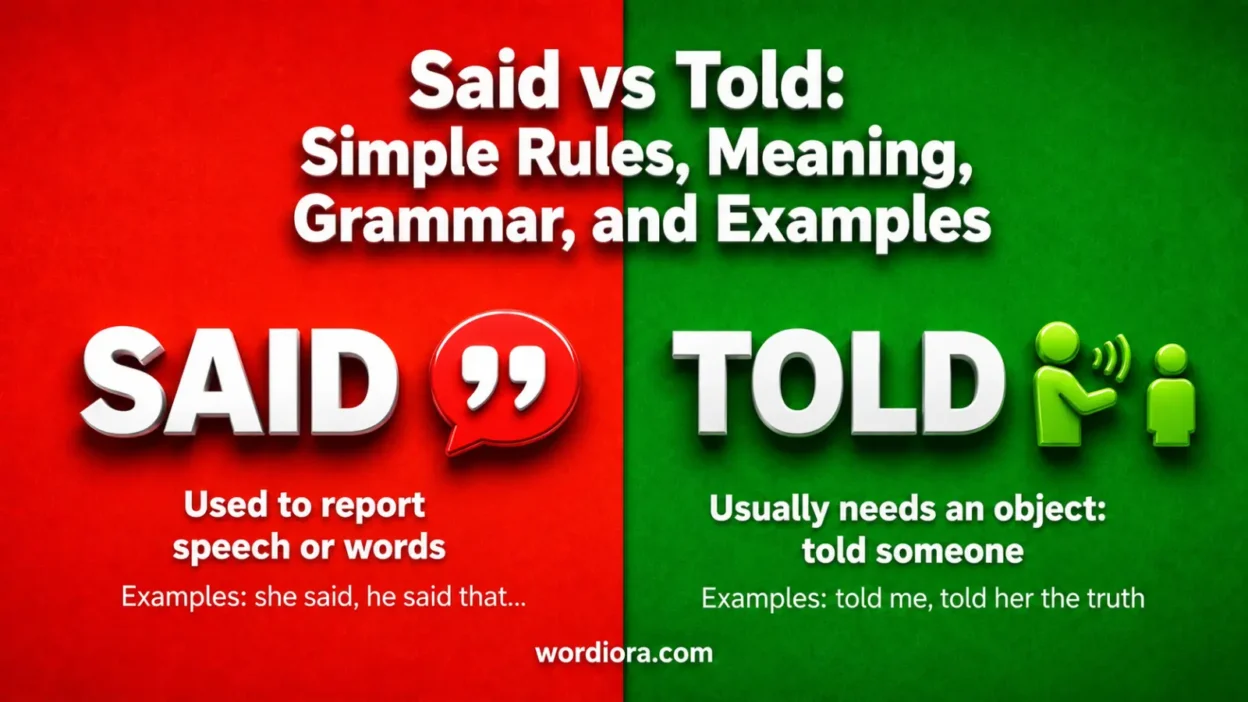
The easiest difference is this: said focuses on the words someone spoke. Told focuses on the person who received the message.
You can write, “She said she was tired.” You can also write, “She told me she was tired.” But “She told she was tired” sounds wrong because told usually needs a person after it.
Quick Answer
Use said when the listener is not named or when you are reporting the exact words.
Use told when you name the person who received the message, advice, order, warning, or information.
Correct:
“She said the meeting was canceled.”
Correct:
“She told me the meeting was canceled.”
Not correct:
“She told the meeting was canceled.”
Why People Confuse Them
People confuse said and told because both words report speech. They both look back at something someone expressed.
The problem is not the basic meaning. The problem is the sentence pattern.
Said can stand without a listener. Told usually needs one.
That is why these two sentences do not feel the same:
“She said she was leaving.”
“She told me she was leaving.”
Both are natural. The second one adds the person who got the message.
Key Differences At A Glance
| Feature | said | told |
|---|---|---|
| Base verb | say | tell |
| Main focus | The words or message | The listener or receiver |
| Common pattern | said + words/message | told + person + message |
| With a person | said to me | told me |
| With instructions | less common | very common |
The main point: said reports what was spoken. Told reports what was communicated to someone.
Meaning and Usage Difference
Said is the past tense of say. It means someone expressed words.
Example:
“Jordan said he would call after work.”
The sentence tells us what Jordan expressed. It does not need to say who heard it.
Told is the past tense of tell. It means someone gave information, instructions, a warning, or a message to another person.
Example:
“Jordan told Maya he would call after work.”
Now the sentence names the person who received the message: Maya.
Use said for quoted speech:
Mom said, “Dinner is ready.”
Use told when the sentence points to the listener:
Mom told us dinner was ready.
You can also use said to when you want to name the listener:
Mom said to us, “Dinner is ready.”
That is correct, but in everyday US English, told us often sounds smoother when the sentence is not a direct quote.
Tone, Context, and Formality
Neither word is more formal by itself. The difference is mostly grammar and focus.
Said is neutral and common in stories, news-style writing, emails, and everyday conversation. It works well when the message matters more than the listener.
Example:
“The manager said the office would close early.”
Told is also neutral and common. It works well when the listener matters or when someone gave directions, advice, or instructions.
Example:
“The manager told the team to leave early.”
Told can sound more direct because it often involves a person receiving information. It can also suggest instruction:
“She told him to wait outside.”
Said does not naturally work in that pattern:
“She said him to wait outside” is wrong.
Which One Should You Use?
| Context | Best Choice | Why |
|---|---|---|
| Reporting someone’s words without naming the listener | said | The focus is the message. |
| Naming who received the message | told | The person comes right after the verb. |
| Giving instructions | told | “Told me to…” is the natural pattern. |
| Using a direct quote | said | It introduces exact spoken words smoothly. |
| Mentioning the listener with “to” | said to | “Said to me” is correct. |
| Talking about advice or warnings | told | Advice and warnings are usually given to someone. |
A quick test helps:
If a person comes right after the verb, told is usually the better choice.
When One Choice Sounds Wrong
Said sounds wrong when it is followed directly by a person.
Wrong:
“She said me the answer.”
Correct:
“She told me the answer.”
Also correct:
“She said the answer to me.”
That second version is grammatical, but it may sound less natural in casual speech.
Told sounds wrong when no listener is included.
Wrong:
“He told that he was busy.”
Correct:
“He said that he was busy.”
Also correct:
“He told us that he was busy.”
With told, the listener can be a name, a noun, or a pronoun:
“She told Alex the news.”
“The teacher told the class about the test.”
“My sister told me she was leaving.”
Common Mistakes (and Quick Fixes)
Mistake:
“I said her I was late.”
Fix:
“I told her I was late.”
Mistake:
“He told to me the news.”
Fix:
“He told me the news.”
Mistake:
“They told they were moving.”
Fix:
“They said they were moving.”
Mistake:
“My teacher said us to study.”
Fix:
“My teacher told us to study.”
Mistake:
“She told, ‘I’m ready.’”
Fix:
“She said, ‘I’m ready.’”
Better if a listener matters:
“She told me she was ready.”
Everyday Examples
“Dad said the car needs gas.”
“Dad told me the car needs gas.”
“The doctor said I should rest.”
“The doctor told me to rest.”
“She said she loved the movie.”
“She told her friends she loved the movie.”
“Our coach said practice starts at 6.”
“Our coach told the team practice starts at 6.”
“I said I was sorry.”
“I told my brother I was sorry.”
Both words can be correct in similar situations, but the sentence structure changes.
Dictionary-Style Word Details
Verb
said: The past tense and past participle of say. It is used when someone expressed words, thoughts, or a message.
Example:
“He said he would be home soon.”
told: The past tense and past participle of tell. It is used when someone gave information, instructions, or a message to another person.
Example:
“He told me he would be home soon.”
Noun
said: Not commonly used as a noun in standard US English. In this comparison, it is mainly a verb form.
told: Not commonly used as a noun in standard US English. In this comparison, it is mainly a verb form.
Synonyms
said: closest plain alternatives include stated, mentioned, replied, answered, and remarked. These are not always exact matches, because each one can add a different tone.
told: closest plain alternatives include informed, notified, explained to, instructed, and warned. These fit best when a listener or receiver is included.
Clear antonyms are not always simple for either word. In some contexts, the opposite idea may be stayed silent, kept quiet, or withheld information, but those are context-based opposites, not perfect one-word matches.
Example Sentences
said:
“She said the store closes at 9.”
“He said, ‘I’ll text you later.’”
“They said they needed more time.”
told:
“She told me the store closes at 9.”
“He told his roommate he would text later.”
“They told the manager they needed more time.”
Word History
said: Modern English uses said as the past form of say.
told: Modern English uses told as the past form of tell.
The practical history point is simple: these are not two spellings of the same word. They come from two different verbs, so they follow different sentence patterns.
Phrases Containing
said:
“said yes”
“said no”
“said that”
“said to me”
“as I said”
told:
“told me”
“told us that”
“told you so”
“all told”
“was told to”
Some phrases have special uses. For example, all told means “in total,” so it is not the same as reporting what someone said.
FAQs
Is it “I said him” or “I told him”?
Use I told him.
Correct: “I told him the news.”
Wrong: “I said him the news.”
You can say I said to him, but it is usually used with exact words.
Correct: “I said to him, ‘Please wait here.’”
Is it “she said me” or “she told me”?
Use she told me.
Correct: “She told me she was busy.”
Wrong: “She said me she was busy.”
You can also write: “She said to me that she was busy,” but told me sounds more natural in everyday English.
Can I say “said to me”?
Yes. Said to me is correct.
Example: “He said to me, ‘Don’t worry.’”
But when you are not using a direct quote, told me often sounds smoother.
More natural: “He told me not to worry.”
Does “told” always need a person after it?
In active sentences, told usually needs a person, group, or listener.
Correct: “The teacher told us to study.”
Wrong: “The teacher told to study.”
But passive forms are different.
Correct: “I was told to study.”
Which is better with direct quotes: said or told?
Use said with direct quotes most of the time.
Correct: She said, “I’m ready.”
Less natural: She told me, “I’m ready.”
Use told when you are reporting the message to a listener.
Correct: “She told me she was ready.”
Which is better for instructions: said or told?
Use told for instructions.
Correct: “My boss told me to email the client.”
Wrong: “My boss said me to email the client.”
You can use said if you report the exact words.
Correct: “My boss said, ‘Email the client.’”
Are said and told interchangeable?
No. They are related, but they are not fully interchangeable.
Use said when the focus is the words or message.
Use told when the focus includes the person who received the message.
What is the simplest rule for said vs told?
Use this pattern:
said + message
“She said she was tired.”
told + person + message
“She told me she was tired.”
Conclusion
Use said when you want to report words or a message.
Use told when you want to show who received the message.
The safest pattern is:
said + message
“She said she was tired.”
told + person + message
“She told me she was tired.”
For direct quotes, said is usually the cleanest choice. For instructions, warnings, advice, and messages given to a person, told is usually the better choice.