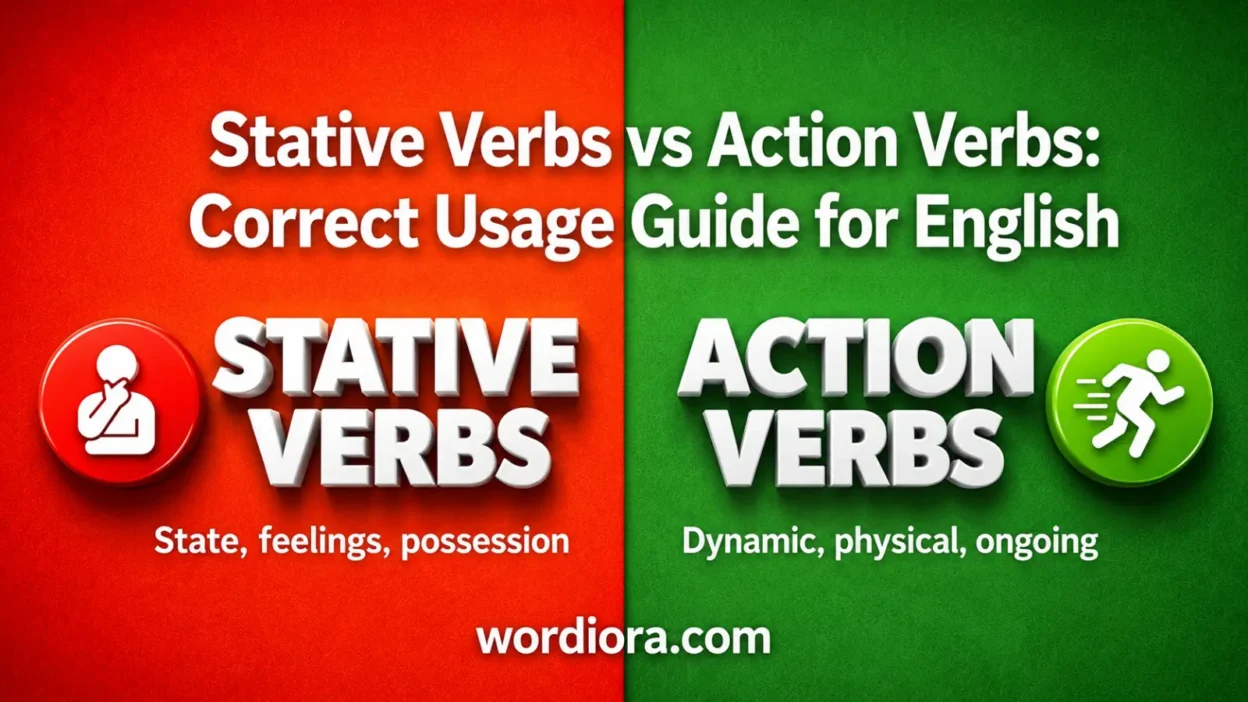
Stative verbs vs action verbs is a choice about meaning, not spelling.
Use a stative verb when the verb describes a state, feeling, belief, possession, sense, or condition. Use an action verb when the verb describes something someone or something does.
The tricky part is that some verbs can work both ways. The verb itself is not always the full answer. The meaning in the sentence decides the choice.
Quick Answer
Stative verbs describe what is, feels, seems, belongs, or exists.
Examples:
I know the answer.
She owns a truck.
This coffee smells fresh.
Action verbs describe what someone or something does.
Examples:
I typed the report.
She drove to work.
The dog chased the ball.
In everyday English, action verbs often work naturally in continuous forms like is running, was cooking, and are studying. Stative verbs usually sound better in simple forms, such as know, believe, own, and seem.
Why People Confuse Them
People confuse these two because school lessons often say, “A verb is an action word.” That is only partly true.
Many verbs do show action. A person can run, text, cook, call, or build.
But some verbs do not show an action at all. A person can know something, like something, own something, or seem tired. Those words are still verbs, but they describe a state.
Another reason is that some verbs change meaning by context.
I think this plan works.
I am thinking about the plan.
The first sentence gives an opinion. The second describes the active process of considering something.
Key Differences At A Glance
| Context | Best Choice | Why |
|---|---|---|
| A feeling or opinion | Stative verb | It describes a state of mind. |
| A physical activity | Action verb | It shows something being done. |
| Possession | Stative verb | It shows ownership, not an activity. |
| A task happening now | Action verb | It can appear in a continuous form. |
| A sense or appearance | Usually stative verb | It describes how something seems, sounds, smells, or feels. |
| A deliberate sense-related act | Action verb | The subject is doing something on purpose. |
Meaning and Usage Difference
A stative verb tells us about a condition or state.
Common types include:
Feelings: love, hate, like, prefer
Thoughts: know, believe, understand, remember
Possession: have, own, belong
Senses: see, hear, smell, taste, feel
Appearance: seem, appear, look
A useful plain pronunciation note: stative sounds like STAY-tiv. That helps because the word is less common than action.
An action verb tells us about an action, event, or process.
Examples include:
run, write, send, cook, drive, call, study, build, clean, explain
The tense pattern is often the biggest clue.
Natural: I know the answer.
Awkward in standard use: I am knowing the answer.
Natural: I am writing the answer.
Also natural: I write answers every day.
Stative verbs often use simple tense for a current state. Action verbs can use simple tense or continuous tense, depending on meaning.
Tone, Context, and Formality
Neither term is more formal in normal grammar talk. The difference is about sentence meaning.
Still, the sentence form can affect tone.
“I know the answer” sounds natural and direct.
“I am knowing the answer” sounds wrong in standard US English.
“I like this song” sounds normal.
“I’m liking this song” can sound casual and moment-based, as if the feeling is happening right now and may change soon.
In school writing, tests, resumes, emails, and polished business writing, use the standard form unless you have a clear reason not to.
That means:
I own a small business.
Not: I am owning a small business.
She understands the policy.
Not: She is understanding the policy.
But action verbs work well in continuous forms:
She is reviewing the policy.
We are meeting at 3 p.m.
Which One Should You Use?
Choose stative verbs when the sentence answers “What is the state?”
She believes you.
The laptop belongs to Carlos.
The soup tastes salty.
He needs a ride.
Choose action verbs when the sentence answers “What is happening?” or “What is the subject doing?”
She emailed you.
Carlos picked up the laptop.
The chef tasted the soup.
He called for a ride.
Here is the key test: Can the action start, continue, and stop?
You can start cooking, keep cooking, and stop cooking. So cook is an action verb in that use.
You do not usually start owning a phone, continue owning it for five minutes, and stop owning it as an active event. So own is stative.
When One Choice Sounds Wrong
A stative verb sounds wrong when it is forced into an action pattern without a special meaning.
Wrong: I am believing you.
Better: I believe you.
Wrong: She is owning two cars.
Better: She owns two cars.
Wrong: This blanket is feeling soft.
Better: This blanket feels soft.
But some verbs change meaning and become natural as action verbs.
Stative: I have a car.
Action: I am having lunch.
Stative: I see your point.
Action: I am seeing a doctor today.
Stative: This soup tastes spicy.
Action: The chef is tasting the soup.
So the real question is not “Is this verb always stative?” The better question is “What does this verb mean in this sentence?”
Common Mistakes and Quick Fixes
Mistake 1: Using continuous tense with a clear state
Wrong: I am knowing her address.
Fix: I know her address.
Mistake 2: Treating all sense verbs the same
Stative: The candle smells sweet.
Action: She is smelling the candle.
The first sentence describes the candle. The second sentence describes what she is doing.
Mistake 3: Missing the meaning change in have
Stative: We have three tickets.
Action: We are having dinner downtown.
Mistake 4: Thinking all mental verbs are stative
Some mental verbs can show action when they mean an active process.
Stative: I think you are right.
Action: I am thinking about your offer.
Mistake 5: Using a stiff form when a simple one is clearer
Awkward: The plan is seeming fair.
Better: The plan seems fair.
Everyday Examples
Here are natural US-English pairs that show the difference.
I want a new backpack.
I am shopping for a new backpack.
She likes iced coffee.
She is drinking iced coffee.
This jacket fits well.
I am trying on the jacket.
We believe the update is helpful.
We are testing the update today.
The office looks quiet.
The manager is looking at the schedule.
My brother has a new apartment.
My brother is moving this weekend.
Here is one compact comparison:
| Feature | Stative verbs | Action verbs |
|---|---|---|
| Main job | Describe a state | Describe an action or process |
| Common tense pattern | Often simple tense | Simple or continuous tense |
| Easy question | What is true? | What is happening? |
| Examples | know, own, seem, need | run, write, call, build |
Dictionary-Style Word Details
Verb
• stative verbs: The phrase itself is not used as a verb. It names a group of verbs that describe states, such as know, own, need, and seem.
• action verbs: The phrase itself is not used as a verb. It names a group of verbs that describe actions, such as run, write, cook, and send.
Noun
• stative verbs: This is a plural noun phrase. It refers to verbs that describe states rather than actions.
• action verbs: This is a plural noun phrase. It refers to verbs that express actions, events, or processes.
Synonyms
• stative verbs: Closest plain alternatives include state verbs, non-action verbs, and non-continuous verbs.
• action verbs: Closest plain alternatives include dynamic verbs and doing verbs.
Helpful contrast: in this grammar context, stative verbs and action verbs are opposites in meaning, though some verbs can move between the two groups depending on the sentence.
Example Sentences
• stative verbs: I understand the instructions.
• stative verbs: The house belongs to my aunt.
• stative verbs: That answer seems right.
• action verbs: I printed the forms.
• action verbs: The team finished the project.
• action verbs: She is making dinner.
Word History
• stative verbs: Stative comes from the idea of a state or condition. In grammar use, it labels verbs that express a state rather than an action.
• action verbs: Action verb is a direct grammar phrase: it joins action with verb to name a verb that expresses action. No special history is needed to understand the modern use.
Phrases Containing
• stative verbs: stative verb, stative meaning, stative use, stative sense
• action verbs: action verb, action verb list, action verb example, dynamic action verb
Want a deeper breakdown of verbs that express action, movement, and temporary activities? Read our detailed guide ondynamic-verbs-vs-stative-verbsto better understand how these verb types work in real sentences.
FAQs
Are stative verbs and action verbs both real verbs?
Yes. Both are real verbs. The difference is what they describe. Stative verbs describe states, feelings, thoughts, possession, or conditions. Action verbs describe actions or processes.
What is the easiest way to tell them apart?
Ask: Is something happening, or is something simply true?
If something is happening, use an action verb.
Example: She is cooking dinner.
If something is simply true, use a stative verb.
Example: She knows the answer.
Can a verb be both stative and action?
Yes. Some verbs can be stative or action depending on meaning.
Example:
I have a car.
We are having lunch.
In the first sentence, have shows possession. In the second, having means eating or experiencing lunch.
Why do stative verbs often sound wrong in continuous tense?
Stative verbs usually describe a state, not an action in progress. That is why sentences like I am knowing the answer sound unnatural in standard US English.
The natural version is:
I know the answer.
Is “think” a stative verb or an action verb?
It can be both.
Stative: I think this is a good idea.
Action: I am thinking about your offer.
When think means “believe,” it is stative. When it means “consider,” it can be action-based.
Is “feel” a stative verb or an action verb?
It depends on the sentence.
Stative: This blanket feels soft.
Action: The doctor is feeling my wrist for a pulse.
The first sentence describes a quality. The second describes an action.
Should I say “I like it” or “I’m liking it”?
I like it is the standard choice.
I’m liking it can appear in casual speech when someone means their feeling is developing right now, but it is less standard. For clear everyday writing, use I like it.
Are action verbs better than stative verbs?
No. They do different jobs. Action verbs are useful when you want to show movement, effort, or activity. Stative verbs are useful when you want to describe a feeling, fact, belief, condition, or relationship.
What are common stative verbs?
Common stative verbs include know, believe, understand, like, love, hate, own, belong, need, seem, appear, smell, taste, and feel.
What are common action verbs?
Common action verbs include run, write, call, send, cook, drive, build, clean, study, explain, buy, and finish.
Conclusion
The difference between stative verbs vs action verbs is simple once you focus on meaning.
Use stative verbs for states, feelings, beliefs, possession, senses, and conditions. Use action verbs for things people or things do.
The most important caution is context. A verb like think, have, see, taste, or feel can be stative in one sentence and action-based in another.
When in doubt, ask: Is the sentence describing a state, or is something happening? That answer usually tells you which choice fits.