Both terms are correct, but they do not mean the same thing.
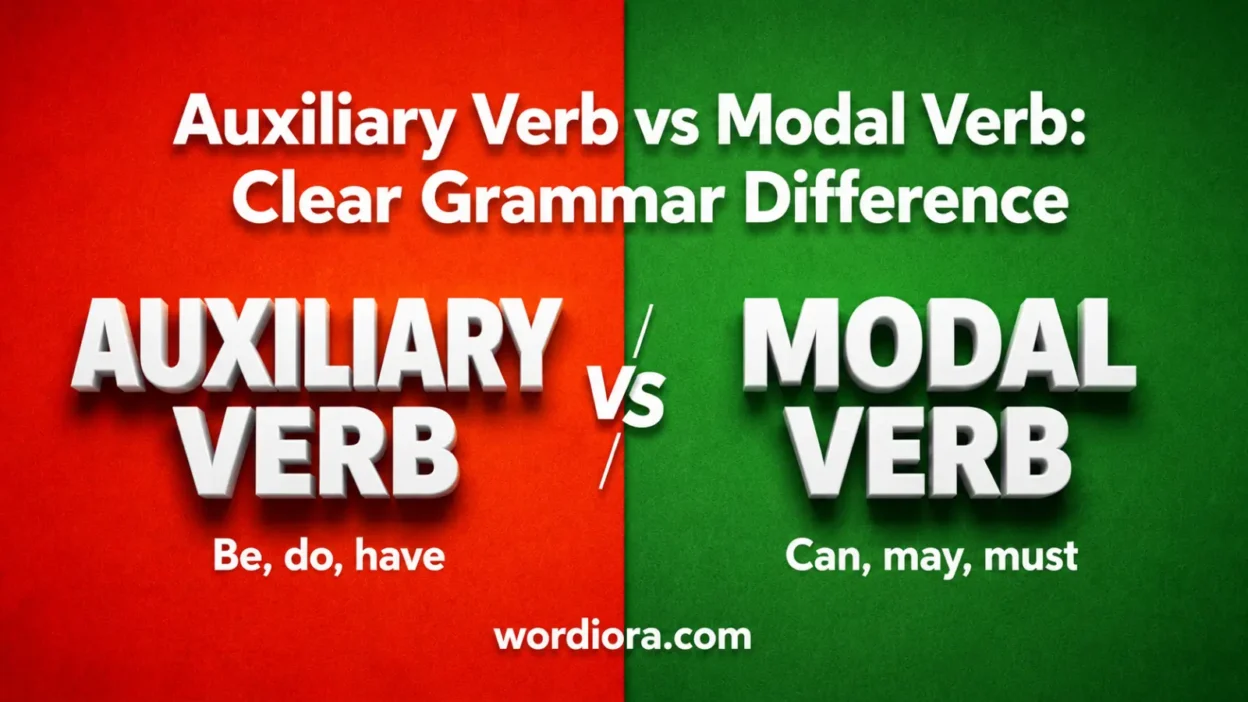
An auxiliary verb is the broader term. It means a helping verb used with a main verb. A modal verb is a special kind of auxiliary verb that adds meaning such as ability, possibility, permission, advice, or necessity.
So the real answer is simple: all modal verbs are auxiliary verbs, but not all auxiliary verbs are modal verbs.
Quick Answer
Use auxiliary verb when you mean any helping verb, such as be, have, or do.
Use modal verb when you mean a helping verb such as can, could, may, might, must, should, will, or would.
Examples:
- She is working.
Is is an auxiliary verb. - She can work late.
Can is a modal verb.
The modal verb is still a helper, but it does more than build a tense or question. It changes the meaning of the main verb.
Why People Confuse Them
People confuse auxiliary verb and modal verb because both help another verb.
In She has finished, the word has helps the main verb finished.
In She might finish, the word might helps the main verb finish.
The difference is in the job. Has helps form a tense. Might shows possibility.
That is why this comparison is not really about two equal groups. It is about a broad grammar label and one important subtype inside that label.
Key Differences At A Glance
| Context | Best Choice | Why |
|---|---|---|
| You mean any helping verb | auxiliary verb | It covers be, have, do, and modals |
| You mean can, could, may, might, must, should, will, or would | modal verb | These express ability, possibility, permission, advice, or necessity |
| You are explaining tense | auxiliary verb | Be and have often help build tense forms |
| You are explaining a question or negative | auxiliary verb | Do, be, and have often form questions and negatives |
| You are explaining permission | modal verb | May and can often show permission |
| You are explaining obligation | modal verb | Must and should often show duty, advice, or need |
| You are naming the larger category | auxiliary verb | Modal verbs fit inside this category |
| You are correcting “She cans go” | modal verb | Modals do not take normal verb endings |
Meaning and Usage Difference
An auxiliary verb helps another verb carry grammar information. It can help show tense, voice, questions, negatives, emphasis, or other sentence structure.
Common auxiliary verbs include:
- be: She is studying.
- have: They have left.
- do: Did you call?
A modal verb helps another verb by adding the speaker’s view of the action. It often shows what is possible, allowed, required, advised, or likely.
Common modal verbs include:
- can: I can drive.
- may: You may leave early.
- must: We must submit the form.
- should: You should rest.
Here is the core comparison:
| Feature | auxiliary verb | modal verb |
|---|---|---|
| Type | Broad helping-verb category | Special kind of auxiliary verb |
| Main job | Helps form grammar structure | Adds meaning such as ability, permission, or necessity |
| Common examples | be, have, do | can, could, may, might, must, should, will, would |
| Form changes | Often changes form: is, are, was, has, had, does, did | Usually does not change form: I can, she can |
| Main verb after it | Form depends on structure | Usually base form: can go, should try |
Pronunciation is not the main confusion, but auxiliary can trip readers. In everyday US pronunciation, say it like awg-ZIL-yuh-ree verb. Modal is simpler: MOH-dul verb.
Tone, Context, and Formality
Both terms are standard grammar terms.
Auxiliary verb sounds broader and more technical. Teachers, editors, and grammar books use it when explaining sentence structure.
Modal verb is more specific. It is the right term when the sentence uses a helper such as can, might, should, or must.
In casual conversation, most people say helping verb instead of auxiliary verb. In school or editing, auxiliary verb is more precise.
In US English, the difference is not mainly about formality. It is about accuracy.
Which One Should You Use?
Use auxiliary verb when you are talking about the full helper-verb family.
Good uses:
- Do is an auxiliary verb in Do you agree?
- Has is an auxiliary verb in She has arrived.
- Was is an auxiliary verb in The car was repaired.
Use modal verb when you are talking about helpers that show attitude, possibility, permission, ability, advice, or need.
Good uses:
- Can is a modal verb in I can help.
- Might is a modal verb in It might rain.
- Should is a modal verb in You should call first.
When in doubt, ask: Is the word showing a meaning like ability, permission, or necessity? If yes, modal verb is probably the better label.
When One Choice Sounds Wrong
Calling is a modal verb sounds wrong in a sentence like:
- She is working.
Here, is helps form the present progressive. It does not show possibility, permission, or obligation. Call it an auxiliary verb.
Calling can only an auxiliary verb is not wrong, but it may be too broad in a sentence like:
- She can work from home.
Since can shows ability or permission, modal verb is the more exact label.
The safest wording is:
- Can is a modal verb.
- A modal verb is a type of auxiliary verb.
Common Mistakes (and Quick Fixes)
Mistake: She cans drive.
Fix: She can drive.
Why: A modal verb does not take -s for third-person singular.
Mistake: Do you can come?
Fix: Can you come?
Why: A modal verb forms the question by moving before the subject.
Mistake: She might to call.
Fix: She might call.
Why: Most modal verbs are followed by the base form of the main verb.
Mistake: He is a modal verb in “He is running.”
Fix: Is is an auxiliary verb in “He is running.”
Why: It helps form the verb structure, but it is not a modal.
Mistake: Modal verbs and auxiliary verbs are completely separate.
Fix: Modal verbs are a special kind of auxiliary verb.
Why: The modal group sits inside the larger helper-verb category.
Everyday Examples
- I have finished the report.
Have is an auxiliary verb. - I should finish the report today.
Should is a modal verb. - Are you joining the meeting?
Are is an auxiliary verb. - Can you join the meeting?
Can is a modal verb. - The package was delivered this morning.
Was is an auxiliary verb. - The package might arrive this morning.
Might is a modal verb. - Did Maya text you?
Did is an auxiliary verb. - Would Maya text you first?
Would is a modal verb.
Dictionary-Style Word Details
Verb
- auxiliary verb: The phrase names a verb type. Individual auxiliary verbs, such as be, have, and do, are verbs. The phrase itself is not used as an action word.
- modal verb: The phrase names a verb type. Individual modal verbs, such as can, must, and should, are verbs. The phrase itself is not used as an action word.
Noun
- auxiliary verb: A count noun phrase. Example: “Do” is an auxiliary verb in that question.
- modal verb: A count noun phrase. Example: “Might” is a modal verb in that sentence.
Synonyms
- auxiliary verb: The closest plain alternative is helping verb. In some grammar contexts, auxiliary alone may also be used.
- modal verb: Close alternatives include modal auxiliary, modal auxiliary verb, and modal.
Clear antonyms are not very useful here. Main verb or lexical verb can be a contrast, but not an exact opposite in every sentence.
Example Sentences
- auxiliary verb: Do is an auxiliary verb in Do you need a receipt?
- auxiliary verb: Have is an auxiliary verb in They have moved.
- modal verb: Could is a modal verb in Could you send the file today?
- modal verb: Must is a modal verb in Employees must wear badges.
Word History
- auxiliary verb: Auxiliary is tied to the idea of help or support, which fits its grammar role as a helping verb.
- modal verb: Modal is tied to mode or manner, which fits its grammar role because modals show the speaker’s view of an action, such as whether it is possible, allowed, or required.
No exact first-use date is needed to understand the modern grammar choice.
Phrases Containing
- auxiliary verb: primary auxiliary verb, auxiliary verb phrase, modal auxiliary verb
- modal verb: modal auxiliary, modal auxiliary verb, core modal verb, semi-modal verb
FAQs
Is a modal verb the same as an auxiliary verb?
Not exactly. A modal verb is a type of auxiliary verb, but an auxiliary verb is the broader category. Words like be, have, and do are auxiliary verbs, while words like can, may, must, and should are modal verbs.
Are all modal verbs auxiliary verbs?
Yes. Modal verbs help the main verb, so they are part of the auxiliary verb family. The difference is that modal verbs add meanings such as ability, permission, possibility, advice, or necessity.
Are all auxiliary verbs modal verbs?
No. Many auxiliary verbs are not modal verbs. For example, is, have, and do can work as auxiliary verbs, but they are not modal verbs.
What are examples of auxiliary verbs?
Common auxiliary verbs include be, have, and do.
Examples:
- She is working.
- They have finished.
- Do you agree?
What are examples of modal verbs?
Common modal verbs include can, could, may, might, must, shall, should, will, and would.
Examples:
- I can help.
- You should call first.
- It might rain later.
What is the main difference between auxiliary verb and modal verb?
An auxiliary verb helps build the grammar of a sentence, such as tense, questions, negatives, or voice. A modal verb helps the main verb too, but it adds meaning such as possibility, permission, ability, advice, or obligation.
Is “can” an auxiliary verb or a modal verb?
Can is a modal verb. Since modal verbs are a type of auxiliary verb, can is also an auxiliary verb in the broader sense. The more exact label is modal verb.
Is “is” a modal verb?
No. Is is an auxiliary verb when it helps another verb, as in She is studying. It is not a modal verb because it does not express meanings like permission, possibility, or obligation.
Can a sentence have both an auxiliary verb and a modal verb?
Yes. A sentence can include both.
Example:
- She must have forgotten the meeting.
Here, must is a modal verb, and have is another auxiliary verb in the verb phrase.
Which term should I use in grammar writing?
Use auxiliary verb when you mean any helping verb. Use modal verb when you are talking specifically about words like can, could, may, might, must, should, will, or would.
Conclusion
Use auxiliary verb for the broad category of helping verbs.
Use modal verb for the special helping verbs that show meanings like ability, permission, possibility, advice, or necessity.
The easiest way to remember the difference is this: auxiliary verb is the larger label; modal verb is the more specific label.