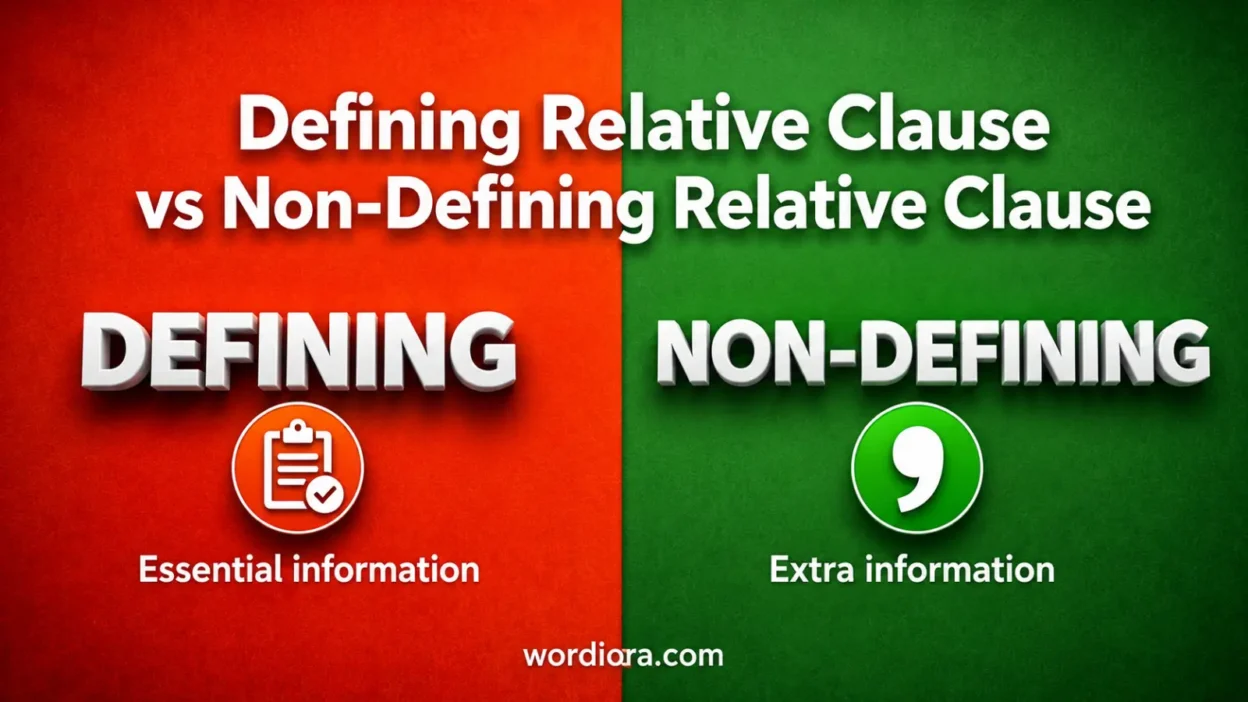
A defining relative clause and a non defining relative clause are both used to add information about a noun. The choice depends on whether that information is needed to identify the noun.
This is not just a punctuation issue. A comma can change what the sentence means.
Example:
The employees who work remotely joined the meeting.
This means only the remote employees joined.
The employees, who work remotely, joined the meeting.
This suggests all the employees work remotely, and all of them joined.
Quick Answer
Use a defining relative clause when the clause tells the reader which person, thing, place, or idea you mean.
Use a non defining relative clause when the clause gives extra information about a noun that is already clear.
A defining relative clause usually has no commas.
A non defining relative clause is usually set off with commas.
Also, in standard edited English, that can introduce a defining relative clause, but it should not introduce a non defining relative clause.
Why People Confuse Them
People confuse these two because both clauses often begin with words like who, which, whose, where, or when.
The sentence may look almost the same. The difference is the job the clause is doing.
A defining relative clause answers:
“Which one?”
A non defining relative clause adds:
“By the way, here is more information.”
The comma is the biggest visible clue, but the meaning comes first. You choose the clause type based on whether the information is essential.
Key Differences At A Glance
| Feature | defining relative clause | non defining relative clause |
|---|---|---|
| Main job | Identifies the noun | Adds extra information |
| Commas | No commas | Uses commas |
| Can be removed? | Not without changing the meaning | Usually yes |
| Common pronouns | who, that, which, whose, where, when | who, which, whose, where, when |
| Uses “that”? | Yes, often | No |
| Example | The car that needs repairs is in the garage. | My car, which needs repairs, is in the garage. |
The standard written form is often non-defining with a hyphen. This guide keeps the searched form, non defining relative clause, while explaining the grammar clearly.
Meaning and Usage Difference
A defining relative clause limits the noun. It tells readers exactly which noun you mean.
Example:
The student who submitted the form can leave early.
This does not mean every student can leave early. It means only the student who submitted the form.
A non defining relative clause does not limit the noun. It adds extra detail about a noun that is already identified.
Example:
Maya, who submitted the form, can leave early.
The name Maya already identifies the person. The clause simply adds extra information.
Both terms name types of relative clauses. These clauses usually modify nouns, so they work like adjective information inside a sentence.
Tone, Context, and Formality
Both forms are normal in formal and informal English. The difference is not really tone. It is meaning and sentence structure.
A defining relative clause is common when the reader needs help identifying the noun:
The report that you requested is on your desk.
A non defining relative clause often sounds a little more polished or explanatory because it adds a side detail:
The report, which you requested yesterday, is on your desk.
In everyday US writing, use commas carefully. A non defining relative clause can sound wrong if the noun is not already clear.
Which One Should You Use?
| Context | Best Choice | Why |
|---|---|---|
| You need to identify which person or thing | defining relative clause | The information is essential |
| The noun is already clear | non defining relative clause | The information is extra |
| The clause begins with “that” | defining relative clause | “That” fits defining clauses |
| The clause is set off with commas | non defining relative clause | Commas mark added information |
| Removing the clause changes the main meaning | defining relative clause | The clause is doing necessary work |
| Removing the clause leaves the main point clear | non defining relative clause | The clause is only adding detail |
A quick test helps: remove the clause. If the reader no longer knows which noun you mean, use a defining relative clause. If the sentence still identifies the noun clearly, use a non defining relative clause.
When One Choice Sounds Wrong
A defining relative clause sounds wrong when you add commas around essential information.
Wrong: The laptop, that has the blue sticker, is mine.
Better: The laptop that has the blue sticker is mine.
The blue sticker identifies which laptop you mean, so the clause is defining.
A non defining relative clause sounds wrong when you use that after a comma.
Wrong: My laptop, that has a blue sticker, is on the table.
Better: My laptop, which has a blue sticker, is on the table.
Here, my laptop is already identified. The blue sticker detail is extra.
Common Mistakes (and Quick Fixes)
Mistake 1: Using commas with essential information
Wrong: The nurse, who called me, left a voicemail.
Better: The nurse who called me left a voicemail.
Use no commas if the clause tells which nurse.
Mistake 2: Leaving out commas with extra information
Wrong: Denver which gets snow in spring hosted the event.
Better: Denver, which gets snow in spring, hosted the event.
The city name already identifies the place.
Mistake 3: Using “that” in a non defining relative clause
Wrong: My brother, that lives in Austin, is visiting.
Better: My brother, who lives in Austin, is visiting.
Use who for a person in a non defining relative clause.
Mistake 4: Making the meaning too broad
The snacks that contain nuts are in the kitchen.
This means only the nut-containing snacks are in the kitchen.
The snacks, which contain nuts, are in the kitchen.
This suggests all the snacks contain nuts.
Everyday Examples
Defining relative clause:
The apartment that faces the park costs more.
Non defining relative clause:
Our apartment, which faces the park, costs more.
Defining relative clause:
The teacher who runs the debate club is organizing the trip.
Non defining relative clause:
Mrs. Carter, who runs the debate club, is organizing the trip.
Defining relative clause:
The store where I bought my phone has closed.
Non defining relative clause:
Target, where I bought my phone, has updated its return policy.
Defining relative clause:
The email that includes the invoice went to spam.
Non defining relative clause:
The email, which includes the invoice, went to spam.
Dictionary-Style Word Details
Verb
• defining relative clause: Not used as a verb in standard US English. It is a grammar term for a type of clause.
• non defining relative clause: Not used as a verb in standard US English. It is also a grammar term for a type of clause.
Noun
• defining relative clause: A noun phrase naming a relative clause that gives essential identifying information about a noun.
• non defining relative clause: A noun phrase naming a relative clause that gives extra, nonessential information about a noun.
Synonyms
• defining relative clause: Closest plain alternatives include restrictive relative clause and essential relative clause.
• non defining relative clause: Closest plain alternatives include nonrestrictive relative clause, nonessential relative clause, and sometimes parenthetical relative clause.
The two terms are opposites within the category of relative clauses.
Example Sentences
• defining relative clause: The volunteers who signed up for Saturday should arrive by 8 a.m.
• defining relative clause: The file that has the final budget is in the shared folder.
• non defining relative clause: Our volunteers, who signed up last week, should arrive by 8 a.m.
• non defining relative clause: The final budget, which is in the shared folder, needs one more review.
Word History
• defining relative clause: The term is built from ordinary grammar words: defining means identifying or limiting, relative refers to the relation to a noun, and clause means a group of words with a subject and verb.
• non defining relative clause: The term uses non defining to show that the clause does not identify or limit the noun. Many grammar references also use the labels restrictive and nonrestrictive for the same basic contrast.
No specific first-use date is needed to choose between the two correctly.
Phrases Containing
• defining relative clause: defining relative clause examples; defining relative clause with that; defining relative clause exercises; defining relative clause commas
• non defining relative clause: non defining relative clause examples; non defining relative clause commas; non defining relative clause with which; non defining relative clause exercises
FAQs
What is the main difference between a defining relative clause and a non defining relative clause?
A defining relative clause gives essential information that identifies the noun. A non defining relative clause gives extra information about a noun that is already clear.
Does a defining relative clause use commas?
No. A defining relative clause usually does not use commas because the information is needed to complete the meaning.
Example:
The book that I borrowed is on the table.
Does a non defining relative clause use commas?
Yes. A non defining relative clause is usually set off with commas because the information is extra.
Example:
My book, which I borrowed from Mia, is on the table.
Can I use “that” in a non defining relative clause?
No. In standard edited English, that is not used in a non defining relative clause.
Wrong:
My car, that needs repairs, is outside.
Correct:
My car, which needs repairs, is outside.
Can I remove a defining relative clause from a sentence?
Not without changing the meaning. If you remove it, the reader may not know which person or thing you mean.
Example:
The employee who handles payroll is out today.
Without the clause, The employee is out today is too vague.
Can I remove a non defining relative clause from a sentence?
Yes, usually. The sentence should still make sense because the clause only adds extra detail.
Example:
Jordan, who handles payroll, is out today.
You can remove the clause:
Jordan is out today.
Are defining relative clauses and restrictive clauses the same?
Yes. A defining relative clause is often called a restrictive relative clause, especially in US grammar and writing guides.
Are non defining relative clauses and nonrestrictive clauses the same?
Yes. A non defining relative clause is often called a nonrestrictive relative clause because it does not restrict or limit the noun.
Which is more common in everyday writing?
Both are common. Defining relative clauses are very common when identifying people or things. Non defining relative clauses are common when adding extra detail, especially in polished or explanatory writing.
What is the easiest way to choose the right one?
Ask: Does this clause tell the reader which one I mean?
If yes, use a defining relative clause with no commas.
If no, use a non defining relative clause with commas.
Conclusion
The difference between a defining relative clause and a non defining relative clause is simple once you focus on meaning.
A defining relative clause identifies the noun. It is essential and usually has no commas.
A non defining relative clause adds extra information. It is set off with commas and does not use that.
Use the defining form when the reader needs the detail to know which person or thing you mean. Use the non defining form when the noun is already clear and you are only adding helpful extra information.