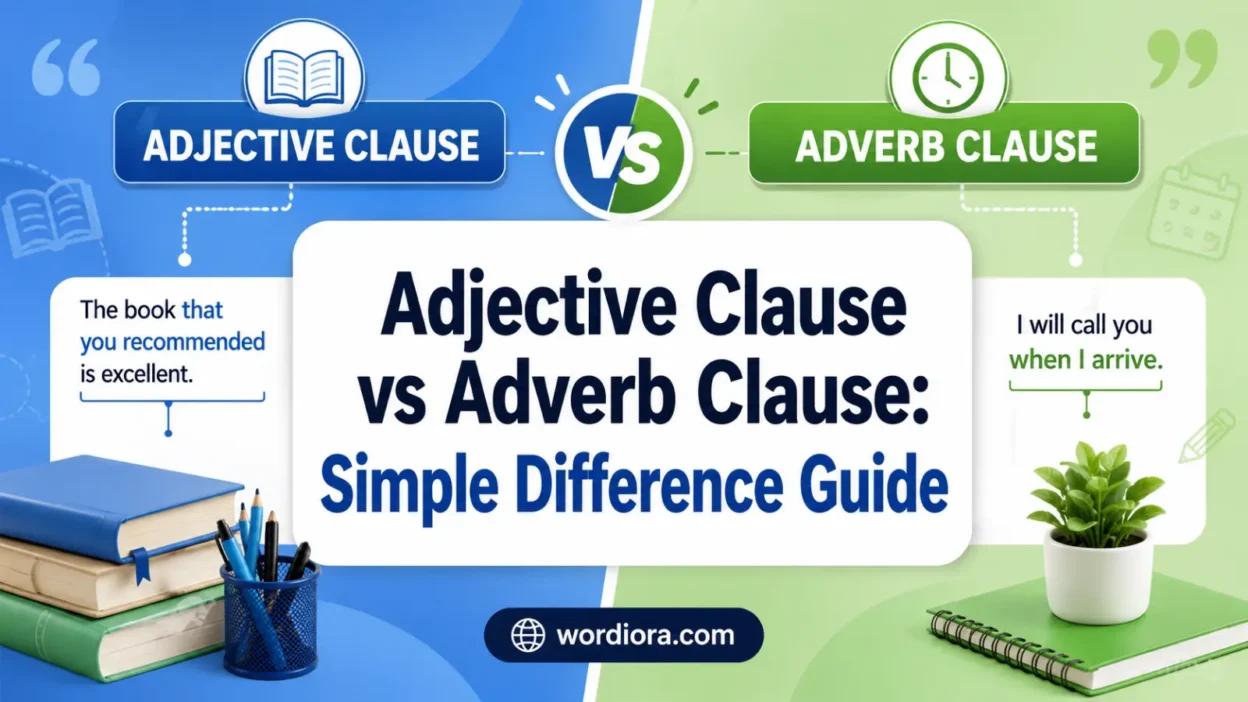
Both adjective clause and adverb clause are correct grammar terms. The difference is not about which term is “better.” It is about what the clause does in the sentence.
An adjective clause describes a noun or pronoun. An adverb clause explains something about an action, condition, time, reason, place, manner, degree, or contrast.
The easiest question is: What does the clause modify?
Quick Answer
Use adjective clause when the clause gives more information about a noun or pronoun.
Example:
The student who won the scholarship thanked her teacher.
The clause who won the scholarship describes student, so it is an adjective clause.
Use adverb clause when the clause gives more information about a verb, adjective, adverb, or whole idea.
Example:
The student thanked her teacher because she won the scholarship.
The clause because she won the scholarship explains why she thanked her teacher, so it is an adverb clause.
Why People Confuse Them
People confuse these terms because both are dependent clauses. That means both have a subject and a verb, but they do not always stand alone as complete sentences.
They can also start with similar-looking words. For example, where can begin different kinds of clauses.
Adjective clause:
That is the cafe where we met.
Adverb clause:
We sat where we could hear the music.
The first clause describes cafe. The second clause explains where the sitting happened.
Key Differences At A Glance
| Context | Best Choice | Why |
|---|---|---|
| The clause describes a person, place, thing, or idea | adjective clause | It modifies a noun or pronoun |
| The clause answers “which one?” or “what kind?” | adjective clause | It identifies or describes a noun |
| The clause explains when something happened | adverb clause | It modifies the action |
| The clause explains why something happened | adverb clause | It gives the reason for the action |
| The clause begins with because, although, if, when, or while | adverb clause, often | These often introduce adverb clauses |
| The clause begins with who, whom, whose, which, or that | adjective clause, often | These often introduce adjective clauses |
| The clause can move to the front of the sentence naturally | adverb clause, often | Many adverb clauses are flexible in position |
Meaning and Usage Difference
An adjective clause works like an adjective. It tells us more about a noun or pronoun.
The car that has the broken taillight needs service.
The clause points to which car. It does not explain when, why, or how the car needs service. It identifies the noun.
An adverb clause works like an adverb. It tells us more about an action or situation.
I called the shop after the car started making noise.
The clause explains when the calling happened.
Here is a compact comparison:
| Feature | adjective clause | adverb clause |
|---|---|---|
| Main job | Describes a noun or pronoun | Describes an action, condition, or idea |
| Common question | Which one? What kind? | When? Where? Why? How? Under what condition? |
| Common starters | who, whom, whose, which, that, where, when, why | because, although, if, when, while, after, before, since |
| Usual position | Usually after the noun it describes | Beginning, middle, or end of sentence |
Tone, Context, and Formality
Neither term is more formal than the other. Both are standard grammar labels used in school, editing, and writing instruction.
In everyday writing, you usually do not need to name the clause. You just need to use it correctly.
In grammar lessons, tests, tutoring, and editing notes, the label matters. Calling a clause an adjective clause when it explains time or reason can confuse the sentence analysis.
For example:
I stayed home because the roads were icy.
This is not an adjective clause. It does not describe home. It explains why I stayed home.
Which One Should You Use?
Choose adjective clause if the clause gives information about a noun or pronoun.
Ask: Which noun does this clause describe?
Example:
The laptop that I bought last year still works well.
The clause describes laptop.
Choose adverb clause if the clause gives information about the main action or situation.
Ask: Does this clause tell when, where, why, how, or under what condition?
Example:
The laptop shut down when the battery overheated.
The clause tells when the shutdown happened.
When One Choice Sounds Wrong
A clause label sounds wrong when it points to the wrong part of the sentence.
Wrong label:
In “The nurse who checked me in was kind,” who checked me in is an adverb clause.
Better:
Who checked me in is an adjective clause because it describes nurse.
Wrong label:
In “We left early because the meeting ended,” because the meeting ended is an adjective clause.
Better:
Because the meeting ended is an adverb clause because it explains why we left early.
The words at the beginning can help, but they should not be your only test. Always check what the whole clause is doing.
Common Mistakes (and Quick Fixes)
Mistake 1: Looking only at the first word.
The word when does not always make a clause an adverb clause.
Adjective clause:
I remember the day when we moved into this apartment.
The clause describes day.
Adverb clause:
I called my sister when we moved into this apartment.
The clause tells when I called.
Mistake 2: Forgetting that adjective clauses usually sit near the noun.
Unclear:
I returned the jacket to the clerk that had a torn sleeve.
This sounds like the clerk had a torn sleeve.
Clear:
I returned the jacket that had a torn sleeve to the clerk.
Mistake 3: Treating a dependent clause as a full sentence.
Fragment:
Because the file was missing.
Fixed:
I emailed the office because the file was missing.
Everyday Examples
Adjective clause examples:
The neighbor who walks his dog every morning waved at us.
I saved the receipt that came with the order.
The movie which everyone recommended was sold out.
The restaurant where we had brunch just reopened.
Adverb clause examples:
I made coffee before the meeting started.
She smiled because the news was good.
We can leave if the rain stops.
Although the store was busy, the cashier stayed calm.
Use the noun test for adjective clauses. Use the when, why, where, how, or condition test for adverb clauses.
Dictionary-Style Word Details
Verb
• adjective clause: Not commonly used as a verb in standard US English. It is a grammar term, not an action word.
• adverb clause: Not commonly used as a verb in standard US English. It is also a grammar term, not an action word.
Noun
• adjective clause: A compound noun phrase. It names a dependent clause that functions like an adjective by describing a noun or pronoun.
• adverb clause: A compound noun phrase. It names a dependent clause that functions like an adverb by modifying a verb, adjective, adverb, or larger idea.
Synonyms
• adjective clause: Closest plain alternatives: relative clause, adjectival clause.
• adverb clause: Closest plain alternatives: adverbial clause, dependent adverb clause.
Clear antonyms do not fit well here. These terms name different clause functions, not true opposites.
Example Sentences
• adjective clause: The teacher who helped me after class wrote a recommendation letter.
• adjective clause: We rented the apartment that gets morning sun.
• adverb clause: I packed an umbrella because the forecast looked bad.
• adverb clause: When the bus arrived, everyone lined up.
Word History
• adjective clause: The label combines adjective with clause because this kind of clause acts like an adjective.
• adverb clause: The label combines adverb with clause because this kind of clause acts like an adverb.
The exact first use of these full grammar labels is not needed for choosing between them. Their modern meaning comes from their function in a sentence.
Phrases Containing
• adjective clause: restrictive adjective clause, nonrestrictive adjective clause, reduced adjective clause, adjective clause examples.
• adverb clause: adverb clause of time, adverb clause of reason, adverb clause of condition, adverb clause of contrast.
Conclusion
Both terms are correct, but they are not interchangeable.
An adjective clause describes a noun or pronoun. It helps answer which one? or what kind?
An adverb clause explains an action, condition, or situation. It often answers when, where, why, how, under what condition, or to what degree.
When you are unsure, do not rely only on the first word of the clause. Find what the clause modifies. That one step usually tells you the right answer.