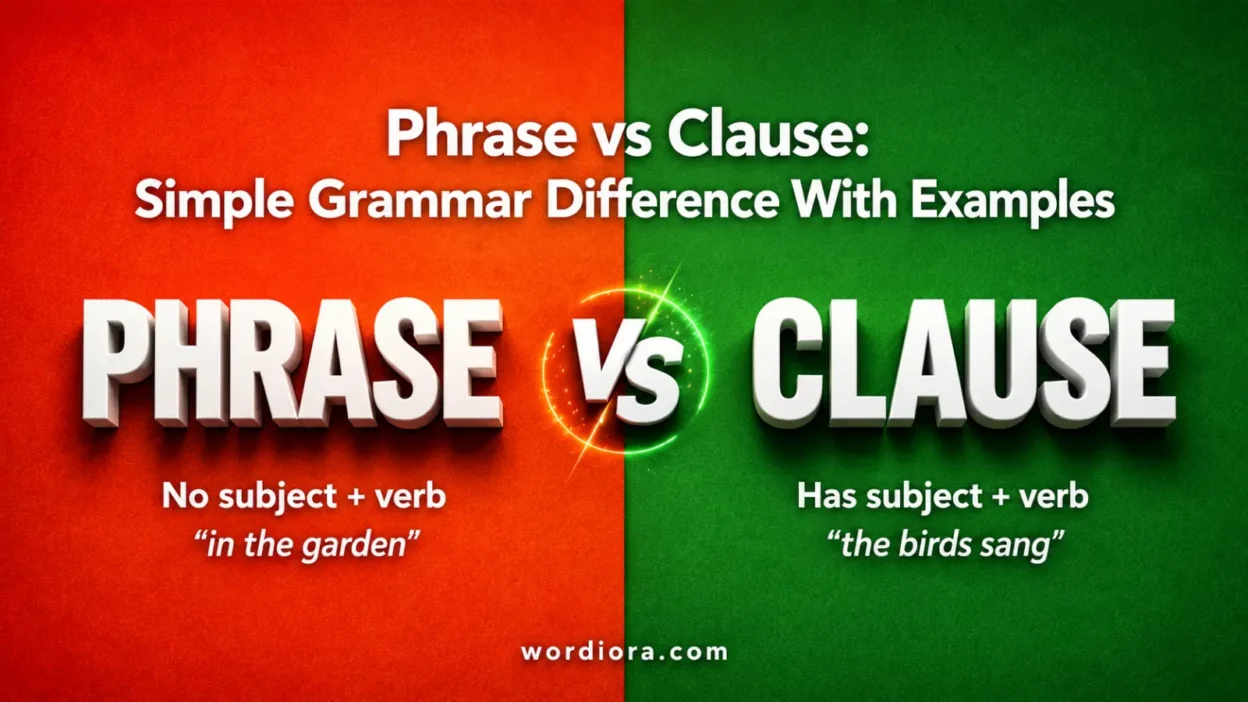
Phrase vs clause is a common grammar comparison because both are groups of words, and both help build sentences. The key difference is simple: a phrase does not contain both a subject and a verb, while a clause does.
A phrase adds information. A clause can often express an action or idea more completely because it includes a subject-verb relationship.
Compare these:
- Phrase: after the meeting
- Clause: after the meeting ended
The first group of words gives a time idea, but it has no subject doing an action. The second has a subject, the meeting, and a verb, ended.
Quick Answer
Use phrase when the word group does not contain both a subject and a verb.
Use clause when the word group does contain a subject and a verb.
Examples:
- Phrase: in the parking lot
- Clause: we waited in the parking lot
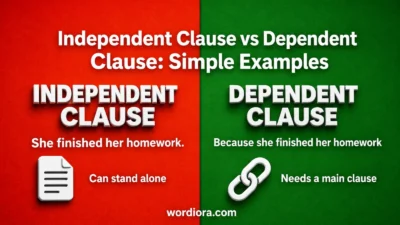
A clause may be independent or dependent. An independent clause can stand alone as a sentence. A dependent clause has a subject and verb but still needs another part to complete the meaning.
Examples:
- Independent clause: We waited in the parking lot.
- Dependent clause: because we waited in the parking lot
Why People Confuse Them
People confuse phrases and clauses because both can appear inside longer sentences and both can add detail.
Look at this sentence:
After lunch, we walked to the bookstore because the weather was nice.
This sentence includes:
- After lunch — phrase
- we walked to the bookstore — clause
- because the weather was nice — clause
The confusion usually comes from looking only at length. A phrase can be long, and a clause can be short. Length is not the test. The real test is whether the word group contains a subject and a verb.
Key Differences At A Glance
| Context | Best Choice | Why |
|---|---|---|
| A word group without both a subject and verb | Phrase | It works as a unit but does not contain a full subject-verb pair. |
| A word group with a subject and verb | Clause | It has someone or something doing or being something. |
| A word group that can stand alone as a sentence | Independent clause | It expresses a complete thought. |
| A word group with a subject and verb but incomplete meaning | Dependent clause | It needs another clause to complete the sentence. |
| A short detail such as “near the door” | Phrase | It adds location but has no subject-verb pair. |
| A longer detail such as “where the dog was sleeping” | Clause | It includes a subject and verb. |
Meaning and Usage Difference
A phrase is a group of words that works together as one part of a sentence. It may act like a noun, adjective, or adverb, but it does not contain a complete subject-verb relationship.
Examples:
- the red backpack
- under the kitchen table
- running late again
A clause is a group of words that contains a subject and a verb. Some clauses can stand alone, while others depend on another clause.
Examples:
- she called me
- when she called me
- the package arrived
Compact comparison:
- Phrase: gives detail, but does not contain both subject and verb.
- Clause: contains a subject and verb.
- Phrase: cannot stand alone as a complete sentence.
- Independent clause: can stand alone as a complete sentence.
- Dependent clause: has a subject and verb but cannot stand alone.
Tone, Context, and Formality
Both phrase and clause are standard grammar terms. Neither is slang, casual, or overly formal.
You will see both words in school assignments, grammar guides, editing notes, and writing lessons.
In everyday conversation, people may say “part of the sentence” instead of phrase or clause. In grammar instruction, though, the distinction matters because it helps explain sentence structure.
For example:
- Before dinner is a phrase.
- Before dinner started is a clause.
The difference changes how the sentence works, especially when punctuation is involved.
Which One Should You Use?
Use phrase when you are naming a word group that does not have both a subject and a verb.
Example:
During the storm is a phrase.
Use clause when you are naming a word group that has a subject and a verb.
Example:
When the storm ended is a clause.
A quick test is to look for two things:
- Who or what is the sentence part about?
- What is that person or thing doing, being, or experiencing?
If you can find both, you probably have a clause. If not, you probably have a phrase.
Many writers confuse phrases with clauses because clauses can be either complete or incomplete thoughts. Our in-depth breakdown of independent clause vs dependent clause explains how to identify each one correctly in everyday writing.
When One Choice Sounds Wrong
Calling a phrase a clause sounds wrong when the word group has no subject-verb pair.
Incorrect: “In the hallway” is a clause.
Correct: “In the hallway” is a phrase.
There is no subject doing an action. The words tell where something happens, but they do not form a clause.
Calling a clause a phrase sounds wrong when the word group clearly has a subject and verb.
Incorrect: “The lights went out” is a phrase.
Correct: “The lights went out” is a clause.
Here, the lights is the subject, and went out is the verb phrase.
Common Mistakes (and Quick Fixes)
One common mistake is thinking every incomplete sentence part is a phrase. That is not true. A dependent clause can be incomplete as a sentence but still be a clause.
Example:
Although the game was canceled
This cannot stand alone as a complete sentence, but it is still a clause because it has a subject, the game, and a verb, was canceled.
Another mistake is assuming a long word group must be a clause.
Example:
The old coffee shop near the train station
This is a phrase. It is long, but it does not tell what the coffee shop does or is doing.
A third mistake is treating every word group with a verb form as a clause.
Example:
Running across the field
This contains running, but there is no clear subject-verb pair. It is a phrase, not a clause.
Quick FAQ
Is every clause a sentence?
No. An independent clause can be a sentence, but a dependent clause cannot stand alone as a complete sentence.
Can a phrase have a verb form?
Yes. A phrase can include a verb form, as in walking to class, but it still is not a clause unless it has a subject-verb relationship.
Can a sentence contain both phrases and clauses?
Yes. Most longer sentences contain both.
Everyday Examples
Here are natural examples of phrases:
- after work
- near the front desk
- the blue jacket on the chair
- waiting for the bus
- with a careful smile
Here are natural examples of clauses:
- I finished the report
- because I finished the report
- the phone rang
- when the phone rang
- she forgot her keys
Now compare them in full sentences:
Phrase: After work, Maya stopped by the grocery store.
Clause: After work ended, Maya stopped by the grocery store.
Phrase: The keys on the counter belong to Sam.
Clause: The keys that are on the counter belong to Sam.
Phrase: We stayed inside during the storm.
Clause: We stayed inside while the storm passed.
Dictionary-Style Word Details
Verb
Phrase can be used as a verb meaning to express something in a particular way.
Example:
She phrased the message carefully.
Clause is not commonly used as an everyday verb in modern American English. In ordinary grammar writing, use clause as a noun.
Noun
Phrase as a noun means a group of words that functions as a unit but does not form a complete clause.
Examples:
- noun phrase
- verb phrase
- prepositional phrase
Clause as a noun means a group of words with a subject and verb. In grammar, clauses are often independent or dependent.
Examples:
- independent clause
- dependent clause
- relative clause
Synonyms
For phrase, close words include:
- expression
- wording
- word group
- grammatical unit
For clause, close words depend on context:
- grammatical unit
- sentence part
- provision
- section
In grammar, though, clause should not be replaced loosely with phrase, because the two terms do not mean the same thing.
Example Sentences
Phrase examples:
- The phrase under the bed tells where the shoes were.
- A noun phrase can work as the subject of a sentence.
- She used a short phrase to describe the problem.
Clause examples:
- The clause we arrived late has a subject and a verb.
- A dependent clause needs another clause to complete the sentence.
- The sentence begins with a clause that explains the reason.
Word History
For practical grammar use, the history of these words matters less than their current function.
The important modern distinction is this:
- A phrase works as a word group without a full subject-verb structure.
- A clause contains a subject and verb.
That difference is the rule readers need most when identifying sentence parts.
Phrases Containing
Common terms with phrase include:
- noun phrase
- verb phrase
- adjective phrase
- adverb phrase
- prepositional phrase
Common terms with clause include:
- independent clause
- dependent clause
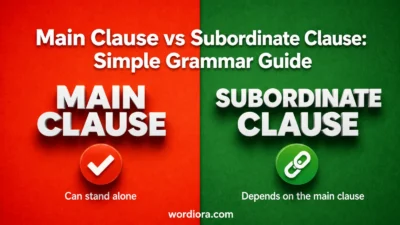
- main clause
- subordinate clause
- relative clause
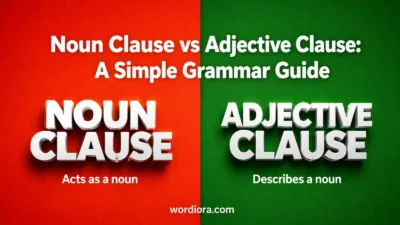
- noun clause
- adverb clause
Conclusion
The difference between phrase vs clause comes down to the subject-verb test.
A phrase is a group of words that works together but does not contain both a subject and a verb. A clause is a group of words that does contain a subject and a verb.
Use phrase for word groups like near the window, after the meeting, and the book on the shelf.
Use clause for word groups like the window opened, after the meeting ended, and the book fell off the shelf.