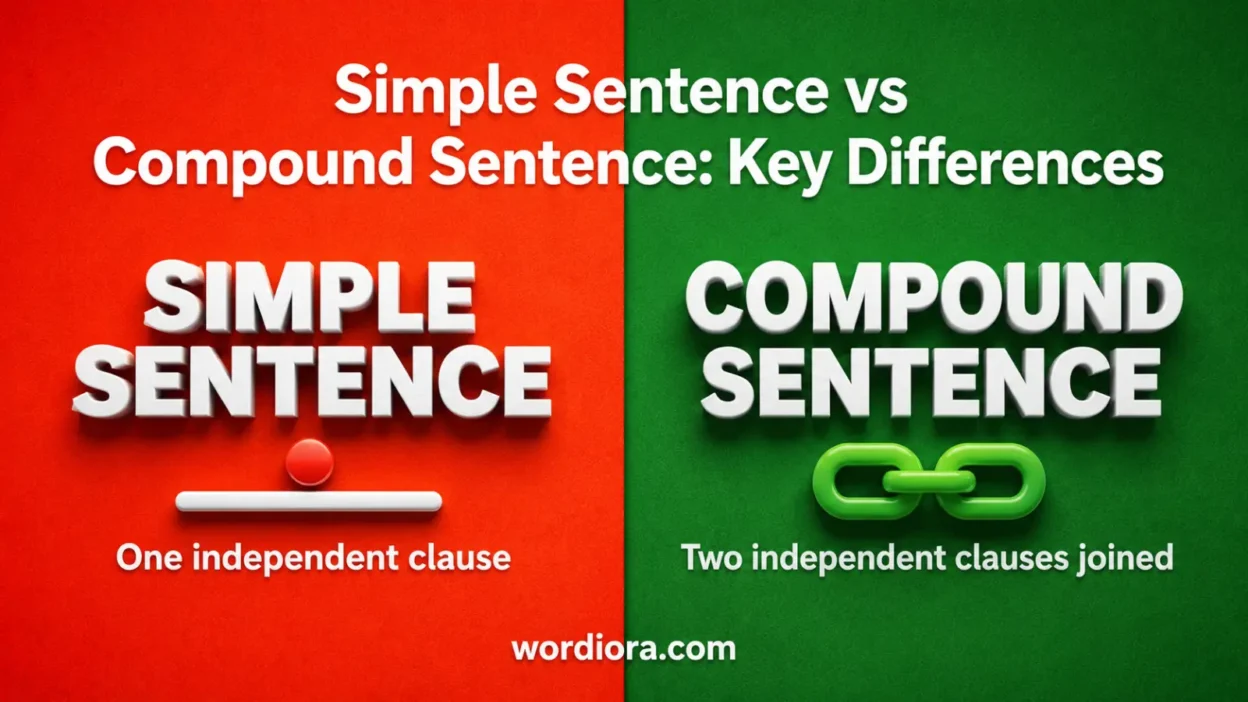
A simple sentence and a compound sentence are both complete sentences, but they work differently. A simple sentence contains one independent clause. A compound sentence contains two or more independent clauses joined together.
Writers often confuse them because both can be short, clear, and grammatically correct. The difference comes down to structure, not length.
Understanding the distinction helps you write more naturally, avoid run-on sentences, and vary your sentence style effectively.
Quick Answer
A simple sentence has one independent clause:
The dog barked.
A compound sentence has at least two independent clauses connected with a coordinating conjunction or punctuation:
The dog barked, and the mail carrier stepped back.
Why People Confuse Them
The confusion usually happens because sentence length does not determine sentence type.
A short sentence can still be compound:
I called, but nobody answered.
And a long sentence can still be simple if it contains only one independent clause:
The students sitting near the back of the crowded auditorium quietly took notes during the lecture.
People also mistake phrases for clauses. A sentence may contain extra details without becoming compound.
Key Differences At A Glance
| Context | Best Choice | Why |
|---|---|---|
| One complete idea | Simple sentence | Keeps the message direct and clean |
| Two equal ideas connected together | Compound sentence | Shows a relationship between ideas |
| Fast, punchy writing | Simple sentence | Creates clarity and speed |
| Balanced comparison or contrast | Compound sentence | Connects related thoughts smoothly |
| Basic statements | Simple sentence | Easier to read quickly |
| Combining related actions | Compound sentence | Prevents choppy writing |
Quick Structural Comparison
| Feature | Simple Sentence | Compound Sentence |
|---|---|---|
| Independent clauses | One | Two or more |
| Coordinating conjunction needed | No | Usually |
| Can stand alone | Yes | Yes |
| Sentence complexity | Basic | More developed |
| Common punctuation | Period | Comma + conjunction or semicolon |
Meaning and Usage Difference
A simple sentence expresses one complete thought.
Examples:
Mia drives to work.
The game ended early.
My brother loves spicy food.
A compound sentence combines separate but related thoughts.
Examples:
Mia drives to work, and her sister takes the train.
The game ended early, so everyone went home.
My brother loves spicy food, but I prefer mild dishes.
The key idea is independence. Each side of a compound sentence could stand alone as its own sentence.
For example:
The store closed early.
We went somewhere else.
These can become a compound sentence:
The store closed early, so we went somewhere else.
Tone, Context, and Formality
Simple sentences often sound more direct and forceful.
The meeting is canceled.
Compound sentences usually sound smoother and more conversational because they connect ideas.
The meeting is canceled, but we will reschedule it soon.
Neither type is inherently more formal. Strong writing usually mixes both.
Simple sentences help with:
- emphasis
- clarity
- dramatic effect
- concise communication
Compound sentences help with:
- flow
- transitions
- balanced ideas
- showing contrast or cause
Which One Should You Use?
Use a simple sentence when:
- the point is straightforward
- you want strong clarity
- the sentence already contains enough detail
Use a compound sentence when:
- two ideas are closely related
- separate sentences feel too abrupt
- you want smoother rhythm between ideas
For example:
Simple:
The forecast changed suddenly.
Compound:
The forecast changed suddenly, so the event moved indoors.
The second version better explains the relationship between the ideas.
When One Choice Sounds Wrong
Using too many simple sentences in a row can sound repetitive.
I woke up late. I missed the bus. I called a rideshare. I arrived tired.
A compound sentence can improve flow:
I woke up late, so I missed the bus and called a rideshare.
On the other hand, forcing too many ideas into compound sentences can feel heavy or cluttered.
Less natural:
I finished the report, and I answered emails, and I scheduled meetings.
Better:
I finished the report, answered emails, and scheduled meetings.
Not every sentence needs multiple clauses.
Common Mistakes (and Quick Fixes)
Mistake 1: Confusing a compound predicate with a compound sentence
Not compound:
Sarah cooked dinner and cleaned the kitchen.
This sentence has one subject and one independent clause.
Compound:
Sarah cooked dinner, and her roommate cleaned the kitchen.
Mistake 2: Creating a run-on sentence
Incorrect:
The movie started late we still enjoyed it.
Correct:
The movie started late, but we still enjoyed it.
Mistake 3: Using a comma incorrectly
Incorrect:
I was tired, I stayed home.
Correct:
I was tired, so I stayed home.
Or:
I was tired. I stayed home.
Everyday Examples
Simple sentences:
- The baby is sleeping.
- Traffic was terrible today.
- My phone battery died.
- The concert starts at eight.
- Everyone laughed.
Compound sentences:
- The baby is sleeping, so please stay quiet.
- Traffic was terrible today, but I still arrived on time.
- My phone battery died, and I forgot my charger.
- The concert starts at eight, so we should leave soon.
- Everyone laughed, and the speaker smiled.
Dictionary-Style Word Details
Verb
Neither “simple sentence” nor “compound sentence” functions as a verb. These are grammar terms used as noun phrases.
Examples:
- Teachers explain simple sentences early in grammar lessons.
- Editors often combine short statements into compound sentences.
Noun
Simple sentence
A sentence containing one independent clause.
Compound sentence
A sentence containing two or more independent clauses joined by conjunctions or punctuation.
Synonyms
Simple sentence:
- single-clause sentence
- independent-clause sentence
Compound sentence:
- coordinated sentence
- multi-clause sentence
These are near-equivalent grammar descriptions, not perfect substitutes.
Example Sentences
Simple sentence:
The kids played outside.
Our flight leaves tomorrow.
Compound sentence:
The kids played outside, and their parents watched from the porch.
Our flight leaves tomorrow, but the weather may delay it.
Word History
The term “simple sentence” comes from traditional grammar classification based on clause structure.
“Compound sentence” developed from the idea of combining complete thoughts into a larger grammatical unit using coordination.
These terms have been standard in English grammar instruction for generations.
Phrases Containing
Common phrases include:
- simple sentence structure
- compound sentence examples
- compound sentence with conjunction
- simple vs compound sentences
- independent clause
- coordinating conjunction
Still confused between compound and complex sentences? This easy guide on compound sentence vs complex sentence breaks down the differences with simple examples.
FAQ
Can a simple sentence be long?
Yes. A simple sentence can be very long as long as it contains only one independent clause.
Does every compound sentence need a conjunction?
No. Some compound sentences use a semicolon instead of a coordinating conjunction.
Example:
The rain stopped; the crowd returned outside.
Is a compound sentence always better than a simple sentence?
No. Both are useful. The best choice depends on clarity, rhythm, and how ideas connect.
What is the easiest way to identify a compound sentence?
Check whether the sentence contains two complete thoughts that could stand alone as separate sentences.
Can a sentence have commas and still be simple?
Yes. Commas alone do not make a sentence compound.
Example:
After dinner, we watched a movie.
This is still a simple sentence because it has one independent clause.
Conclusion
A simple sentence contains one independent clause, while a compound sentence contains two or more independent clauses joined together.
The difference is structural, not based on sentence length.
Simple sentences create clarity and impact. Compound sentences improve flow and connect related ideas. Strong writing uses both naturally instead of relying too heavily on either one.
Once you learn to identify independent clauses, the difference between simple and compound sentences becomes much easier to spot.