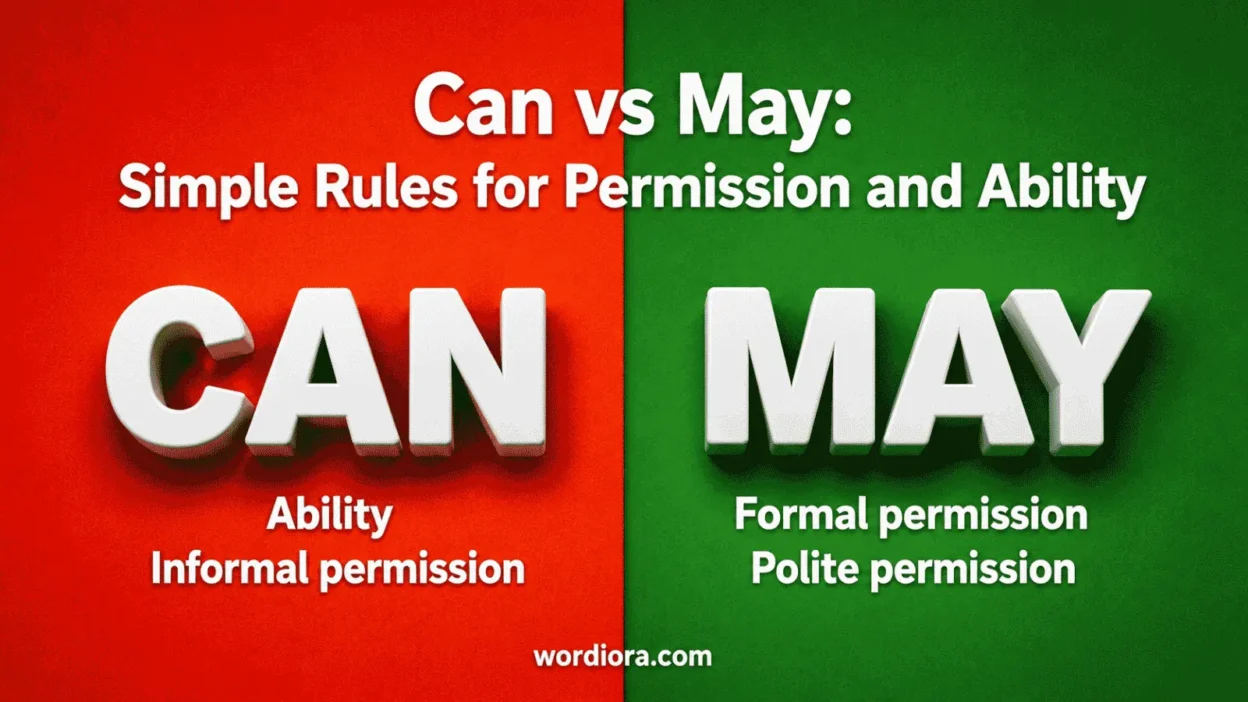
The difference between can vs may is mostly about ability, permission, possibility, and tone.
Use can when you mean someone is able to do something or when you are speaking casually about permission. Use may when you want to sound more formal, polite, or official, especially when asking for or granting permission.
Both words are correct in many permission sentences. The better choice depends on the setting.
Quick Answer
Use can for ability:
“I can drive a manual car.”
Use may for formal permission:
“May I leave early today?”
Use can for everyday permission:
“Can I borrow your charger?”
Use may for possibility when the result is uncertain:
“It may rain later.”
The old classroom rule says can means ability and may means permission. That rule is useful, but it is too strict for modern American English. In everyday speech, can is widely used for permission.
Why People Confuse Them
People confuse can and may because both can appear in permission questions.
“Can I sit here?”
“May I sit here?”
Both sentences ask for permission, but they do not feel the same. Can I sit here? sounds normal, casual, and direct. May I sit here? sounds more formal or extra polite.
The confusion also comes from school corrections. Many people were taught that “Can I go to the restroom?” is wrong because it asks whether the person is physically able to go. In real use, most listeners understand that the speaker is asking for permission, not describing physical ability.
That does not mean may is useless. It still matters in formal writing, rules, official notices, polite requests, and careful professional language.
Key Differences At A Glance
| Context | Best Choice | Why |
|---|---|---|
| Physical or mental ability | can | It shows what someone is able to do. |
| Casual permission | can | It sounds natural in everyday speech. |
| Formal permission | may | It sounds more polite, official, or traditional. |
| Official rules | may | It often fits policies, instructions, and formal notices. |
| Uncertain possibility | may | It suggests something is possible but not definite. |
| Definite practical possibility | can | It shows that something is possible or available. |
Meaning and Usage Difference
Can usually means ability, capacity, or practical possibility.
“She can finish the report by noon.”
This means she is able to finish it.
“You can park on this side of the street.”
This means parking is allowed or possible there.
May usually points to permission or possibility.
“You may enter after the bell rings.”
This grants permission.
“The meeting may end early.”
This means the meeting could end early, but it is not certain.
Here is the simplest way to separate them:
| Feature | can | may |
|---|---|---|
| Core meaning | ability or practical possibility | permission or uncertain possibility |
| Tone | casual, direct, everyday | formal, polite, official |
| Common permission use | “Can I leave now?” | “May I leave now?” |
| Best fit | speech, everyday writing, ability | formal requests, rules, possibility |
Tone, Context, and Formality
Tone is the biggest practical difference.
Can sounds relaxed and natural:
“Can I call you after lunch?”
“Can we move the meeting?”
“Can guests use the pool?”
These are normal in everyday American English.
May sounds more formal:
“May I speak with the manager?”
“Employees may request remote work on Fridays.”
“Visitors may enter through the east gate.”
In casual conversation, may can sound polite, careful, or sometimes stiff. In professional notices, policies, and formal requests, it often sounds clear and appropriate.
For example, a company handbook would likely say:
“Employees may use personal days after supervisor approval.”
A coworker would more likely say:
“Can I take a personal day next Friday?”
Both are understandable. The setting decides which one sounds better.
Still confused about polite expressions and modal verbs? Check out our detailed guide on could-vs-would to understand their differences, proper usage, and real-life sentence examples.
Which One Should You Use?
Use can when you are talking about ability:
“She can lift the box.”
“I can meet at 3.”
“They can solve the problem.”
Use can when the permission request is casual:
“Can I grab a coffee?”
“Can we sit outside?”
“Can I use your phone?”
Use may when the permission request is formal or polite:
“May I ask a question?”
“May we begin?”
“May I see your ID?”
Use may when writing rules, notices, or instructions:
“Students may submit late work with approval.”
“Customers may return unused items within 30 days.”
“Guests may not enter restricted areas.”
Use may for uncertain possibility:
“She may be at the office.”
“The package may arrive tomorrow.”
“There may be a delay.”
When One Choice Sounds Wrong
Can sounds wrong when the sentence needs a clearly formal or official tone.
Weak in a formal notice:
“Employees can access confidential files only with approval.”
Better:
“Employees may access confidential files only with approval.”
The first sentence is understandable, but the second sounds more like a rule.
May sounds wrong when the sentence is really about ability.
Awkward:
“He may swim across the lake.”
Better:
“He can swim across the lake.”
The improved sentence says he has the ability to swim across the lake. May would suggest permission or possibility, not skill.
May can also sound unnatural in everyday requests if the situation is casual.
Stiff:
“May I get a refill?”
Natural:
“Can I get a refill?”
The formal version is not incorrect, but it may sound overly careful in a casual diner or coffee shop.
Common Mistakes (and Quick Fixes)
Mistake: Using may for ability.
Weak: “I may type 90 words per minute.”
Better: “I can type 90 words per minute.”
Mistake: Using can when a formal rule needs a more official tone.
Weak: “Guests can enter after checking in.”
Better: “Guests may enter after checking in.”
Mistake: Thinking can is always wrong for permission.
Too strict: “Can I leave?” is incorrect.
Better: “Can I leave?” is fine in everyday speech. “May I leave?” is more formal.
Mistake: Using may to ask someone else to do something.
Awkward: “May you send me the file?”
Better: “Can you send me the file?”
For requests asking another person to act, can you is natural. May I works when asking permission for yourself.
Everyday Examples
“I can help you after lunch.”
“Can I use the conference room?”
“You can take the last slice.”
“May I ask who is calling?”
“Students may use calculators on this section.”
“The train may be delayed.”
“We can meet in person or by video.”
“May I place you on a brief hold?”
“You can find the form on the website.”
“The office may close early on Friday.”
In these examples, can feels direct and practical. May feels more formal, polite, or uncertain.
Dictionary-Style Word Details
Verb
Can is a modal verb used to show ability, permission, or practical possibility.
Examples:
“She can speak Spanish.”
“You can leave your bag here.”
May is a modal verb used to show permission or possibility.
Examples:
“You may begin.”
“The answer may depend on the context.”
Noun
Can can also be a noun meaning a metal container.
Example:
“Open a can of soup.”
That noun use is separate from the modal verb in can vs may.
May can be a noun when it names the month.
Example:
“Graduation is in May.”
That noun use is also separate from the modal verb.
Synonyms
For can, close meanings include:
“be able to”
“be allowed to”
“have the ability to”
For may, close meanings include:
“be permitted to”
“be allowed to”
“might”
These are not always interchangeable. “Be able to” fits ability. “Be permitted to” fits formal permission. “Might” fits possibility.
Example Sentences
“She can run five miles without stopping.”
“Can I call you tomorrow?”
“You may begin when ready.”
“The policy may change next year.”
“Visitors can buy tickets at the front desk.”
“Visitors may not enter without a badge.”
Word History
Both can and may are long-established English modal verbs. Their older uses helped shape the modern distinction: can became strongly connected with ability, while may stayed closely connected with permission and possibility.
For today’s writer, the important point is not memorizing old forms. The useful point is choosing the word that fits the meaning and tone of the sentence.
Phrases Containing
Common phrases with can:
“as best I can”
“can do”
“can’t help it”
“if you can”
Common phrases with may:
“may as well”
“be that as it may”
“come what may”
“may or may not”
These phrases are fixed or familiar expressions, so do not replace one word with the other unless the sentence actually calls for a different meaning.
Conclusion
The best choice in can vs may depends on meaning and tone.
Use can for ability, casual permission, and practical possibility. Use may for formal permission and uncertain possibility.
For everyday speech, “Can I?” is usually natural. For formal requests, rules, and polished professional writing, “May I?” or “may” often sounds better.
The easiest rule is this: can is usually the everyday choice; may is the more formal or uncertain one.