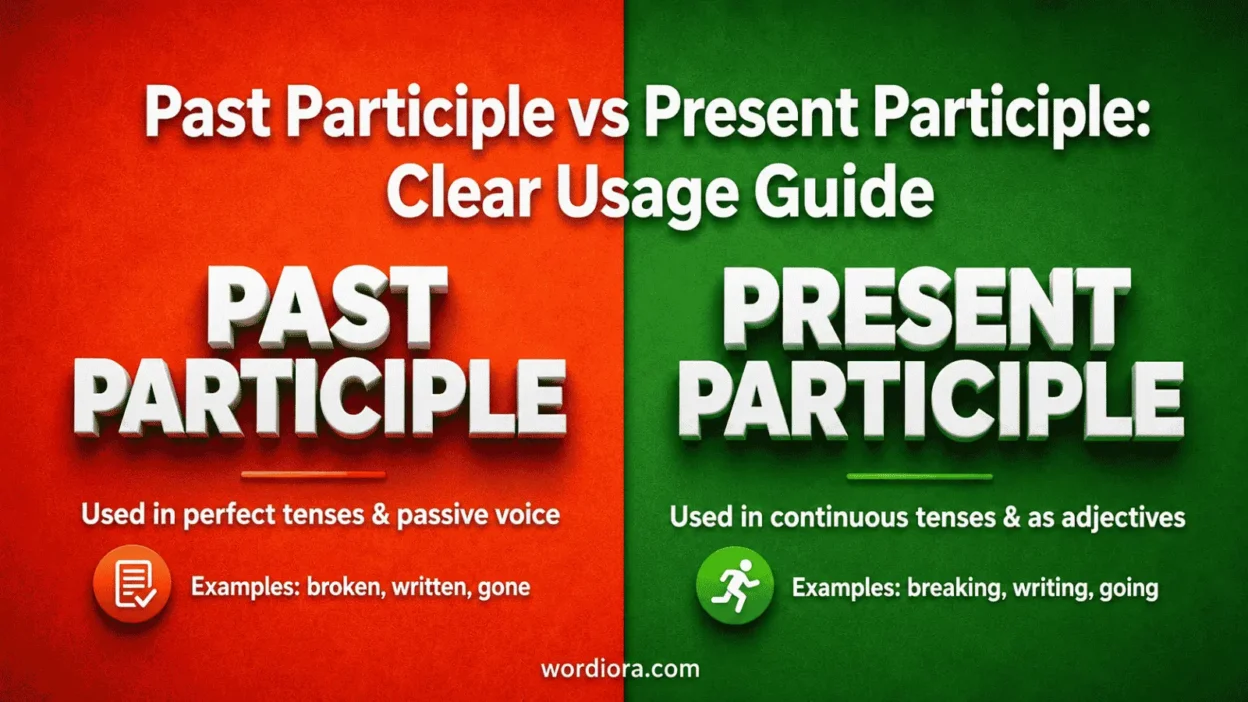
The difference between past participle vs present participle comes down to form and function.
A present participle usually ends in -ing, as in running, talking, or breaking. A past participle often ends in -ed, -en, -d, -t, or -n, as in finished, broken, built, or seen.
Both forms come from verbs, but they are not used the same way. A present participle often shows ongoing action. A past participle often shows a completed action, a resulting state, or a passive meaning.
Quick Answer
Use a present participle when the action is ongoing, active, or happening at the same time as another action.
Use a past participle when the action is completed, received by the subject, or used with perfect tenses and passive voice.
Examples:
- Present participle: The dog is barking.
- Past participle: The window was broken.
- Present participle as adjective: The movie was boring.
- Past participle as adjective: The audience looked bored.
A simple way to remember it:
- Present participle = doing
- Past participle = done, affected, or completed
Why People Confuse Them
People confuse past participles and present participles because both forms can act like adjectives.
For example:
- a boring class
- a bored student
Both words describe nouns, but they do not describe the same thing. Boring means the class causes boredom. Bored means the student feels boredom.
That same pattern appears in many common pairs:
- confusing / confused
- exciting / excited
- tiring / tired
- surprising / surprised
- frightening / frightened
The present participle often describes what causes a feeling or action. The past participle often describes who experiences it or what condition results from it.
Key Differences At A Glance
| Context | Best Choice | Why |
|---|---|---|
| Ongoing action | present participle | It shows an action in progress: She is studying. |
| Perfect tense | past participle | It follows have, has, or had: They have finished. |
| Passive voice | past participle | It follows a form of be: The report was written. |
| Cause of a feeling | present participle | It describes what creates the feeling: an annoying sound |
| Person or thing affected | past participle | It describes the result or reaction: an annoyed customer |
| Reduced active clause | present participle | It keeps an active meaning: Students carrying laptops entered. |
| Reduced passive clause | past participle | It keeps a passive meaning: Files stored online are safe. |
Meaning and Usage Difference
A present participle is the -ing form of a verb.
Examples:
- walking
- eating
- choosing
- writing
- sleeping
It is used with forms of be to create continuous verb forms:
- I am working.
- She was driving.
- They are waiting.
It can also describe a noun:
- a glowing screen
- a moving speech
- a leading company
A past participle is the form used in perfect tenses, passive voice, and many adjective uses.
Examples:
- finished
- eaten
- chosen
- written
- slept
It is used with have, has, or had:
- I have finished.
- She has chosen.
- They had left.
It is also used with forms of be in passive voice:
- The email was sent.
- The door is locked.
- The policy was changed.
As an adjective, it often describes a condition or result:
- a locked door
- a written agreement
- a damaged phone
Tone, Context, and Formality
Neither form is more formal by itself. The difference depends on grammar and meaning, not tone.
In everyday speech, present participles often sound active and immediate:
- The baby is crying.
- The team is winning.
- The water is boiling.
Past participles often sound final, completed, or affected:
- The baby is fed.
- The deal is signed.
- The files are saved.
In formal writing, past participles are common in passive constructions:
- The contract was reviewed.
- The results were confirmed.
- The application has been approved.
Present participles are common when describing ongoing actions or shortening active clauses:
- Employees working remotely must attend the meeting.
- Customers using the app should update their settings.
Which One Should You Use?
Choose the form that matches the meaning you need.
Use present participle when the noun is doing the action:
- The running water filled the sink.
- The crying child needed help.
- The glowing sign caught my attention.
Use past participle when the noun receives the action or shows the result:
- The broken glass was on the floor.
- The approved plan starts Monday.
- The written instructions were clear.
Here is the compact comparison:
- past participle: completed, received, affected, or used with have and passive be
- present participle: ongoing, active, causing, or used with continuous be
When One Choice Sounds Wrong
Some mistakes happen because the wrong participle changes the meaning.
Incorrect:
- I am interest in the job.
- The movie was bored.
- The instructions were confusing me yesterday?
Better:
- I am interested in the job.
- The movie was boring.
- The instructions confused me yesterday.
Use interested when a person feels interest. Use interesting when something causes interest.
Compare:
- The book is interesting.
- I am interested in the book.
The same idea applies here:
- The news was surprising.
- We were surprised by the news.
Common Mistakes (and Quick Fixes)
One common mistake is using the present participle when the past participle is needed after have.
Incorrect:
- I have ate lunch.
- She has went home.
- They had saw the message.
Correct:
- I have eaten lunch.
- She has gone home.
- They had seen the message.
Another common mistake is using the past participle when the present participle should describe an active noun.
Incorrect:
- The fallen rain soaked the field.
Better:
- The falling rain soaked the field.
Use falling when the rain is coming down now. Use fallen when it has already fallen.
Example:
- The fallen leaves covered the sidewalk.
A third mistake is confusing emotional adjective pairs.
Incorrect:
- I was boring during the meeting.
- The speech was inspired.
Better:
- I was bored during the meeting.
- The speech was inspiring.
Everyday Examples
Here are natural examples that show the difference clearly:
- The boiling water spilled over the pot.
- The boiled water cooled on the counter.
- The breaking news interrupted the show.
- The broken vase sat on the table.
- The developing story changed throughout the day.
- The developed plan was ready for review.
- The closing store had a line outside.
- The closed store had a sign on the door.
- The rising cost worried families.
- The risen cost affected the final budget.
In each pair, the present participle points to action in progress. The past participle points to a completed action, result, or condition.
Dictionary-Style Word Details
Verb
Past participle and present participle are names for verb forms.
A present participle is formed with -ing:
- walk → walking
- make → making
- run → running
A past participle is regular or irregular:
- finish → finished
- break → broken
- write → written
- build → built
- see → seen
Noun
As grammar terms, both phrases function as nouns:
- A present participle can describe ongoing action.
- A past participle can help form perfect tenses and passive voice.
Examples:
- Running is the present participle of run.
- Run is also the past participle of run.
- Written is the past participle of write.
Synonyms
These terms do not have exact everyday synonyms, but they can be explained with close grammar descriptions.
For present participle:
- the -ing form
- the active participle
- the continuous form in verb phrases
For past participle:
- the completed participle
- the third principal part of a verb
- the form used with perfect tenses
Use these descriptions only when they fit the grammar context. They are explanations, not perfect replacements.
Example Sentences
- Walking through the park, Maya noticed the new mural.
- The painted fence looked fresh.
- He has written three drafts.
- The team is preparing for Friday’s meeting.
- The package was delivered this morning.
- The glowing review helped the restaurant.
- The signed form is in your inbox.
Word History
The labels present participle and past participle are standard grammar terms used to identify two different verb forms.
The names can be misleading if taken too literally. A present participle does not always refer to present time, and a past participle does not always refer to past time.
For example:
- She was running yesterday.
- The door is locked now.
In the first sentence, running is a present participle used for past time. In the second, locked is a past participle used for a present condition.
Phrases Containing
Common phrases with present participle include:
- present participle phrase
- present participle adjective
- present participle clause
- present participle form
Common phrases with past participle include:
- past participle phrase
- past participle adjective
- past participle form
- irregular past participle
These phrases usually appear in grammar explanations, writing lessons, and discussions of verb forms.
Conclusion
The difference between past participle vs present participle is not about which one sounds better. It is about what the form does.
Use a present participle for -ing forms that show ongoing action, active meaning, or something that causes a reaction.
Use a past participle for completed action, passive meaning, perfect tenses, or a condition that results from an action.
A quick test helps: if the noun is doing the action, the present participle often fits. If the noun received the action or shows the result, the past participle is usually the right choice.