Last Updated: July 30, 2026
Micro Influencers vs Mega Influencers is a word-choice question about picking the right label for the kind of creator you actually mean.
The best term depends on the job you need that creator to do. In current marketing guides, micro influencers usually refer to creators with a smaller, more niche audience, while mega influencers usually refer to creators with celebrity-scale reach. Many current sources place micro influencers around 10,000 to 100,000 followers and mega influencers at 1 million or more, but the exact cutoffs are not perfectly universal across platforms or publishers.
Quick Answer
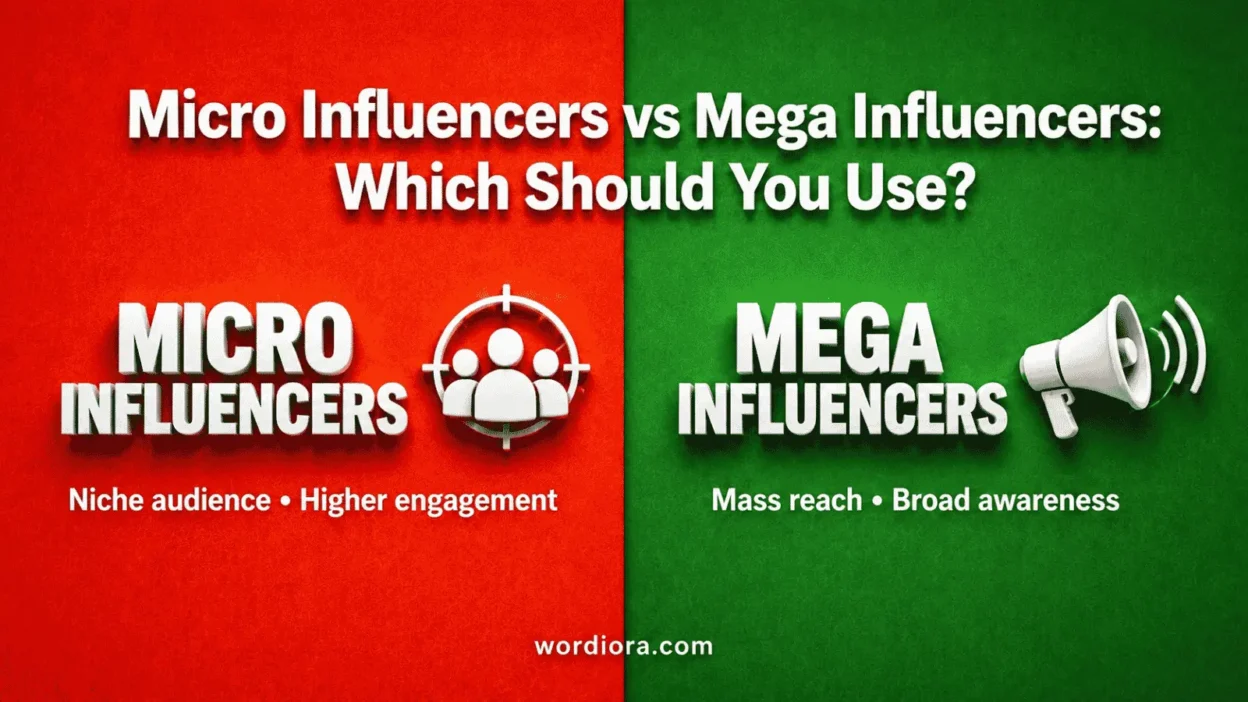
Use micro influencers when you mean creators chosen for niche relevance, stronger audience connection, and more targeted engagement. Use mega influencers when you mean creators chosen for massive visibility, broad awareness, and star-level reach. Neither term is automatically better. The right choice depends on whether your goal is precision or scale. Current industry guides and recent research broadly support that split.
Why People Confuse Them
People confuse these terms because both belong to the same influencer-size system, and both sound like simple descriptions of audience size. But in real use, the difference is not just “smaller” versus “bigger.”
The confusion also comes from inconsistent cutoffs. Some sources define micro influencers tightly, while others use a wider range. Some add a mid-tier category between micro and macro, which makes the borders even less tidy. That means writers often treat the labels as exact when they are really strategic shorthand.
Key Differences At A Glance
The table below reflects the practical distinction that shows up most often in current marketing guidance: micro influencers usually fit trust-heavy, niche campaigns, while mega influencers fit broad-reach awareness work.
| Context | Best Choice | Why |
| Launching a niche product to a specific audience | Micro influencers | Their audience is usually tighter, more focused, and easier to match to a category |
| Creating fast national awareness | Mega influencers | They can put a brand in front of a far larger audience at once |
| Working with a modest budget | Micro influencers | They are usually more accessible and easier to test in groups |
| Building trust through product education | Micro influencers | Their recommendations often feel more personal and community-based |
| Chasing prestige or celebrity association | Mega influencers | Their scale can create instant visibility and status signals |
| Testing multiple creator angles | Micro influencers | Brands can often spread budget across several creators instead of one large bet |
| Driving a big cultural splash | Mega influencers | Their reach is better suited for broad attention and headline moments |
Meaning and Usage Difference
Micro influencers usually means creators whose value comes from closeness: a narrower niche, a more recognizable community, and stronger day-to-day interaction with followers. In plain English, the term suggests relevance, specificity, and trust.
Mega influencers usually means creators whose value comes from scale: a very large audience, stronger general visibility, and often celebrity-level recognition. In plain English, the term suggests reach, fame, and broad exposure.
That is why these are not interchangeable terms. If you write “micro influencers” when you really want mass awareness, your wording undersells the scale you need. If you write “mega influencers” when you really want niche credibility, your wording points to the wrong strategy.
Tone, Context, and Formality
In professional writing, micro influencers usually sounds more performance-focused. It often appears in briefs, campaign plans, and budget discussions where the writer is thinking about audience fit, comment quality, trust, repeat partnerships, or efficient testing.
Mega influencers sounds broader and more visibility-driven. It fits decks, proposals, and launch plans where the goal is mass attention, broad impressions, or public recognition.
One important style point: do not pretend these labels are mathematical facts if your document has not defined them. Since current publishers still vary on the exact follower ranges, the cleanest business writing often names the term and then states the range being used for that project.
Which One Should You Use?
Choose the term that matches your actual objective, not the term that sounds more impressive.
- Choose micro influencers when you need niche fit, stronger community trust, product explainers, repeated creator testing, or more efficient coverage across several voices.
- Choose mega influencers when you need broad awareness, a major launch moment, instant visibility, celebrity-level recognition, or one creator with huge reach.
- Choose neither term by follower count alone if audience fit is weak. Current guidance from major marketing sources puts engagement, content quality, and alignment ahead of raw size.
- Choose a defined internal range if your team works across platforms, because one company’s “micro” may be another company’s “small creator.”
When One Choice Sounds Wrong
Micro influencers sounds wrong when the creator’s main value is mass exposure. A sentence like “We need micro influencers for a one-day national awareness blast” usually signals a mismatch between the term and the goal.
Mega influencers sounds wrong when the creator’s main value is specialized trust. A sentence like “We need mega influencers to build credibility inside a narrow hobby community” usually points to the wrong tier.
Both terms also sound wrong when follower count is treated as the whole story. A huge audience with weak category fit is not automatically the better pick. A smaller audience with strong trust can be far more persuasive in the right setting. Recent research and current industry guidance both support that basic idea.
Common Mistakes (and Quick Fixes)
Mistake: Using micro influencers as a general way to mean “cheap influencers.”
Quick fix: Use it only when you mean smaller-scale creators with niche communities, not just lower cost options.
Mistake: Using mega influencers as a general way to mean “better influencers.”
Quick fix: Use it only when you mean creators with very large reach. Bigger does not automatically mean better for every campaign.
Mistake: Treating the labels as universal across every platform.
Quick fix: Define your follower range inside the brief if the exact tier matters.
Mistake: Choosing the word by vanity.
Quick fix: Choose the word by goal. Trust-focused work and awareness-focused work usually call for different labels and different creator mixes.
Everyday Examples
A skincare startup that wants believable reviews from creators who already speak to acne-prone buyers would usually say it is working with micro influencers.
A national beverage brand that wants one big splash around a summer release would usually say it is partnering with mega influencers.
A marketing manager writing, “We want three micro influencers in the running community rather than one giant lifestyle account,” is using the term naturally.
A brand deck that says, “This campaign needs mega influencers because the priority is reach in a very short window,” is also using the term naturally.
A sentence like “We chose micro influencers for authentic product demos and community feedback” sounds specific and credible.
A sentence like “We chose mega influencers to put the brand in front of millions quickly” sounds specific and credible too.
Dictionary-Style Word Details
Verb
Neither micro influencers nor mega influencers is usually a stand-alone verb in standard American business writing.
Instead, writers use verb phrases built around them, such as work with micro influencers, hire mega influencers, brief micro influencers, or partner with mega influencers.
Noun
Micro influencers: plural noun. Creators with comparatively smaller followings who are usually valued for niche fit, closer audience relationships, and stronger relevance within a specific community. Many current guides place them under 100,000 followers, though exact thresholds vary.
Mega influencers: plural noun. Creators with very large, often celebrity-level followings who are usually valued for broad visibility and large-scale reach. Many current guides place them at 1 million followers or more.
Synonyms
For micro influencers, close substitutes can include small-scale creators, niche creators, or sometimes micro creators. These are near alternatives, not perfect matches.
For mega influencers, close substitutes can include celebrity influencers, large-scale creators, or high-reach creators. Again, these are context-based alternatives, not exact replacements.
Example Sentences
Micro influencers: “The brand chose micro influencers in the home-organizing space because their audiences already cared about storage solutions.”
Micro influencers: “For this product test, micro influencers make more sense than one giant account.”
Mega influencers: “The company brought in mega influencers to maximize opening-week visibility.”
Mega influencers: “If the goal is broad awareness in a short window, mega influencers may be the better fit.”
Word History
Both terms are modern platform-era compounds built from size prefixes attached to influencers. As influencer marketing matured, publishers and brands began sorting creators into tiers by follower size and campaign role, which is why these labels now function as strategic categories rather than casual descriptions. The ranges are widely recognized, but not fully standardized across every source.
Phrases Containing
Common phrases with micro influencers include micro influencers campaign, micro influencers strategy, micro influencers outreach, and micro influencers partnership.
Common phrases with mega influencers include mega influencers campaign, mega influencers reach, mega influencers partnership, and mega influencers launch plan.
Conclusion
When choosing between micro influencers and mega influencers, the real question is not which term sounds bigger. It is which term matches your purpose.
Use micro influencers when you need trust, niche relevance, stronger audience connection, or a more targeted creator mix. Use mega influencers when you need broad awareness, celebrity-level scale, or immediate visibility. If the distinction matters in a brief or article, define your range and choose the label that fits the job, not just the follower count headline.