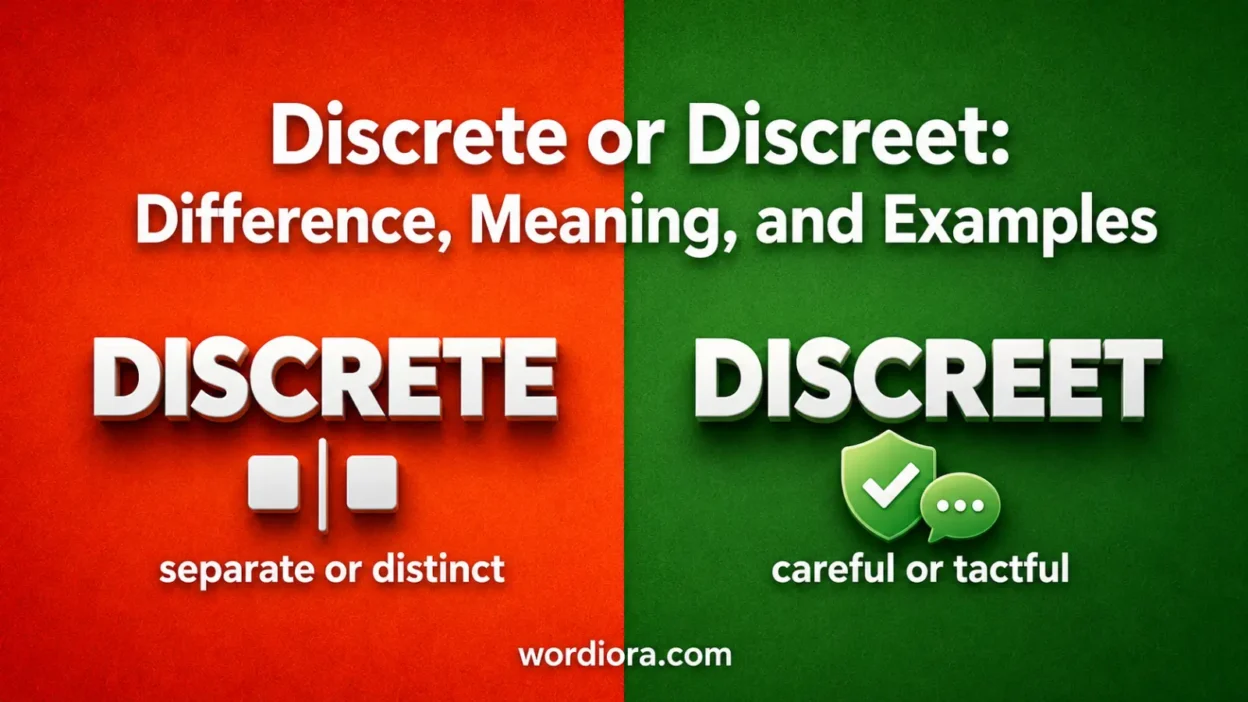
Discrete and discreet are both correct English words, but they do not mean the same thing. Use discrete when something is separate, distinct, or divided into individual parts. Use discreet when someone or something is careful, tactful, private, or not meant to attract attention.
The confusion is easy to understand. These words sound the same, look almost the same, and share a historical connection. Still, in modern US English, they carry different meanings. Choosing the right one helps your sentence sound clear, polished, and accurate.
Quick Answer
Use discrete for separate things: discrete categories, discrete steps, discrete units, discrete data. Use discreet for careful or subtle behavior: a discreet question, a discreet glance, a discreet warning, a discreet design. They are pronounced the same, but they are not interchangeable.
Why People Confuse Them
People confuse discrete and discreet for three main reasons.
First, they are homophones. In everyday speech, both words sound like dih-SKREET. You cannot hear the spelling difference.
Second, the spelling difference is small. Discrete has the final two e letters separated by t. Discreet keeps the two e letters together.
Third, both words can appear in serious or formal writing. That makes the wrong choice less obvious. A sentence may look professional at first, even when the word choice is wrong.
A helpful memory tip is simple: in discrete, the two e letters are separated. That matches the meaning: separate or distinct.
Key Differences At A Glance
| Context | Best Choice | Why |
|---|---|---|
| Separate groups or parts | discrete | The parts are distinct from each other. |
| Careful speech or behavior | discreet | The person is being tactful or private. |
| Data, math, or categories | discrete | The values or groups are separate, not continuous. |
| Privacy or secrecy | discreet | The action avoids attention or embarrassment. |
| Simple style or design | discreet | The design is subtle and not flashy. |
| Steps in a process | discrete | Each step is its own separate action. |
Meaning and Usage Difference
Discrete means separate, distinct, or individually different. It often describes things that can be counted, divided, grouped, or treated as separate units.
Examples:
- The report divided the responses into discrete categories.
- The project has five discrete stages.
- The system records discrete values instead of a continuous range.
Discreet means careful, tactful, private, or unobtrusive. It often describes a person, action, message, design, or behavior that avoids attention.
Examples:
- Please be discreet about the surprise party.
- She gave him a discreet reminder before the meeting.
- The hotel uses discreet lighting in the lobby.
The pronunciation is the same in standard US English: dih-SKREET. Because the words sound alike, the difference must be learned through meaning and spelling.
Here is the compact difference:
| Feature | Discrete | Discreet |
| Basic meaning | Separate or distinct | Careful, private, or subtle |
| Common use | Categories, units, steps, data | Behavior, speech, design, privacy |
| Main idea | Separation | Tact or restraint |
| Example phrase | discrete sections | discreet conversation |
Tone, Context, and Formality
Discrete often sounds more technical, academic, or exact. You may see it in writing about math, research, planning, science, business processes, or data.
Natural phrases include:
- discrete units
- discrete groups
- discrete categories
- discrete variables
- discrete stages
Discreet sounds social, personal, professional, or style-related. It fits situations where someone avoids drawing attention or handles sensitive information carefully.
Natural phrases include:
- discreet conversation
- discreet inquiry
- discreet reminder
- discreet service
- discreet design
Neither word is slang. Both are standard in American English. The difference is not really formality; it is meaning. Discrete is about separation. Discreet is about carefulness or subtlety.
Which One Should You Use?
Choose discrete when your sentence is about separate parts.
Use it for things like:
- separate categories
- separate actions
- separate sections
- countable values
- independent units
Correct: The survey results were sorted into discrete age groups.
Choose discreet when your sentence is about privacy, tact, or low visibility.
Use it for things like:
- careful questions
- quiet warnings
- private behavior
- subtle design
- tactful comments
Correct: The manager was discreet when discussing the employee’s concern.
A quick test can help:
If you mean separate, write discrete.
If you mean careful or private, write discreet.
When One Choice Sounds Wrong
The wrong word can change the meaning of the sentence.
Wrong: Please be discrete about the news.
Correct: Please be discreet about the news.
Why: The sentence means “keep it private” or “handle it carefully,” not “be separate.”
Wrong: The class was divided into three discreet groups.
Correct: The class was divided into three discrete groups.
Why: The groups are separate. They are not being tactful or private.
Wrong: She wore a discrete necklace to the interview.
Correct: She wore a discreet necklace to the interview.
Why: The necklace is subtle or understated. It is not a separate category.
Wrong: The app collects discreet data points.
Correct: The app collects discrete data points.
Why: The data points are separate values.
Common Mistakes (and Quick Fixes)
Mistake 1: Using discrete for private behavior
Wrong: He was discrete about the client’s issue.
Correct: He was discreet about the client’s issue.
Quick fix: If privacy matters, use discreet.
Mistake 2: Using discreet for categories
Wrong: The answers fall into four discreet types.
Correct: The answers fall into four discrete types.
Quick fix: If the sentence means separate types, use discrete.
Mistake 3: Confusing the adverbs
Wrong: She handled the matter discretely.
Correct: She handled the matter discreetly.
Quick fix: Discreetly means carefully or privately. Discretely means separately.
Mistake 4: Treating the words as style variants
Wrong: Either spelling is fine.
Correct: The spelling changes the meaning.
Quick fix: These are different words in modern usage, not casual spelling options.
Everyday Examples
- The budget has three discrete sections: rent, payroll, and supplies.
- The teacher gave each student a discrete task.
- The chart shows discrete values, not a smooth curve.
- The company separated the work into discrete phases.
- Each file is stored as a discrete record.
- Please be discreet when you ask about the issue.
- The assistant made a discreet phone call after the meeting.
- She gave her friend a discreet look across the table.
- The restaurant has a discreet entrance on the side street.
- He handled the awkward question in a discreet way.
Dictionary-Style Word Details
Verb
Discrete: Not commonly used as a verb in standard US English. Use it mainly as an adjective.
Discreet: Not used as a verb in standard US English. Use it as an adjective.
Noun
Discrete: Not commonly used as a noun in everyday US English. The related noun is discreteness, meaning the quality of being separate or distinct.
Discreet: Not used as a noun. The related noun discretion means careful judgment, especially in speech or behavior. Discreetness also exists, but it is less common than discretion.
Synonyms
Discrete: closest plain alternatives include separate, distinct, individual, detached, and independent. Useful opposites include connected, continuous, and unified.
Discreet: closest plain alternatives include tactful, careful, prudent, subtle, unobtrusive, and understated. Useful opposites include indiscreet, careless, obvious, and flashy, depending on the sentence.
Example Sentences
Discrete:
- The plan is divided into several discrete tasks.
- The study measured discrete outcomes.
- Each department works as a discrete unit.
- The software stores each answer as a discrete entry.
Discreet:
- Be discreet when you mention the promotion.
- The nurse gave a discreet signal to the doctor.
- The office has a discreet sign near the door.
- He was discreet about the family matter.
Word History
Discrete and discreet have a shared historical background, but modern English separates their meanings. Today, discrete keeps the idea of separation or distinction. Discreet carries the idea of careful judgment, tact, privacy, or unobtrusive behavior.
For current writing, the practical rule matters most: discrete means separate; discreet means careful or subtle.
Phrases Containing
Discrete:
- discrete categories
- discrete data
- discrete variables
- discrete units
- discrete steps
- discrete stages
- discrete parts
- discrete values
Discreet:
- discreet inquiry
- discreet conversation
- discreet reminder
- discreet glance
- discreet distance
- discreet service
- discreet design
- discreet about the matter
FAQs
Is discrete or discreet correct?
Both are correct, but they mean different things. Discrete means separate or distinct. Discreet means careful, tactful, private, or subtle.
Is discreet the same as private?
Not exactly. Discreet often includes privacy, but it also means careful, tactful, or unobtrusive. A discreet person handles sensitive things without drawing attention.
Is discrete used in math and data writing?
Yes. Discrete is common in math, data, research, and technical writing. It describes separate values, categories, units, or parts.
Are discrete and discreet pronounced the same?
Yes. In standard US English, discrete and discreet are pronounced the same: dih-SKREET. The difference is in spelling and meaning.
What is an easy way to remember discrete vs discreet?
Remember that in discrete, the e letters are separated by t. That fits the meaning: separate or distinct. Use discreet for careful or private behavior.
Conclusion
Discrete and discreet sound the same, but they serve different purposes. Use discrete when you mean separate, distinct, or individually divided. Use discreet when you mean careful, tactful, private, or subtle.
The easiest memory trick is in the spelling: in discrete, the e letters are separated. That matches the meaning. When the sentence is about privacy or tact, choose discreet instead.