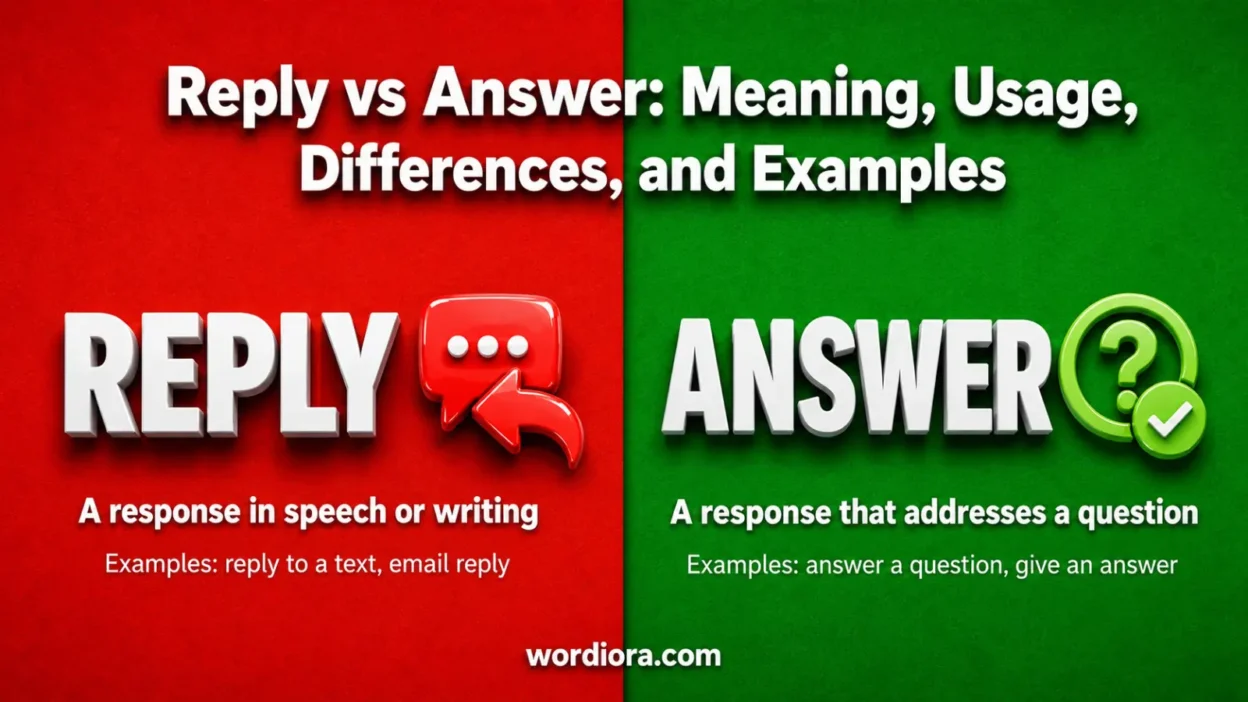
Reply vs answer is a common word-choice problem because both words can mean a response. The difference is not hard, but it depends on the situation.
Use answer when someone asks a question, when a problem needs a solution, or when you pick up a phone or respond to a door.
Use reply when you respond to something someone said or wrote, especially in a message, email, letter, comment, or conversation.
Quick Answer
Both reply and answer are correct words, but they are not always used the same way.
Choose answer when the response should give information, solve something, or satisfy a question.
Choose reply when the focus is on sending or giving a response back to someone.
Examples:
“I answered the question.”
This means I gave the information that was asked for.
“I replied to the email.”
This means I sent a message back.
Sometimes both work:
“She answered my email.”
“She replied to my email.”
Both are possible, but replied to my email sounds more natural when the focus is email communication.
Why People Confuse Them
People confuse reply and answer because both can be nouns and verbs.
You can answer someone, and you can reply to someone. You can give an answer, and you can send a reply.
The overlap is real. A reply can contain an answer. An answer can be sent as a reply. The main difference is focus.
Answer focuses on the information or solution.
Reply focuses on the act of responding back.
That is why “Thanks for your reply” sounds natural in email, while “What is the answer?” sounds natural when someone needs the correct information.
Key Differences At A Glance
| Feature | reply | answer |
|---|---|---|
| Main idea | A response back to someone | A response that addresses a question, call, problem, or need |
| Common pattern | reply to someone or something | answer someone or something |
| Best fit | Emails, texts, comments, letters, conversation turns | Questions, tests, phones, doors, problems |
| Noun use | “I got your reply.” | “I need an answer.” |
| Verb use | “Please reply to the message.” | “Please answer the question.” |
Meaning and Usage Difference
Reply means to respond in words, writing, or action. It often points to communication going back and forth.
You reply to a text.
You reply to a comment.
You reply to a customer’s message.
The most common grammar pattern is reply to.
Correct: “Please reply to my email.”
Not natural in standard US English: “Please reply my email.”
Answer means to respond to a question, call, request, problem, or need. It can also mean to solve something.
You answer a question.
You answer the phone.
You answer the door.
You answer a math problem.
A key grammar difference is that answer can take a direct object.
Correct: “Answer the question.”
Correct: “Answer me.”
Correct: “Answer the phone.”
With reply, use to before the thing or person receiving the response.
Correct: “Reply to the question.”
Correct: “Reply to me.”
Correct: “Reply to the email.”
Tone, Context, and Formality
Neither word is only formal or only casual. Both are normal in US English.
Reply often sounds natural in written communication. It fits email, texting, social media comments, letters, invitations, and customer service messages.
“Thanks for your quick reply.”
“I’ll reply after lunch.”
“She replied to the comment.”
Answer sounds more direct. It fits questions, tests, calls, doors, problems, and situations where someone needs clear information.
“Please answer the question.”
“No one answered the phone.”
“That answer is correct.”
In a work email, reply often names the message itself. Answer often names the information inside the message.
“Thanks for your reply” means thanks for writing back.
“Thanks for your answer” means thanks for giving the information I needed.
If you’re still confused about when someone should answer versus simply respond, this detailed guide on Answer vs Respond breaks down the meaning, tone, and real-life usage differences in a simple way.
Which One Should You Use?
| Context | Best Choice | Why |
|---|---|---|
| A teacher asks a question | answer | The response should provide information. |
| A coworker sends an email | reply | The focus is writing back. |
| A test question has one correct choice | answer | The focus is correctness. |
| A friend sends a text | reply | The focus is sending a message back. |
| The phone rings | answer | The standard phrase is “answer the phone.” |
| Someone knocks on the door | answer | The standard phrase is “answer the door.” |
| A customer leaves a comment | reply | The focus is responding to the comment. |
| A problem needs a solution | answer | The word can mean the solution itself. |
When One Choice Sounds Wrong
Use answer for phones and doors.
Natural: “Can you answer the phone?”
Not natural: “Can you reply to the phone?”
Natural: “Nobody answered the door.”
Not natural: “Nobody replied to the door.”
Use answer for a question when you mean give the needed information.
Natural: “Please answer the question.”
Also possible: “Please reply to the question.”
But answer the question is usually clearer and more direct.
Use reply for emails and messages when you mean write back.
Natural: “Please reply to my email.”
Possible: “Please answer my email.”
But reply to my email is the safer everyday choice.
Common Mistakes (and Quick Fixes)
Mistake: “Please reply my email.”
Fix: “Please reply to my email.”
Mistake: “I replied the question.”
Fix: “I answered the question.”
Also possible: “I replied to the question.”
Mistake: “What is your reply to number 4?”
Fix: “What is your answer to number 4?”
Mistake: “No one replied the phone.”
Fix: “No one answered the phone.”
Mistake: “Send me an answer when you can” in a simple email thread.
Better: “Send me a reply when you can.”
Mistake: “I need a reply to this math problem.”
Better: “I need an answer to this math problem.”
Everyday Examples
“I’ll reply to your text after my meeting.”
“She answered every question in the interview.”
“Did Jason reply to the group chat?”
“The correct answer is C.”
“I emailed the landlord, but I haven’t gotten a reply yet.”
“Can you answer the door? I’m cooking.”
“He gave a clear answer about the deadline.”
“Maria replied, ‘I’ll be there at 7.’”
“The support team replied within an hour.”
“That does not answer my question.”
Dictionary-Style Word Details
Verb
reply: To respond in words, writing, or action. In everyday US English, it is usually followed by to when you name the person, message, question, or comment.
Examples:
“Please reply to the invitation.”
“She replied to my text.”
“He replied that he was busy.”
answer: To speak, write, act, or give information in response. It can take a direct object.
Examples:
“Please answer the question.”
“She answered me right away.”
“He answered the phone.”
Noun
reply: A spoken, written, or acted response.
Examples:
“I got a reply from the office.”
“Her reply was short but polite.”
answer: A response to a question, a correct response, or a solution to a problem.
Examples:
“What is your answer?”
“The answer to the puzzle is simple.”
“We still need an answer from the manager.”
Synonyms
reply: Closest plain alternatives include response, answer, return message, and comeback in casual speech. Response is often the safest general synonym.
A clear opposite is not always available. In many situations, the opposite idea is no reply or silence, but those are not exact word-for-word antonyms.
answer: Closest plain alternatives include response, solution, explanation, and reply, depending on context.
For a question, a useful opposite is question. For a test or problem, useful opposites include wrong answer or incorrect answer, depending on the sentence.
Example Sentences
reply:
“Please reply by Friday.”
“She replied to the message during lunch.”
“I never received a reply from the apartment office.”
“He replied with a short note.”
answer:
“Please answer in complete sentences.”
“She answered the customer’s question.”
“No one answered when I called.”
“The answer depends on the schedule.”
Word History
reply: The word came into English through older French forms connected to a Latin idea of folding back or turning back. That history fits the modern idea of sending something back in response, but modern usage should guide your choice.
answer: The word has Old English roots and has long been tied to speaking back, responding, or satisfying a question or demand. In modern US English, it is especially strong for questions, calls, and solutions.
Phrases Containing
reply:
“reply to an email”
“reply to a comment”
“reply all”
“in reply to”
“no reply”
“awaiting your reply”
answer:
“answer a question”
“answer the phone”
“answer the door”
“answer back”
“answer for something”
“the answer to a problem”
FAQs
Is it better to say reply or answer?
Use answer when someone asks a question or needs information. Use reply when someone sends a message and you write or speak back.
Example:
“Please answer the question.”
“Please reply to my email.”
Can reply and answer mean the same thing?
Sometimes, yes. Both can mean a response. But they do not always fit the same sentence.
“She replied to my email” and “She answered my email” can both work.
But “answer the phone” is correct, while “reply to the phone” is not natural.
Do you reply to a question or answer a question?
Both are possible, but answer a question is usually the better choice.
Use answer a question when giving information. Use reply to a question when focusing on the act of responding, especially in writing or conversation.
Is “reply my email” correct?
No. In standard US English, say reply to my email.
Correct: “Please reply to my email.”
Incorrect: “Please reply my email.”
Is “answer my email” correct?
Yes, answer my email can be correct. It means to respond to the email or address what was asked in it.
Still, reply to my email sounds more natural when you simply mean “write back.”
What is the difference between “no reply” and “no answer”?
No reply usually means no one responded to a message, email, comment, or request.
No answer can mean no one responded, but it is also common with phones, doors, questions, and problems.
Example:
“I got no reply to my email.”
“There was no answer when I called.”
Should I say “thanks for your reply” or “thanks for your answer”?
Both can be correct.
Use thanks for your reply when you mean “thanks for writing back.”
Use thanks for your answer when you mean “thanks for giving the information I needed.”
Can reply be a noun and a verb?
Yes. Reply can be a noun or a verb.
Noun: “I received your reply.”
Verb: “Please reply by Friday.”
Can answer be a noun and a verb?
Yes. Answer can be a noun or a verb.
Noun: “That is the correct answer.”
Verb: “Please answer the question.”
Conclusion
The best choice depends on what kind of response you mean.
Use answer when someone asks a question, a problem needs a solution, or a phone or door needs attention.
Use reply when someone writes, says, or sends something and you respond back.
A simple way to remember it is this: an answer gives the needed information; a reply sends a response back.