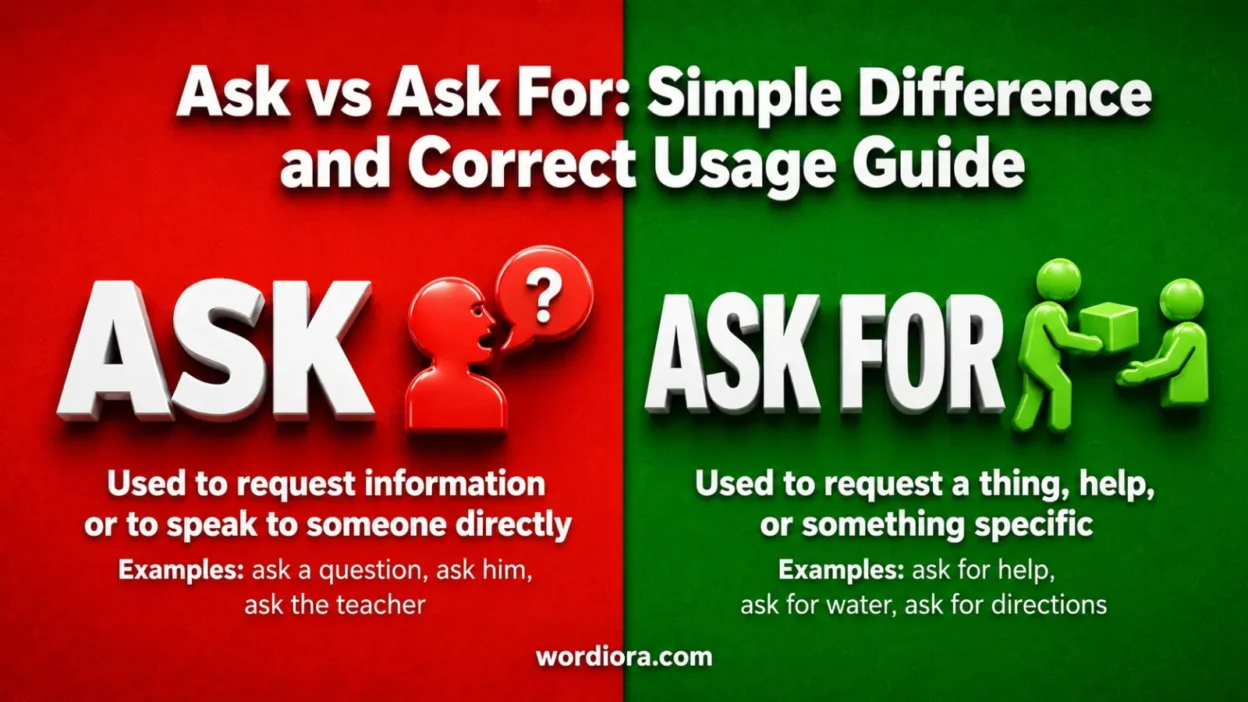
Ask and ask for are both correct, but they are not used the same way.
Use ask when you mean to put a question to someone, request an answer, invite someone, or request an action.
Use ask for when you mean to request something you want to receive, such as help, money, advice, a refund, a name, or a person.
The main difference is sentence structure. Ask often connects to a person, question, action, or topic. Ask for connects to the thing or person being requested.
Quick Answer
Use ask when you are asking a question or telling someone what you asked.
Use ask for when you want someone to give you something or connect you with someone.
Correct:
- I need to ask my manager a question.
- I need to ask for more time.
- She asked me to call back.
- She asked for a refund.
Incorrect:
- I need to ask for my manager a question.
- She asked a refund.
The easy test is this: if the next words name the thing you want to receive, ask for is usually the better choice.
Why People Confuse Them
People confuse ask and ask for because both can involve making a request.
In real life, asking a question and asking for something often happen together. You might ask a server, “Can I get extra napkins?” That is a question, but the real purpose is to request napkins.
Grammar still matters. In a sentence, ask and ask for follow different patterns.
- You ask a person.
- You ask a question.
- You ask someone to do something.
- You ask for a thing.
- You ask for a person when you want to speak to that person.
Key Differences At A Glance
| Context | Best Choice | Why |
|---|---|---|
| You want information | ask | “Ask” fits questions and answers. |
| You want an item | ask for | “For” points to the thing wanted. |
| You want help | ask for | Help is something requested. |
| You want someone to act | ask | Use ask + person + to + verb. |
| You want to speak to someone | ask for | The person is being requested. |
| You state a price | ask | “They’re asking $900” is a price pattern. |
| You invite someone | ask | Use ask + person + to/event/place. |
Meaning and Usage Difference
Ask is the broader word. It can mean to put a question to someone:
- Ask your teacher.
- I asked where the office was.
- She asked me a question.
It can also mean to request an action:
- I asked him to send the file.
- They asked us to arrive early.
- Could you ask Dana to call me?
Ask for is more specific. It means to request something or someone:
- I asked for help.
- He asked for a receipt.
- She asked for the manager.
- They asked for more time.
Here is the cleanest comparison:
- Ask me = direct your question to me.
- Ask for me = request to speak with me or find me.
Those two sentences are both correct, but they do not mean the same thing.
Tone, Context, and Formality
Neither choice is automatically formal or informal. The tone depends more on the whole sentence.
Casual:
- Ask Jake.
- Ask for extra sauce.
Workplace:
- Please ask Maya to review the contract.
- We may need to ask for a deadline extension.
Customer service:
- Ask the front desk.
- Ask for a refund if the charge is wrong.
In formal writing, request may sound more official than ask for, but ask for is still normal, clear US English.
A useful note: ask for is polite by itself, but it can still sound direct. Add words like please, could, or would when the situation needs a softer tone.
Which One Should You Use?
Use ask when the sentence is about a question:
- Ask a question.
- Ask where the room is.
- Ask her what happened.
Use ask when the sentence is about telling someone to do something:
- Ask him to wait.
- Ask your doctor to explain the results.
- Ask the team to send updates.
Use ask for when the sentence is about getting something:
- Ask for directions.
- Ask for permission.
- Ask for help.
- Ask for a copy of the report.
Use ask for when the sentence is about getting connected to a person:
- Ask for Maria at the front desk.
- When you call, ask for billing.
- The customer asked for a supervisor.
Compact comparison:
- Ask: question, person, action, invitation, price.
- Ask for: requested thing, requested help, requested person.
- Ask me: question me.
- Ask for me: request me.
- Ask a favor and ask for a favor can both appear, but ask for a favor is often clearer.
When One Choice Sounds Wrong
Ask for sounds wrong when it is placed before the person being questioned.
Wrong:
- I asked for Sarah what time it was.
Right:
- I asked Sarah what time it was.
- I asked Sarah for the time.
Ask sounds wrong when it is followed by many things you want to receive.
Wrong:
- I asked a refund.
Right:
- I asked for a refund.
Wrong:
- He asked more information.
Right:
- He asked for more information.
Some nouns can work after ask without for, especially when they name information, permission, or a favor.
Correct:
- Ask permission first.
- Ask the price.
- Ask a favor.
- Ask a question.
Still, ask for is often safer when the noun is a thing you want someone to give you.
Common Mistakes (and Quick Fixes)
Mistake 1: Using ask for before a person who should answer.
Wrong:
- Ask for your teacher about the test.
Better:
- Ask your teacher about the test.
Mistake 2: Dropping for before something requested.
Wrong:
- I asked more time.
Better:
- I asked for more time.
Mistake 3: Using ask for with an action.
Wrong:
- She asked for me to sign the form.
Better:
- She asked me to sign the form.
Mistake 4: Changing the meaning by adding for.
- Ask me when you arrive.
This means: direct the question to me. - Ask for me when you arrive.
This means: request to speak with me.
Everyday Examples
Here are natural US-English examples.
With ask:
- I need to ask my boss about Friday.
- Did you ask him why the meeting moved?
- Ask the cashier if they take Apple Pay.
- She asked me to pick up coffee.
- They’re asking $1,200 for the apartment.
With ask for:
- I’m going to ask for a raise next month.
- He asked for a glass of water.
- We asked for a later checkout.
- Call the office and ask for Jenna.
- The customer asked for a copy of the receipt.
Same situation, different structure:
- Ask the nurse when the lab results will be ready.
- Ask for a copy of the lab results.
The first sentence asks a person a question. The second requests a thing.
Dictionary-Style Word Details
Verb
ask: Commonly used as a verb. It can mean to question someone, request action, invite someone, or state a price.
Examples:
- Ask me anything.
- I asked him to wait.
- She asked Luis to dinner.
- The seller is asking $500.
ask for: A phrasal verb. It means to request something or someone.
Examples:
- Ask for help.
- Ask for the manager.
- Ask for a refund.
Noun
ask: Can be used as a noun in phrases like a big ask or a tough ask, meaning a difficult request. In everyday US writing, request is often clearer.
Example:
- Finishing this by tomorrow is a big ask.
ask for: Not commonly used as a noun in standard US English. Asking for can work as a gerund phrase, but that is different from treating ask for as a noun.
Example:
- Asking for help can be hard.
Synonyms
ask: Closest plain alternatives include question, inquire, request, and invite, depending on the sentence.
- “Ask a question” → question, inquire
- “Ask someone to help” → request
- “Ask someone to dinner” → invite
ask for: Closest plain alternatives include request, seek, and call for, depending on context.
- “Ask for help” → request help
- “Ask for advice” → seek advice
- “Ask for the manager” → request the manager
Clear antonyms do not fit every use. For ask, a common opposite in question contexts is answer. For ask for, possible opposites depend on the situation, such as give, offer, or provide, but these are not exact opposites in every sentence.
Example Sentences
ask:
- Ask your brother if he wants pizza.
- I asked the teacher a question after class.
- She asked me to check the address.
- Did they ask you to bring anything?
ask for:
- I asked for extra napkins.
- He asked for advice before signing the lease.
- We asked for more details in writing.
- When you get there, ask for Renee.
Word History
ask: The word has old roots in English and has long carried the ideas of questioning and requesting. The exact history is more complex than a simple one-line origin, so the safest modern takeaway is usage-based: ask is the base verb.
ask for: This is built from ask plus for. In current usage, for points to the thing or person requested.
No special history claim is needed to choose correctly today.
Phrases Containing
ask:
- ask a question
- ask permission
- ask someone out
- ask someone to do something
- a big ask
- don’t ask me
ask for:
- ask for help
- ask for advice
- ask for directions
- ask for a refund
- ask for the manager
- asking for trouble
FAQs
Is “ask” or “ask for” correct?
Both are correct, but they are used differently. Use ask when you are asking a question or asking someone to do something. Use ask for when you are requesting something you want to receive.
What is the main difference between “ask” and “ask for”?
Ask is broader. It can mean to question someone, request an action, invite someone, or state a price. Ask for means to request something or someone.
Do you “ask help” or “ask for help”?
Use ask for help.
Correct:
- I need to ask for help.
Incorrect:
- I need to ask help.
Do you “ask a question” or “ask for a question”?
Use ask a question.
Correct:
- Can I ask a question?
Incorrect:
- Can I ask for a question?
What does “ask for someone” mean?
Ask for someone means to request to speak with that person or find that person.
Example:
- When you call the office, ask for Maria.
This does not mean you are asking Maria a question. It means you want Maria.
What does “ask someone” mean?
Ask someone means to direct a question or request to that person.
Example:
- I’ll ask Maria about the schedule.
Here, Maria is the person receiving the question.
Is “ask for permission” correct?
Yes. Ask for permission is correct because permission is something you are requesting.
Example:
- You should ask for permission before using the photo.
Ask permission is also used, but ask for permission is very clear and natural.
Is “ask for a favor” correct?
Yes. Ask for a favor is correct and common.
Example:
- Can I ask for a favor?
You may also hear ask a favor, but ask for a favor is often clearer in everyday writing.
Can “ask for” sound rude?
Not by itself. Ask for is normal and polite in many situations. Tone depends on the full sentence.
More polite:
- Could I ask for a copy of the receipt, please?
More direct:
- I want to ask for a refund.
What is the easiest way to remember the difference?
Use ask for questions and actions. Use ask for for things you want to receive.
- Ask your teacher a question.
- Ask for extra time.
- Ask him to call you.
- Ask for the manager.
Conclusion
The difference between ask and ask for is mostly about what comes next.
Use ask when you are questioning someone, requesting an action, inviting someone, or stating a price. Use ask for when you are requesting something you want to receive or someone you want to speak with.
The fastest check is simple: if you can replace the phrase with request, ask for may be the right choice. If you are directing a question to a person, use ask.