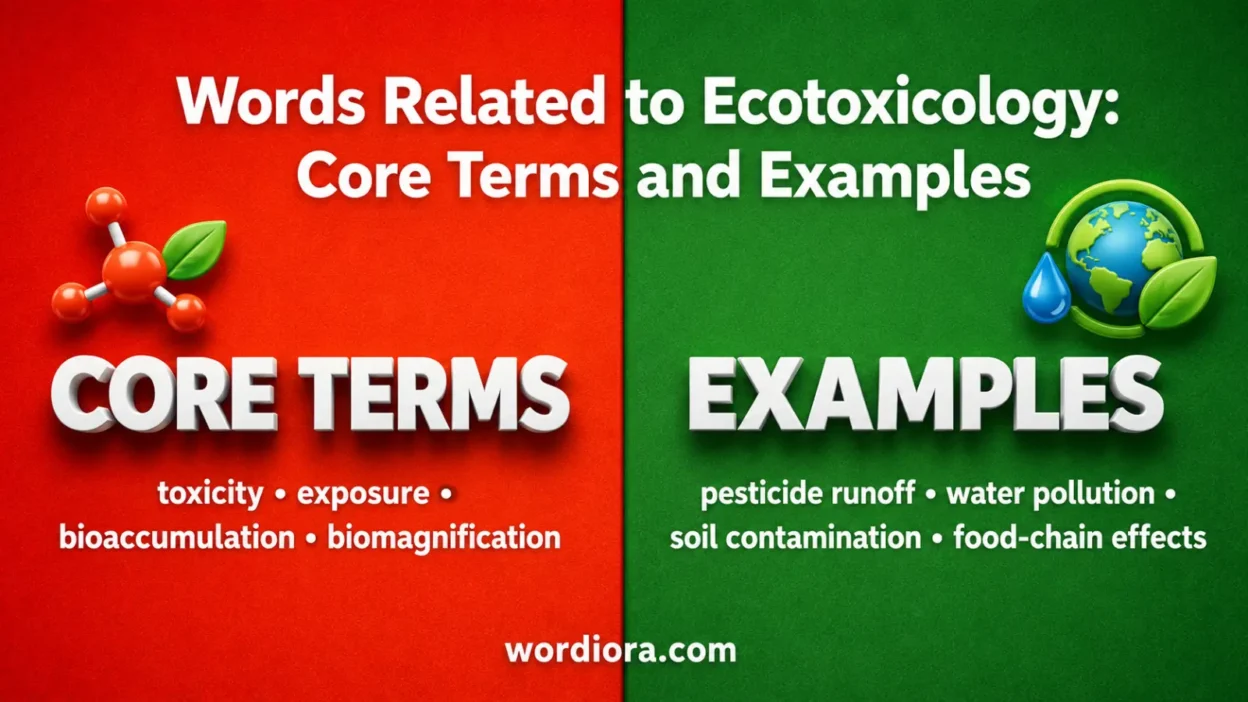
Words related to ecotoxicology include terms from ecology, toxicology, pollution science, environmental monitoring, and risk assessment. Although many of these words are connected, they are not all synonyms. Some name the science itself, while others describe chemicals, exposure pathways, affected organisms, and ecological effects.
A strong vocabulary list for ecotoxicology should include words such as toxicology, ecology, ecotoxicity, pollutant, contaminant, exposure, bioaccumulation, biomagnification, aquatic toxicity, chemical stressor, and risk assessment. Together, these terms help explain how harmful substances affect organisms and ecosystems.
Quick Answer
The best words related to ecotoxicology are:
toxicology, ecology, ecotoxicity, environmental toxicology, pollutant, contaminant, pesticide, chemical stressor, toxicity, exposure, dose, response, bioaccumulation, biomagnification, persistence, biodegradation, aquatic toxicity, terrestrial toxicity, sediment toxicity, ecosystem, biodiversity, population, community, species, food web, trophic level, hazard, endpoint, mortality, sublethal effect, and risk assessment.
These words are useful because ecotoxicology studies how harmful substances affect organisms, populations, communities, and ecosystems. In addition, they cover the main ideas behind environmental harm, chemical exposure, biological effects, and ecological protection.
What The Topic Means
Ecotoxicology is the study of how toxic substances affect living organisms and the environments they depend on. It combines ideas from ecology, which studies relationships in nature, and toxicology, which studies harmful effects of substances.
The topic often appears in discussions of pesticides, industrial chemicals, wastewater, heavy metals, pharmaceuticals, plastic-related chemicals, contaminated sediment, aquatic organisms, wildlife, and environmental risk. Because the field connects chemistry with ecology, its vocabulary includes both everyday environmental words and technical research terms.
Core Related Words
| Word | How It Relates | Best Use |
|---|---|---|
| Toxicology | The study of harmful effects from substances | Naming the science behind toxicity |
| Ecology | The study of organisms and ecosystems | Showing the environmental side of the field |
| Ecotoxicity | The harmful effect of a substance on ecosystems or organisms | Describing environmental toxicity |
| Environmental toxicology | A closely related field focused on toxic substances in the environment | Discussing nearby scientific disciplines |
| Pollutant | A harmful substance introduced into the environment | General environmental writing |
| Contaminant | A substance that is present where it may cause harm | Scientific or regulatory contexts |
| Chemical stressor | A chemical that can put biological systems under stress | Research and risk assessment |
| Exposure | Contact between an organism and a substance | Explaining how harm may begin |
| Toxicity | The degree to which a substance can cause harm | Describing harmful potential |
| Dose | The amount of a substance received by an organism | Testing and effects analysis |
| Response | The biological effect after exposure | Lab and field study descriptions |
| Bioaccumulation | Buildup of a substance in an organism over time | Wildlife and food-chain discussions |
| Biomagnification | Increase of a substance at higher food-chain levels | Food web and predator-risk contexts |
| Persistence | The ability of a substance to remain in the environment | Long-term pollution discussions |
| Biodegradation | Breakdown of a substance by living organisms | Chemical fate and cleanup contexts |
| Aquatic toxicity | Harmful effects on water-dwelling organisms | Fish, algae, invertebrate, and water studies |
| Terrestrial toxicity | Harmful effects on land organisms | Soil, plant, insect, and wildlife studies |
| Sediment toxicity | Harmful effects linked to contaminated sediment | Rivers, lakes, estuaries, and benthic organisms |
| Ecosystem | A community of organisms and its physical environment | Broad ecological impact writing |
| Biodiversity | Variety of life in an area | Discussing ecological health |
| Population | Members of the same species in an area | Measuring effects beyond one organism |
| Community | Interacting populations in an ecosystem | Explaining broader ecological change |
| Food web | Feeding relationships among organisms | Tracing chemical movement through nature |
| Trophic level | A position in a food chain or food web | Explaining biomagnification |
| Risk assessment | Evaluation of possible harm | Regulatory and scientific decision-making |
Related Words By Meaning Group
Science and field terms:
toxicology, ecology, ecotoxicology, environmental toxicology, aquatic toxicology, wildlife toxicology, chemical ecology
These words name the academic or scientific areas connected to ecotoxicology. For example, aquatic toxicology focuses on water-based organisms, while wildlife toxicology focuses on wild animals.
Substance-related words:
pollutant, contaminant, pesticide, herbicide, insecticide, heavy metal, solvent, microplastic, pharmaceutical, industrial chemical
These terms name the kinds of substances often studied in ecotoxicology. In many cases, the concern is not only whether a substance is present, but also how much is present and how long it remains in the environment.
Exposure and movement words:
exposure, pathway, uptake, absorption, ingestion, runoff, leaching, discharge, deposition, transport
These words describe how organisms come into contact with harmful substances. They also explain how those substances move through air, water, soil, or food.
Effect-related words:
toxicity, ecotoxicity, mortality, impairment, stress, inhibition, reproductive harm, developmental effect, sublethal effect, endocrine disruption
These words describe possible biological effects. Some refer to death, while others describe reduced growth, altered behavior, lower reproduction, or other nonfatal harm.
Ecosystem words:
ecosystem, habitat, species, population, community, biodiversity, food web, trophic level, predator, prey
These words connect ecotoxicology to ecological relationships and environmental health. As a result, they are useful when discussing effects that go beyond one organism.
Testing and measurement words:
dose, response, endpoint, assay, biomarker, toxicity test, concentration, threshold, sensitivity, monitoring
These terms are useful when discussing how researchers measure toxic effects. For instance, an endpoint may track survival, growth, reproduction, or behavior.
Risk and management words:
hazard, risk, risk assessment, mitigation, remediation, regulation, environmental quality, safety limit, ecological protection
These words are common when ecotoxicology is used to guide environmental decisions. Therefore, they often appear in scientific, regulatory, and conservation contexts.
Close Synonyms Vs Broader Related Words
There are only a few close matches for ecotoxicology, and even those are not always exact synonyms.
Environmental toxicology is a close related term. However, it may focus more broadly on toxic substances in the environment, including effects on organisms and sometimes human health.
Ecosystem toxicology emphasizes toxic effects at the ecosystem level. Therefore, it is closely related to ecotoxicology, but it is usually more specific in focus.
Aquatic toxicology is narrower than ecotoxicology because it focuses on organisms in water. Similarly, wildlife toxicology is narrower because it focuses on toxic effects in wild animals.
Broader related words include pollution, contamination, biodiversity, ecosystem health, risk assessment, and environmental monitoring. These words are strongly connected to ecotoxicology, but they are not synonyms for the field itself.
Words By Context
For a general science article, use:
ecotoxicology, toxicology, ecology, pollutant, contaminant, ecosystem, toxicity, and exposure.
When writing about water or aquatic studies, use:
aquatic toxicity, fish, algae, invertebrate, sediment toxicity, runoff, water quality, and bioaccumulation.
In soil and land-based contexts, use:
terrestrial toxicity, soil contamination, plant toxicity, earthworm, pesticide, herbicide, and leaching.
For food-chain effects, use:
food web, trophic level, predator, prey, bioaccumulation, biomagnification, and persistence.
When discussing testing and research, use:
dose, response, endpoint, assay, biomarker, concentration, threshold, and sensitivity.
Finally, for environmental management or policy-related writing, use:
risk assessment, hazard, mitigation, remediation, regulation, monitoring, and ecological protection.
Example Sentences
Ecotoxicology helps researchers understand how pollutants affect fish, insects, plants, and entire ecosystems.
A pesticide may have low direct toxicity to birds. However, it can still harm them indirectly by reducing their food supply.
Scientists measured aquatic toxicity to see how the chemical affected freshwater organisms.
Some pollutants can bioaccumulate in fish. Over time, those substances may also biomagnify in predators higher in the food web.
The study used several biological endpoints, including growth, survival, and reproduction.
Environmental agencies may use risk assessment to decide whether a contaminant poses a threat to wildlife.
A sublethal effect may not kill an organism immediately. Instead, it can reduce feeding, movement, or reproduction.
Common Mistakes When Choosing Related Words
Avoid using ecology as a direct synonym for ecotoxicology. Ecology is much broader and does not automatically involve toxic substances.
Likewise, pollution and ecotoxicology should not be treated as the same thing. Pollution is the problem or condition, while ecotoxicology is the field that studies harmful effects from toxic substances in ecosystems.
General environmental words such as nature, green, or outdoors are usually too broad. Unless the context clearly supports them, they can weaken a precise related-words list.
Another common mistake is using only chemical names. Terms like mercury, lead, PFAS, or pesticide may be relevant; however, a good vocabulary guide should also include exposure, testing, organism, and ecosystem terms.
Finally, not every related word is a synonym. Bioaccumulation, endpoint, runoff, and biodiversity are related to ecotoxicology, but they do not mean ecotoxicology.
Quick Reference List
Closest field terms: ecotoxicology, environmental toxicology, ecosystem toxicology, aquatic toxicology, wildlife toxicology
Core science words: toxicology, ecology, toxicity, ecotoxicity, exposure, dose, response, endpoint
Substance words: pollutant, contaminant, pesticide, herbicide, insecticide, heavy metal, industrial chemical, pharmaceutical
Movement and fate words: runoff, leaching, discharge, transport, persistence, biodegradation, bioaccumulation, biomagnification
Ecological words: ecosystem, habitat, species, population, community, biodiversity, food web, trophic level
Effect words: mortality, impairment, stress, inhibition, reproductive harm, developmental effect, sublethal effect
Decision-making words: hazard, risk, risk assessment, mitigation, remediation, monitoring, regulation
Best Picks for Everyday Use
For most everyday writing, the best related words are toxicology, ecology, ecotoxicity, pollutant, contaminant, exposure, toxicity, bioaccumulation, biomagnification, ecosystem, biodiversity, and risk assessment.
These terms are accurate without being overly technical. In addition, they cover the main parts of the topic: harmful substances, exposure, biological effects, movement through ecosystems, and environmental decision-making.
For a more scientific tone, use chemical stressor, endpoint, dose-response, aquatic toxicity, sediment toxicity, sublethal effect, and trophic level. These choices are especially useful in research, testing, and environmental assessment contexts.
FAQs
What are the best words related to ecotoxicology?
The best words related to ecotoxicology include toxicology, ecology, ecotoxicity, pollutant, contaminant, exposure, toxicity, bioaccumulation, biomagnification, aquatic toxicity, ecosystem, biodiversity, and risk assessment.
Is ecotoxicology the same as toxicology?
No. Toxicology is the broader study of harmful effects caused by substances. Ecotoxicology, however, focuses specifically on how toxic substances affect organisms, populations, communities, and ecosystems.
Is environmental toxicology a synonym for ecotoxicology?
Environmental toxicology is a close related term, but it is not always an exact synonym. Ecotoxicology usually emphasizes ecological effects, while environmental toxicology may also include broader environmental and health-related concerns.
What words are related to ecotoxicology in water studies?
Useful water-related terms include aquatic toxicity, sediment toxicity, runoff, water quality, fish toxicity, algae, invertebrates, bioaccumulation, and biomagnification.
What words are related to ecotoxicology in soil studies?
Useful soil-related terms include terrestrial toxicity, soil contamination, pesticide, herbicide, leaching, plant toxicity, earthworm, microbial activity, and remediation.
What is the difference between bioaccumulation and biomagnification?
Bioaccumulation means a substance builds up inside an organism over time. Biomagnification, in contrast, means the substance becomes more concentrated at higher levels of a food web.
Is pollution a related word for ecotoxicology?
Yes, pollution is related to ecotoxicology, but it is not a synonym. Pollution refers to harmful substances or conditions in the environment, while ecotoxicology is the study of their effects on living systems.
What are simple words related to ecotoxicology for everyday writing?
For everyday writing, use pollutant, contaminant, toxicity, exposure, ecosystem, wildlife, water quality, biodiversity, and environmental risk. These words are clear, accurate, and easy to understand.
Conclusion
The strongest words related to ecotoxicology are not random environmental terms. Instead, they come from the field’s real meaning: the study of how toxic substances affect organisms, populations, communities, and ecosystems.
Use toxicology, ecology, ecotoxicity, pollutant, contaminant, exposure, bioaccumulation, biomagnification, aquatic toxicity, ecosystem, biodiversity, and risk assessment when you need clear and accurate vocabulary. Meanwhile, broader terms such as pollution, monitoring, remediation, and regulation work best when the context calls for environmental management or decision-making.