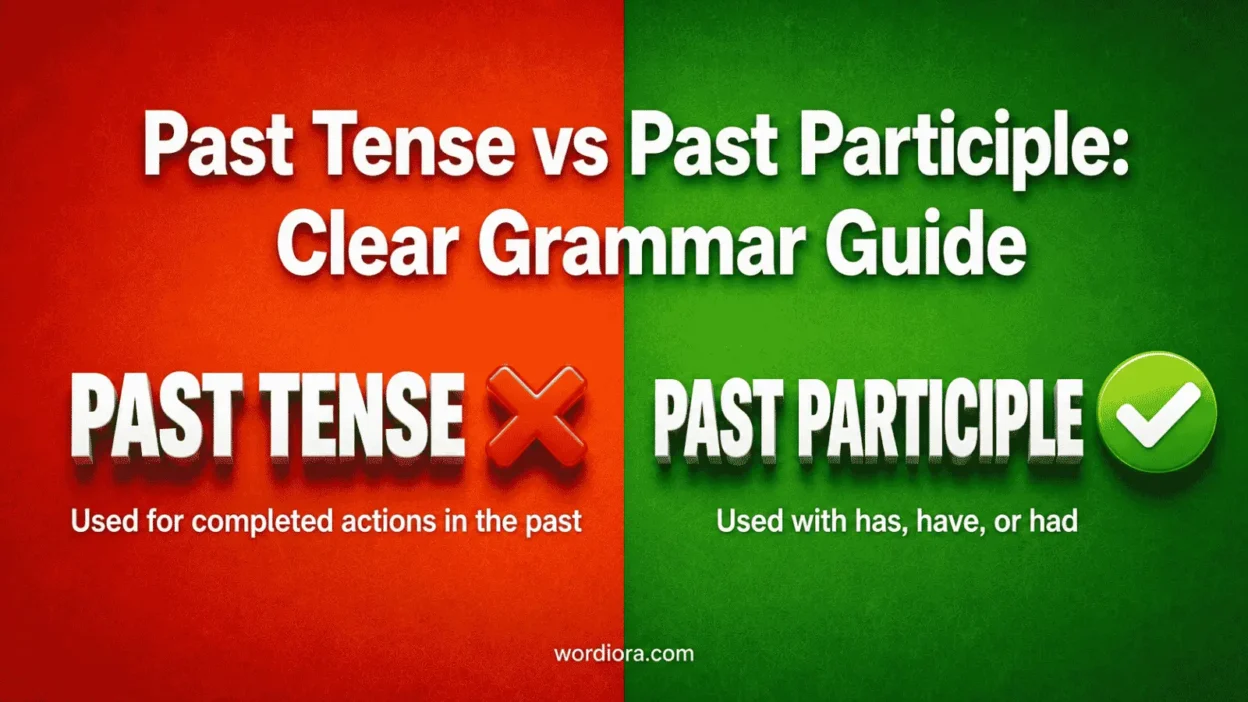
Past tense vs past participle is a common grammar comparison because the two forms often look alike. With regular verbs, they are usually identical: walked, called, played. With many irregular verbs, they are different: went and gone, saw and seen, wrote and written.
The quick difference is this: past tense tells when an action happened. Past participle helps form certain verb phrases or works like an adjective.
That distinction matters because sentences such as “I seen it” or “She has went home” sound wrong in standard American English.
Quick Answer
Use past tense when the verb stands on its own to describe something that happened in the past.
Example:
I went home early.
Use past participle after a helping verb such as have, has, had, is, are, was, were, be, being, or been.
Example:
I have gone home early before.
The past tense can usually stand alone. The past participle usually needs a helper unless it is acting as an adjective.
Why People Confuse Them
People confuse past tense and past participle because regular verbs hide the difference.
For example:
I walked to class yesterday.
I have walked to class before.
In both sentences, walked looks the same. The first sentence uses the simple past tense. The second uses the past participle with have.
The confusion becomes clear with irregular verbs:
I wrote the report.
I have written the report.
Here, wrote is the past tense. Written is the past participle.
If past tense grammar still feels tricky, our guide on Simple Past vs Past Participle explains when and how to use each form correctly in everyday English.
Key Differences At A Glance
| Context | Best Choice | Why |
|---|---|---|
| A completed action in the past | past tense | The verb can stand alone |
| A sentence with have, has, or had | past participle | Perfect forms need a participle |
| A sentence with is, are, was, or were in passive form | past participle | Passive voice uses a form of be plus a participle |
| A word describing a noun | past participle | Participles can work like adjectives |
| A simple past-time statement | past tense | The sentence directly places the action in the past |
Meaning and Usage Difference
Past tense is a tense. It places an action or state in the past.
Examples:
She called yesterday.
They left after dinner.
He bought a new laptop.
In these sentences, the main verb shows that the action happened before now.
Past participle is a verb form. It does not create a complete past-tense sentence by itself in standard use. It often appears with a helping verb.
Examples:
She has called twice.
They had left before dinner.
The laptop was bought online.
The past participle also appears as an adjective:
The broken chair was moved to the garage.
The written instructions were clear.
So the main difference is function. Past tense tells time directly. Past participle helps build other forms or describes something.
Tone, Context, and Formality
Both past tense and past participle are normal in everyday, professional, and academic writing. The issue is not formality. The issue is grammatical fit.
In casual speech, some people say things like:
I seen that movie.
She done the assignment.
Those forms may appear in regional or informal speech, but they are not standard for edited American English. In schoolwork, business writing, applications, reports, and published writing, use the standard forms:
I saw that movie.
She did the assignment.
For perfect forms, use the participle:
I have seen that movie.
She has done the assignment.
Still confused about participles? This quick guide on past participle vs present participle explains the differences with simple examples.
Which One Should You Use?
Use the past tense when there is no helping verb and the sentence simply reports a past action.
Correct:
We drove to Austin last weekend.
Use the past participle after have, has, or had.
Correct:
We have driven to Austin before.
Use the past participle after a form of be in passive voice.
Correct:
The car was driven by my sister.
Use the past participle when the word describes a noun.
Correct:
The driven employees finished the project early.
Compact comparison:
- Past tense: happened in the past; often stands alone.
- Past participle: used with helpers; can form perfect tenses, passive voice, or adjectives.
- Past tense example: She spoke clearly.
- Past participle example: She has spoken clearly.
When One Choice Sounds Wrong
A past participle sounds wrong when it is used alone as the main verb in a simple past sentence.
Wrong:
I seen your message.
Correct:
I saw your message.
A past tense form sounds wrong when a past participle is required after a helper.
Wrong:
I have saw your message.
Correct:
I have seen your message.
The same pattern applies to many common irregular verbs:
Wrong:
He has went home.
Correct:
He has gone home.
Wrong:
They had ate lunch.
Correct:
They had eaten lunch.
Common Mistakes and Quick Fixes
One common mistake is using the past tense after have.
Wrong:
She has wrote three emails.
Correct:
She has written three emails.
Another mistake is using the past participle without a helper.
Wrong:
They gone to the store.
Correct:
They went to the store.
A third mistake is assuming every verb works like a regular verb. Regular verbs often use the same form for past tense and past participle, but irregular verbs may not.
Regular:
I cleaned the kitchen.
I have cleaned the kitchen.
Irregular:
I took the photo.
I have taken the photo.
The quick fix is to look for a helper. If the sentence uses have, has, had, is, are, was, were, be, being, or been, the past participle is usually the right form.
Everyday Examples
I ran three miles this morning.
I have run three miles every Saturday this month.
She chose the blue jacket.
She has chosen the blue jacket for the trip.
They began the meeting at nine.
The meeting had begun before I arrived.
He broke the glass.
The glass was broken during the move.
We sang at the school event.
We have sung at that event before.
The teacher gave clear directions.
The directions were given before the test.
Dictionary-Style Word Details
Verb
Past tense is a verb tense used to show that an action or state happened before the present moment.
Example:
She finished the form.
Past participle is a verb form used with helping verbs or as a modifier.
Example:
She has finished the form.
The finished form is on the desk.
Noun
Past tense can also refer to the category itself.
Example:
The verb is in the past tense.
Past participle names a specific verb form.
Example:
Taken is the past participle of take.
Synonyms
For past tense, close grammar labels include simple past and preterite, though they are not always used in exactly the same way in every grammar discussion.
For past participle, a close label is participle form, but that phrase is broader because English also has present participles, such as running and writing.
Example Sentences
Past tense:
Maya sent the invoice on Friday.
The kids found the missing key.
I made dinner after work.
Past participle:
Maya has sent the invoice.
The missing key was found under the couch.
Dinner had been made before we got home.
Word History
Both terms come from traditional grammar labels used to describe verb forms and verb time. For practical writing, the history matters less than the function: past tense marks past time directly, while past participle helps build other forms.
Phrases Containing
Common phrases with past tense include:
simple past tense
past-tense verb
regular past tense
irregular past tense
Common phrases with past participle include:
past participle form
regular past participle
irregular past participle
past participle adjective
Conclusion
The difference between past tense and past participle is easier once you focus on job, not appearance.
Use past tense for a completed past action when the verb stands on its own: She went home.
Use past participle with helping verbs or as a describing word: She has gone home. The broken lamp was replaced.
When you are unsure, check the words around the verb. If there is a helper such as have, has, had, was, or were, you probably need the past participle. If the verb stands alone in a simple past statement, you probably need the past tense.