Last Updated: July 30, 2026
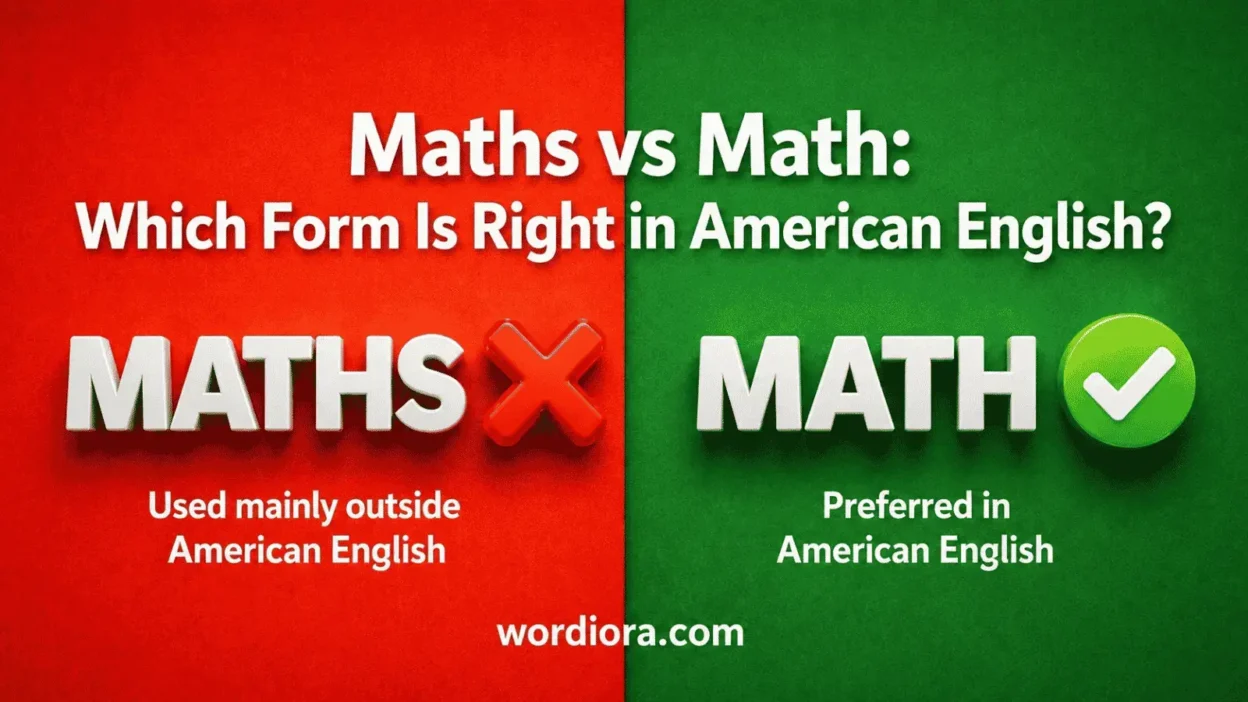
If you are writing for a US audience, the better choice is usually math, not maths. Both words mean the same thing, and both are shortened forms of mathematics, but current dictionary labeling treats math as the standard American form and maths as chiefly British.
That makes Maths vs Math a word-choice question, not a spelling mistake in the usual sense. The meaning stays the same. What changes is the regional fit and the way the word sounds to your reader.
Quick Answer
Use math in American English. Use maths in British English and many other varieties of English influenced by British usage. If you want the most neutral or formal option in any region, use mathematics.
So if your article, school site, business copy, or everyday sentence is aimed at readers in the United States, write math class, math homework, and good at math. In that setting, maths will usually look imported rather than natural.
Why People Confuse Them
The confusion is easy to understand. The full word is mathematics, and because it ends in -s, many writers assume the shortened form should keep that s everywhere. But English does not shorten words in only one fixed way, and standard regional habits matter more than strict logic here. Current dictionary entries show that American English settled on math, while British English kept maths.
Another reason people pause is that both forms are visible online. A US reader may see maths in British news, school materials, or international posts, while a UK reader may see math in American textbooks, apps, and videos. That overlap can make one form look “more correct,” when the real issue is usually audience and region.
Key Differences At A Glance
The chart below reflects current dictionary labeling and standard regional usage.
| Context | Best Choice | Why |
| US school, college, or general American writing | math | It is the standard American form |
| UK school, college, or general British writing | maths | It is the standard British form |
| Formal academic phrasing in any region | mathematics | It is the full, neutral form |
| Official title, course name, or quotation | Follow the source | Preserve the original wording |
| Mixed international audience | Pick one and stay consistent, or use mathematics | Consistency matters more than forcing both |
Meaning and Usage Difference
In meaning, there is almost no difference at all. Both math and maths refer to the subject of mathematics. The real difference is regional preference, not a shift in definition.
- Same meaning: the subject of mathematics
- American default: math
- British default: maths
- Most formal full form: mathematics
Tone, Context, and Formality
Both short forms are more casual than mathematics. Cambridge labels mathematics as formal, while Collins defines math as an informal short form. Dictionary.com likewise treats maths as an informal short form in British use.
That means your choice depends on both region and tone. In a casual American sentence, I hate math sounds normal. In a formal course description, Department of Mathematics is usually better than either shortened form. In a British school context, maths teacher sounds ordinary, not informal in a sloppy way.
Many students also ask whether “maths” is different from “mathematics.” Here’s a helpful breakdown of maths-vs-mathematics with easy examples and regional usage tips.
Which One Should You Use?
For American readers, choose math almost every time. That includes blog posts, school pages, tutoring sites, product copy, worksheets, captions, and everyday speech written in US English.
Choose maths when you are writing for a British audience or preserving British wording. If your readers are spread across regions and you do not want either shortened form to feel local, use mathematics instead.
A good practical rule is simple: match the reader, not your personal guess about which shortening “should” be more logical. In usage, familiar form beats theoretical neatness.
When One Choice Sounds Wrong
In American writing, maths often sounds slightly off because it clashes with what US readers expect to see in everyday phrases like math class, math homework, and do the math. Collins explicitly labels math as the American form and lists do the math as an American idiom.
By the same logic, math can sound noticeably American in a British school context where maths is the established local form. So the wrong-sounding choice is usually not “wrong English.” It is just the wrong fit for the audience.
Common Mistakes and Quick Fixes
One common mistake is mixing both forms in the same piece: math class in one paragraph and maths homework in the next. Pick one regional style and hold it all the way through unless you are quoting someone directly.
Another mistake is assuming maths must be more correct because mathematics ends in -s. Current dictionaries do not support that idea. They treat the choice as regional, with math normal in American English and maths chiefly British.
A third mistake is treating the subject like an ordinary plural noun. Cambridge notes that academic subjects such as mathematics/maths are used as singular nouns even though they end in -s. In standard American editing, write Math is hard and Mathematics is important, not Math are or Mathematics are.
Everyday Examples
Here is how the choice looks in natural American English:
- I have a math test tomorrow.
- She teaches math at a middle school in Texas.
- He has always been good at math.
- The tutoring center offers help with math and reading.
And here is the British-style version of the same idea:
- I have a maths test tomorrow.
- She teaches maths at a secondary school.
- He has always been good at maths.
- The school added extra maths support this term.
If you are writing in US English, the first group will sound natural to your reader. If you are writing in British English, the second group will.
Dictionary-Style Word Details
Verb
Neither math nor maths is normally used as a verb in standard edited English. In phrases like do the math, the word is still a noun, not a verb.
Noun
Both words function as nouns meaning mathematics. Dictionary labeling marks math as the American form and maths as chiefly British.
Synonyms
The closest full-form equivalent for both is mathematics. Some related classroom terms, such as arithmetic, algebra, and geometry, belong to the same subject area, but they are not full replacements for math or maths because they name parts of the field rather than the whole field.
Example Sentences
- Math is my favorite subject this semester.
- Our district is hiring a new math teacher.
- She is stronger in English than in maths.
- The school wants better results in maths and science.
Word History
Current dictionaries treat both forms as shortened versions of mathematics. Merriam-Webster records a first known use of maths in 1911, and Collins labels math as a shortened form in American English.
Phrases Containing
Common American phrases include do the math, math class, math teacher, and math homework. In British usage, you are more likely to see maths class, maths teacher, or maths homework. The phrase should usually match the same regional pattern as the base word.
Conclusion
For American English, the right everyday choice is math. Maths is not wrong in itself, but it is mainly British and will usually sound out of place in US-focused writing. When you want the safest cross-regional option, use mathematics.
So the clean rule is this: write math for American readers, maths for British readers, and mathematics when you want a more formal full form. That keeps the choice simple, accurate, and natural