
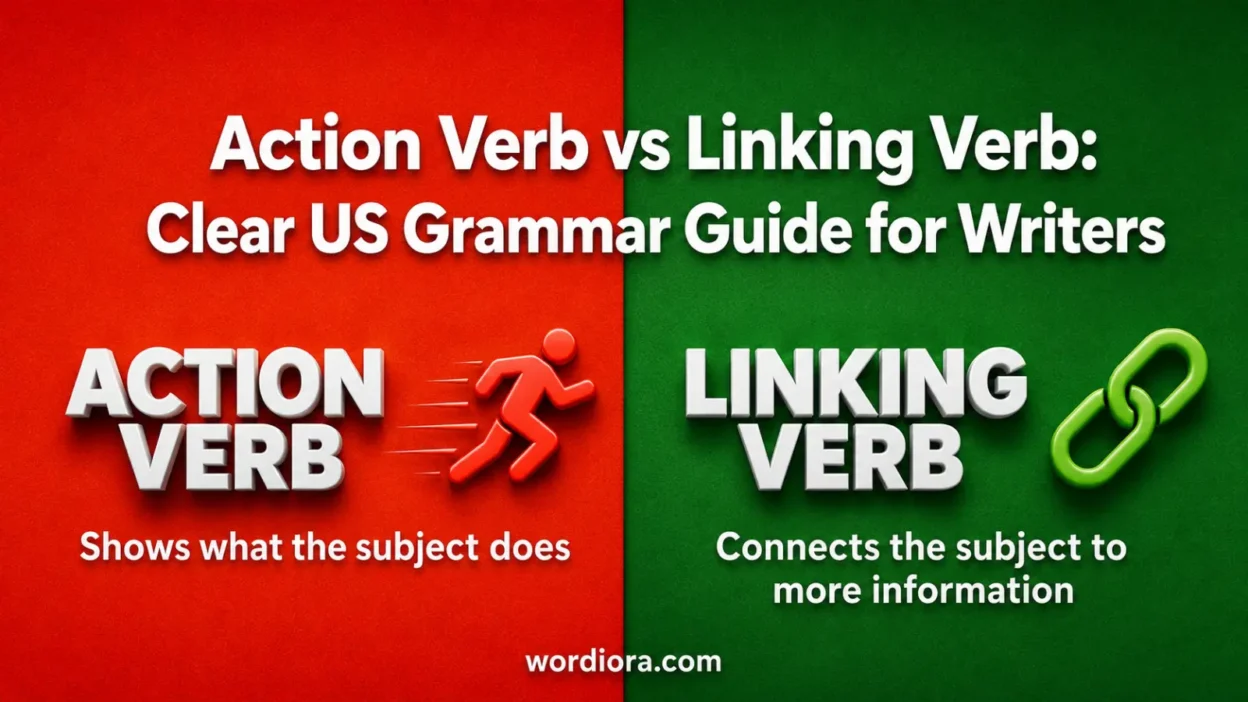
An action verb and a linking verb are both verbs, but they do different jobs in a sentence.
An action verb tells what the subject does. A linking verb connects the subject to a word or phrase that describes or identifies it.
That is the main difference in action verb vs linking verb. The choice depends on how the verb works in the sentence, not just on the verb by itself.
Quick Answer
Use an action verb when the subject is doing something.
Use a linking verb when the sentence is telling what the subject is, seems, becomes, feels like, looks like, or remains.
Examples:
An action verb shows action:
Maya opened the window.
A linking verb connects the subject to a description:
Maya seems tired.
In the second sentence, seems does not show an action Maya performs. It links Maya to the description tired.
Why People Confuse Them
People confuse action verbs and linking verbs because some verbs can work both ways.
Look at these two sentences:
The soup smells spicy.
Jordan smells the soup.
In the first sentence, smells links soup to the description spicy. It is a linking verb.
In the second sentence, smells tells what Jordan does. It is an action verb.
So the real question is not, “What kind of verb is this word forever?” The better question is, “What is this verb doing in this sentence?”
Key Differences At A Glance
| Feature | action verb | linking verb |
|---|---|---|
| Main job | Shows what the subject does | Connects the subject to a description or identity |
| Common pattern | Subject + verb + object or detail | Subject + verb + subject complement |
| Easy example | She runs daily. | She is ready. |
| What follows it | Often an object, adverb, or phrase | Often an adjective, noun, or noun phrase |
| Key question | What did the subject do? | What is the subject like, or what is it? |
Meaning and Usage Difference
An action verb expresses physical or mental activity. It can describe something visible, like run, cook, or drive. It can also describe something mental, like think, believe, or remember.
Examples:
He fixed the bike.
I remembered the address.
A linking verb does not show the subject doing an action. It links the subject to more information about the subject.
Examples:
He is a mechanic.
The bike looks new.
In linking verb sentences, the word after the verb often describes or identifies the subject. That word or phrase is called a subject complement.
In The bike looks new, new describes bike. The bike is not doing the action of looking. The sentence tells how the bike appears.
Tone, Context, and Formality
This choice is not mainly about formal or informal style. It is about grammar and meaning.
Both action verbs and linking verbs are normal in everyday US English.
Action verbs often make writing feel more direct because they show movement, choice, work, or thought.
Weak: The report was a review of the budget.
Stronger: The report reviewed the budget.
That does not mean linking verbs are bad. Linking verbs are the right choice when you need to describe, define, or identify the subject.
Correct: The report is complete.
Correct: The results seem accurate.
Correct: The manager became concerned.
A sentence with a linking verb can be clear, natural, and professional.
Which One Should You Use?
| Context | Best Choice | Why |
|---|---|---|
| The subject performs an action | action verb | It tells what the subject does |
| The sentence describes the subject | linking verb | It connects the subject to a quality |
| The sentence identifies the subject | linking verb | It connects the subject to a noun or noun phrase |
| You want stronger workplace writing | action verb, when accurate | It often makes the sentence more direct |
| A sense verb describes a quality | linking verb | The verb links the subject to a description |
| A sense verb describes an activity | action verb | The subject is doing the sensing |
Use the sentence meaning as your guide.
If the subject is doing something, use or identify an action verb.
If the verb connects the subject to what it is or what it is like, use or identify a linking verb.
When One Choice Sounds Wrong
A linking verb can sound wrong when the sentence needs real action.
Wrong: She became the package on the porch.
Correct: She placed the package on the porch.
The subject is doing something with the package, so the sentence needs an action verb.
An action verb can sound wrong when the sentence only describes the subject.
Wrong: The room smells strongly.
Better: The room smells strong.
Here, smells links room to the description strong. The word after it should describe the room, not the act of smelling.
But in this sentence, an action verb reading is different:
The dog smelled carefully along the trail.
Now the dog is doing the smelling, so the adverb carefully fits.
Common Mistakes (and Quick Fixes)
Mistake 1: Treating every sense verb as an action verb.
Wrong idea: Feel always shows action.
Better: Feel can be linking or action.
I feel nervous.
Linking verb. Nervous describes I.
I felt the cold glass.
Action verb. The subject does the touching.
Mistake 2: Using an adverb after a linking verb when an adjective is needed.
Less natural: The cake tastes wonderfully.
Better: The cake tastes wonderful.
The cake is being described. It is not tasting something in a careful or wonderful way.
Mistake 3: Memorizing a list without checking the sentence.
A list helps, but context matters more.
The kids grew quiet.
Linking verb.
The kids grew tomatoes.
Action verb.
Everyday Examples
Action verb: The driver stopped at the red light.
Linking verb: The driver seemed upset.
Action verb: Ava looked through the photos.
Linking verb: Ava looked happy in the photos.
Action verb: We tasted the chili before dinner.
Linking verb: The chili tasted smoky.
Action verb: The team proved the claim.
Linking verb: The plan proved useful.
Action verb: Marcus stayed at the hotel.
Linking verb: Marcus stayed calm during the delay.
Action verb: The dog smelled the blanket.
Linking verb: The blanket smelled clean.
Dictionary-Style Word Details
Verb
• action verb: The phrase itself is not used as a verb. It names a type of verb that expresses action, activity, or mental action.
• linking verb: The phrase itself is not used as a verb. It names a type of verb that links a subject to a description or identity.
Noun
• action verb: A noun phrase. It means a verb that shows what the subject does, such as run, build, choose, or think.
• linking verb: A noun phrase. It means a verb that connects the subject to a subject complement, such as is, seems, becomes, looks, or feels.
Synonyms
• action verb: Closest plain alternatives include doing verb and verb of action. These are helpful in simple grammar lessons, but they are not always exact labels.
• linking verb: Close grammar alternatives include copula and copular verb. In everyday school grammar, linking verb is the clearer term.
• Antonyms: There is no perfect everyday antonym for either phrase. In basic grammar lessons, action verb and linking verb are often taught as contrasting categories, but English verbs can have other roles too.
Example Sentences
• action verb: In Nora packed her lunch, packed is an action verb.
• action verb: In The students discussed the project, discussed is an action verb.
• linking verb: In Nora is hungry, is is a linking verb.
• linking verb: In The students seemed prepared, seemed is a linking verb.
Word History
• action verb: This is a grammar label built from action plus verb. It names the verb by what it expresses.
• linking verb: This is a grammar label built from linking plus verb. It names the verb by what it does in the sentence: it links the subject to more information.
The exact history of these teaching labels is less important than their current grammar use. Modern US grammar lessons use both terms to explain sentence function.
Phrases Containing
• action verb: strong action verb, action verb list, action verb example, identify the action verb
• linking verb: common linking verb, linking verb sentence, linking verb example, identify the linking verb
Confused between action and state verbs? Explore our guide on stative verbs vs action verbs for a clearer understanding.
FAQs
Is “is” an action verb or a linking verb?
Is is usually a linking verb. It connects the subject to a noun, adjective, or other description.
Example: The answer is correct.
Here, is links answer to correct.
Can a verb be both an action verb and a linking verb?
Yes. Some verbs can be action verbs in one sentence and linking verbs in another.
Example: She looked tired.
Here, looked is a linking verb.
Example: She looked at the clock.
Here, looked is an action verb.
How do I know if a verb is linking?
Check whether the verb connects the subject to a description or identity.
Example: The soup smells good.
The soup is not doing an action. Smells links soup to good, so it is a linking verb.
How do I know if a verb is an action verb?
Ask whether the subject is doing something.
Example: The chef stirred the soup.
The chef is doing the action, so stirred is an action verb.
Are linking verbs always forms of “be”?
No. Forms of be, such as is, are, was, and were, are common linking verbs, but they are not the only ones.
Other linking verbs can include seem, become, feel, look, smell, taste, sound, and remain, depending on the sentence.
Should I use an adjective or adverb after a linking verb?
Use an adjective when the word describes the subject.
Correct: The pizza tastes delicious.
Not: The pizza tastes deliciously.
Delicious describes the pizza, so the adjective is correct.
Is “feel” an action verb or a linking verb?
It depends on the sentence.
I feel tired.
Linking verb. Tired describes I.
I felt the fabric.
Action verb. The subject is touching something.
What is the easiest test for action verb vs linking verb?
Try replacing the verb with a form of be, such as is or are. If the sentence still makes basic sense, the verb may be linking.
The flowers smell fresh.
The flowers are fresh.
That works, so smell is a linking verb in that sentence.
Conclusion
The difference between an action verb and a linking verb is simple once you look at the sentence.
An action verb tells what the subject does.
A linking verb connects the subject to what it is, seems, becomes, feels like, or looks like.
Some verbs can be either one, so do not judge by the word alone. Judge by the job it does in the sentence.
If the subject is doing something, you are looking at an action verb. If the verb connects the subject to a description or identity, you are looking at a linking verb.